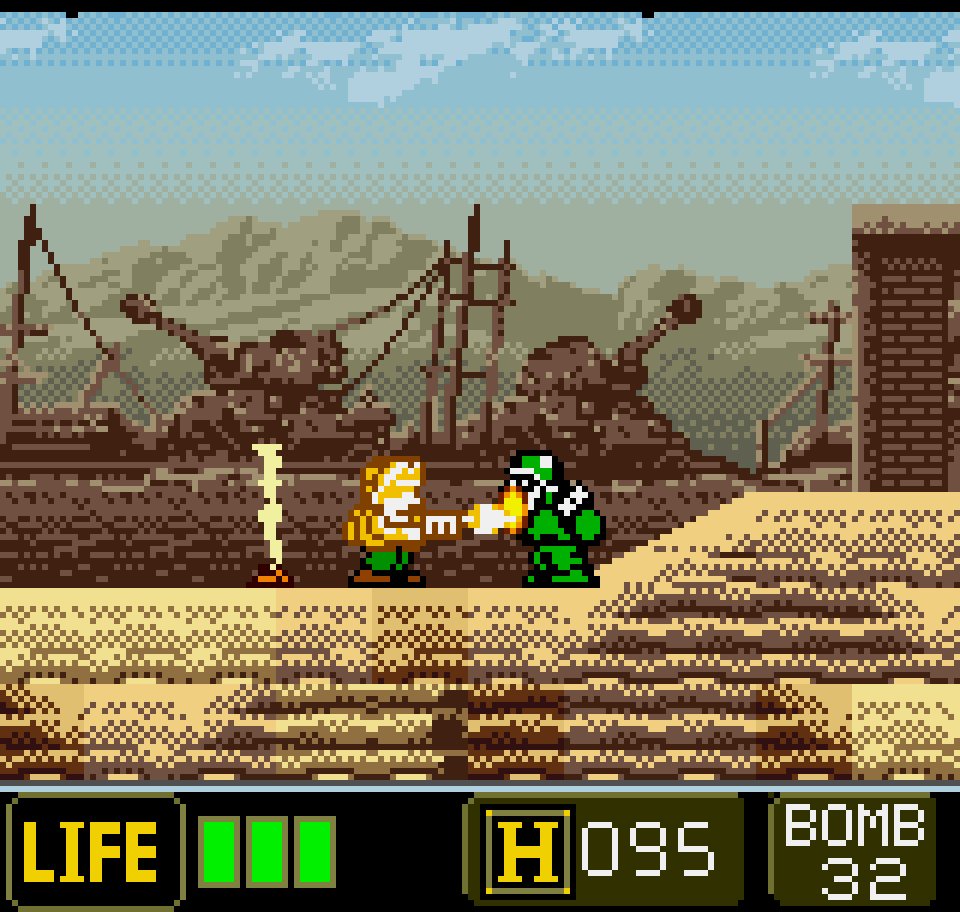
At a glance: Metal Slug: 2nd Mission · Neo Geo Pocket Color · SNK, 2000 · Run-and-gun · Score: 9.0/10
If 1st Mission proved Metal Slug could work in your pocket, 2nd Mission — arriving in 2000, in the Neo Geo Pocket Color’s brief prime — sets out to prove it can thrive there. This is the bigger sequel in every direction: a much larger mission count, multiple playable characters with genuinely different handling, more vehicles, more hidden routes and a presentation pass that pushes the little screen noticeably harder. It is the game SNK’s handheld action library is remembered by, and it earns the honour.
The setup widens the war. Morden’s forces are back, now allied with new machinery and a fresh conspiracy, and the Peregrine Falcons respond by fielding a proper roster. You begin with new recruits Gimlet and Red Eye, and can unlock the series’ own Tequila — no, not a drink: a special forces operative — along with Margaret, a defecting officer whose inside knowledge opens different routes through the campaign. Characters are not palette swaps: speed, jumping and weapon handling vary enough that a stage that frustrated you with one soldier can fall to another, and the game encourages swapping between runs.
A campaign with real depth
The mission map is the star. Dozens of stages branch and rejoin, with hidden exits that reward poking at suspicious walls and taking the dangerous upper route. Prisoners of war — more than a hundred across the whole campaign — wait in cages, ceilings and behind destructible scenery, and rescuing them all is a completionist project of real size. Vehicle sections multiply: the Slug tank returns alongside the Slug Flyer, a rocket pack, an underwater mini-sub sequence and a wonderfully silly mine-cart ride. Variety is the design rule; no two consecutive missions ask quite the same thing of you.
Mechanically it is a refinement rather than a reinvention. The two-button scheme from the first game returns, weapons feel punchier, and the new ability to carry a powered-up arsenal into the teeth of a boss fight gives the game its best moments. Bosses are the biggest improvement: multi-part machines and set-piece duels that fill the screen in a way the first mission only attempted. Slowdown still visits when everything explodes at once — on this hardware, that is practically a series tradition — but it reads as emphasis rather than failure.
Dozens of branching stages, more than a hundred prisoners to rescue, and a roster that changes how missions play: this is a sequel that understood the assignment.
Presentation and polish
Visually, 2nd Mission squeezes the NGPC palette with real craft. Parallax is used sparingly but effectively, the new desert, jungle and industrial zones each have a distinct colour identity, and the soldiers’ comic animation — the detail that makes Metal Slug Metal Slug — is all present in miniature. Digitised voice samples return, clearer this time, and the soundtrack’s marches and tension themes translate well. Two-player link support lets a friend join the war with a second cartridge, a feature the first game lacked and this one wears proudly.

Criticisms? The difficulty curve is friendlier than arcade veterans may want, and checkpoints are kind. The branching structure, for all its virtues, can make a first blind run feel scattershot — you will finish the campaign having missed entire theatres, which is either a flaw or the entire point depending on your temperament. And like its predecessor, it lives in the shadow of the arcade games’ animation, a shadow no 1999-2000 handheld could escape.
The connoisseur’s details
Replay value was clearly a design brief, not an accident. Beyond the POW count and the hidden exits, 2nd Mission tracks your performance with a ranking structure that grades completed runs, and the differences between characters are meaningful enough that route guides treat them as distinct games: a high-jumping character opens paths a heavy gunner must detour around, and the unlockable operatives genuinely change the campaign’s texture. The two-player link mode deserves its footnote in series history too — cooperative Metal Slug on a handheld was a 2000 novelty, and with two cartridges and a cable, this is where you could first do it in your pocket.
Its reputation has only grown with distance. When SNK assembled the Neo Geo Pocket Color Selection compilations, both pocket Slugs were obvious inclusions, and new players consistently single out 2nd Mission as the discovery of the set — the one that plays less like a historical conversion and more like a lost mainline entry. That is the fairest summary available: not a spin-off, not a souvenir, but Metal Slug, mission two, with everything the mission required.
The sound design deserves its own commendation. Mission-start briefings, weapon pickups announced with that unmistakable voice, the percussive chatter of the Heavy Machine Gun scaled to the pocket’s speaker — the audio team treated the little chip as an instrument rather than a limitation, and the result is a game that sounds expensive. Through headphones, on original hardware, it remains one of the most striking technical flexes in the library: all of this, from a cartridge, in 2000, on two AA batteries that will outlast your weekend.
Completionists should budget accordingly. Between the branching map, the character-specific routes, the full POW ledger and the ranking grades, 2nd Mission is easily the longest action game on the system — a twenty-hour shadow falls from a cartridge most players finish in four. That ratio, spectacle to secrets, is the truest measure of the sequel’s ambition, and the reason it anchors so many ‘best of the system’ arguments even against the fighters.
A last word on difficulty settings and accessibility: the game is generous with continues and kind with checkpoints, which in 2000 read as softness and in 2026 reads as respect. The challenge lives where it should — in the optional depths, the hidden routes, the full POW ledger, the top ranks — rather than in a wall between the player and the ending. That design choice is a large part of why the game converts newcomers so reliably: it lets you finish, then dares you to finish properly.
Put the two pocket missions together and you have the NGPC’s action manifesto: the first proved the concept, the second built the cathedral. Play them in order, in one sitting if the batteries allow — and on this hardware, the batteries always allow.
There is a reason this cartridge, alone among the system’s action games, gets mentioned in the same breath as the arcade originals by people who own the arcade originals. It is the completeness of the thing: the sense that no corner was cut where a fan would look, that the team counted the POWs and the hidden exits and the character differences and decided, every time, to include them. Sequel-making is usually an exercise in budget. Here it reads as an exercise in pride — SNK’s pride, Nazca’s pride, and the pride of a handheld that refused, to the very end, to be the small option.
Verdict
Metal Slug: 2nd Mission is the complete package: the NGPC’s best action game, a top-tier handheld run-and-gun by any era’s standards, and — with its later re-release in the Neo Geo Pocket Color Selection — happily easy to play today. On original hardware it remains a technical flex and a design lesson in how to scale a big arcade idea down without scaling down its heart. Essential.