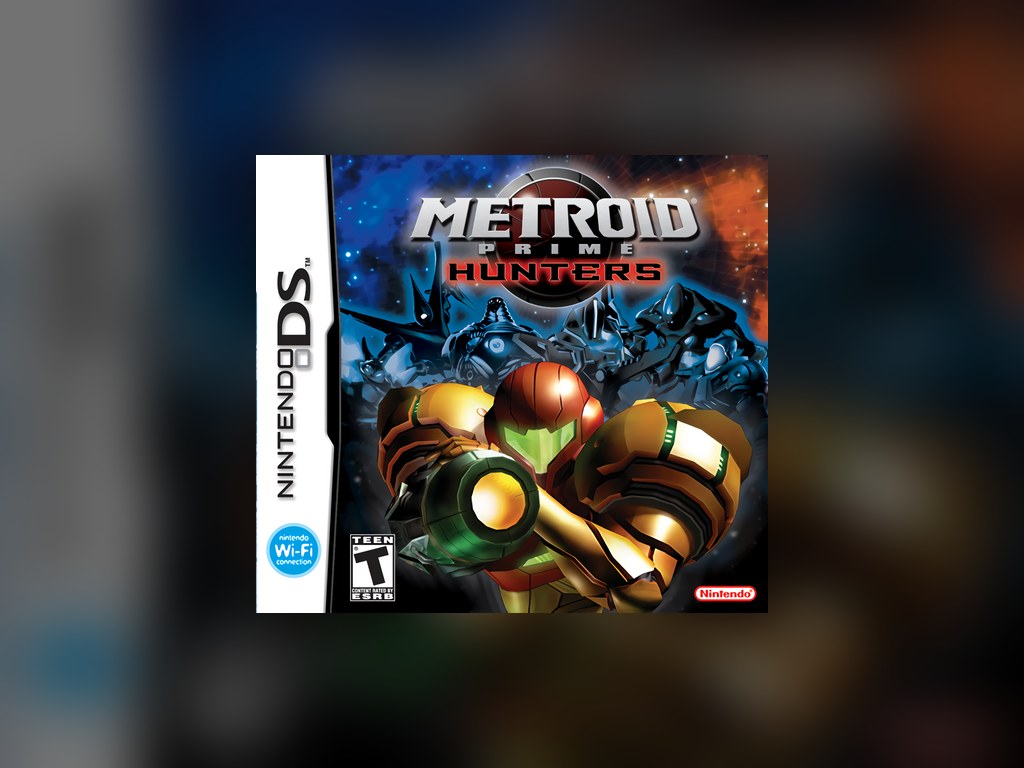
At a glance: Metroid Prime Hunters · Nintendo DS · Nintendo, 2006 · First-person shooter · Score: 7.5/10
Nintendo’s NST studio faced an odd brief with Metroid Prime Hunters in 2006: make a first-person shooter — a genre the DS had no business hosting — out of Metroid, a series about solitary exploration. Their answer split the difference audaciously. Hunters keeps a single-player campaign of planet-hopping exploration, but its heart is multiplayer: an arena shooter with seven playable bounty hunters, online deathmatches via Nintendo Wi-Fi Connection, and a stylus aiming scheme that remains, nearly two decades later, one of the most precise control methods ever put on a handheld. The demo, First Hunt, had shipped with the DS itself at launch; the full game had a lot to live up to.
The campaign sends Samus to the Alimbic Cluster, answering a telepathic summons promising ultimate power — bait that has also drawn six rival hunters, each a small masterpiece of silhouette and specialisation. Kanden turns into a crawling stinglarva; Sylux into a speeding trike; Trace snipes from invisibility; Weavel splits into a turret and a torso. Every hunter has an alt-form and an affinity weapon, which makes the roster feel like a proper hero-shooter years before the term existed. The single-player structure — three planets and a station, revisited with new gear, punctuated by hunter duels and escape sequences — is recognisably Metroid, if leaner than console Prime.

The stylus is a mouse
Control is the headline. The D-pad (or face buttons, for left-handers) moves Samus; the stylus on the touch screen aims, exactly like a PC mouse; the shoulder button fires. After twenty minutes of acclimatisation it clicks, and then Hunters plays faster and more accurately than any dual-analogue handheld shooter of its generation — circle-strafing, jump-pad trick shots and sniper duels all work. The cost is ergonomic: long sessions cramp the hand unless you use the bundled thumb strap or prop the system, the era’s universal complaint. Multiple alternative schemes, including dual-book-style options, soften but never erase the trade-off.
As an FPS campaign, Hunters is good rather than great: environments repeat textures, the scan-visor lore is thinner than Retro’s games, and boss encounters recycle. But as a technology demonstration it is staggering — full 3D worlds, dynamic lighting, voice clips and FMV cut-scenes running at a smooth clip on a machine less powerful than a Nintendo 64’s later years, with a soundtrack of pounding industrial menace that sells the arena tone.

Online in the arena
Multiplayer is where Hunters earned its reputation. Battle, survival, bounty, defender, prime hunter and nodes modes across a dozen arenas, with bots to fill lobbies, voice chat in friend lobbies — on a Nintendo handheld, in 2006 — and full online play made it the system’s premier competitive shooter. Balance niggles (Trace’s sniping and Sylux’s shock coil drew deserved grumbles) never broke the scene, and single-cartridge download play meant one copy could arm a roomful of rivals. The official servers closed in 2014; the local modes remain fully alive for anyone with two systems and a friend.
With a stylus for a mouse, Hunters out-aimed every handheld shooter of its generation — and paid for it in hand cramps.
Revisiting Hunters today means accepting its split personality: a solid, handsome Metroid adventure attached to a great arena shooter whose online heyday has passed. What survives intact is the ambition. NST proved first-person shooting could not just work on the DS but excel, and the hunter roster remains the most inventive expansion of the Metroid universe outside Retro’s own work.
The hunters, ranked by menace
The rival roster is Hunters’ most durable creation, and it rewards a closer look. Each hunter’s affinity weapon rewrites a standard arm — Sylux’s Shock Coil drains health to feed its user, Trace’s Imperialist is a true sniper rifle with a zoom the DS screen somehow supports, Noxus’s Judicator freezes at close range — and each alt-form trades firepower for mobility puzzles in the campaign and escape options in the arena. Their introductions are pure theatre: duels announced by name cards and musical stings, in a structure closer to a fighting game’s arcade ladder than to Metroid’s usual silence. The expanded universe never really used them again, which the fanbase counts as one of the series’ great wastes.
Technically, NST’s engine remains a benchmark for the hardware: dynamic lighting on a system with no dedicated lighting hardware, FMV sequences, voice samples, and arena maps with jump-pad verticality that the stylus aiming could actually exploit. Load times are minimal, the frame rate holds in four-player chaos, and the whole production squeezes into a cartridge from an era when that meant real megabytes mattered. As a demonstration of what the DS could do in expert hands, Hunters was the launch generation’s trump card — the game you showed a PSP owner to end an argument about which machine had the more interesting future.
The honest modern framing is this: Hunters is a superb multiplayer artefact with a good campaign, rather than a great campaign with multiplayer attached, and players who arrive with that expectation will love it. Its local modes need only a second DS and a friend; its bots keep the arenas populated solo; and its control scheme — the thing everyone warned you about — takes one evening to learn and repays it with the most precise shooting the platform ever hosted. Samus has had grander adventures. She has never had a faster one on a handheld.

Playing it today
Buyers should hunt the full cartridge rather than the old First Hunt demo (a charming curio, but a demo) and should expect prices to reflect the game’s reputation as a technical showcase — fair, not frightening. On a DSi XL, incidentally, Hunters becomes something close to its best self: the big screens flatter its arenas, the weight suits its grip, and the stylus aiming feels made for the larger stage. It is the DS’s most improbable achievement — a credible, competitive, online FPS on a machine sold with a puppy game — and improbable achievements are what collections are for.
There is also the matter of what Hunters proved to the industry watching it. Before 2006, the received wisdom held that first-person shooters belonged to PCs and home consoles, that handheld players wanted gentler things, and that Nintendo’s audience in particular would not come. Hunters’ sales and its thriving online scene refuted all three in a single launch window, and the lineage runs directly from its stylus to every touch-aimed and gyro-aimed shooter that followed on Nintendo hardware. Splatoon’s motion controls have ancestors, and the most important of them is a thumb strap on a silver clamshell.
Verdict
Hunters is the DS’s shooter benchmark: technically astonishing, control-scheme brave, multiplayer-rich, and slightly hollow where a Prime campaign should be deepest. Samus devotees will find exploration lite; shooter fans will find a small miracle. Score it as an arena game with an adventure attached and it shines — seven hunters, one stylus, and the fastest trigger finger the DS ever hosted.