
At a glance: Miner 2049er · Atari 400/800 · Big Five Software / Bill Hogue, 1982 · Platform game · Score: 8.5/10
Before the platform game settled into its long reign of running left to right and jumping on heads, Miner 2049er proposed something different: the whole screen is the level, every girder of it must be claimed, and the clock is always, always lying to you about how much time you have left. Bill Hogue’s 1982 hit for Big Five Software was written for the Atari 8-bit first, and it shows — this is a game designed around the machine’s colour, its single-button stick and its players’ patience, and it became one of the young platform’s defining cartridges.
You are Bounty Bob, a mountie-turned-miner (the backstory involves the Royal Canadian Mounted Police and a claim-jumping villain named Yukon Yohan, because 1982 box copy was a lawless place) exploring a uranium mine one irradiated floor at a time. The mutant creatures patrolling the platforms were, the story insists, once ordinary animals. They are not ordinary now, and touching one costs a Bob.
Paint the floor with your feet
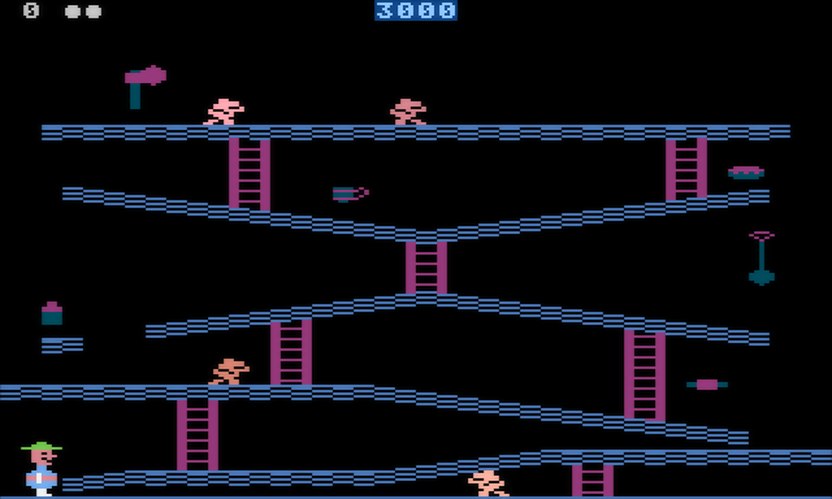
The core rule is beautifully blunt: walk over every section of platform to fill it in, and the level ends when the whole structure is painted. Around that rule Hogue built ten stations, each a small mechanical puzzle of slides, ladders, lifts, transporters and cannons. The slides are the joy of it — greased chutes that dump you two floors down whether you planned it or not — and the lifts are its discipline, platforms on fixed cycles that demand you plan a route the way a chess player plans exchanges. Scattered around are the miner’s lost belongings — a lantern here, a dynamite bundle there — and grabbing one makes the mutants briefly edible, the Pac-Man debt acknowledged and cheerfully paid.

What elevates it above a clone is the demand for total coverage. A speedrunner’s route through a Miner station is a thing of beauty, because the game forces you to think in loops: paint the dangerous top floor while the lift is coming, drop down the slide to mop up the bottom, ride back up before the timer’s bonus drains away. Miss one square of girder — and there is always one square, tucked behind a mutant’s patrol — and the whole ballet must be improvised again with seconds bleeding off the clock.
Ten stations, no filler
Variety was the game’s 1982 boast, and it holds up. One station is a maze of radioactive lifts; another centres on a cannon that fires Bob across the screen at a cost of TNT per shot, a tiny resource economy inside an arcade game. The transporter station splits Bob across numbered pads and scrambles every route you thought you had memorised. Later stations stack the tricks — slides into lifts into mutant traffic — until the final floors feel less like levels and more like final exams. Ten sounds modest now; in a genre where three repeating screens was the norm, it was a feast, and the difficulty curve across them is close to perfect.

Miner 2049er understood something its imitators missed: a platform level should be a route to be solved, not a corridor to be crossed.
Atari first, and it shows
The 8-bit version runs in the machine’s rich playfield colours with smooth, characterful animation — Bob’s little legs scissor away, the mutants bounce with real menace — and the sound does a lot with POKEY’s voices, from the springy jump to the descending slide whistle. Just as importantly, it controls exactly right on the stock Atari stick: precise stops, no inertia, jumps with a fixed, learnable arc. Later conversions to lesser machines kept the levels and lost the crispness; this is the reference version. The one period compromise is flicker when the screen gets crowded — and the Atari’s sprite hardware means a mutant or two can briefly share a scanline’s rent.
The Hogue method
Bill Hogue was barely out of his teens when he built Miner 2049er, and Big Five Software — the company he co-founded — sold it from magazine ads with a confidence the game immediately justified. What impresses, returning to it, is the completeness of the craft: the difficulty is tuned station by station rather than by global speed-ups, the bonus items are placed where a brave route and a coward’s route diverge, and the whole package is wrapped in a presentation — the little title vignette, Bob’s bow-legged walk, the death jingle — that gives a game about painting floors a genuine personality. The mutants have it too: each species keeps its own patrol logic, and learning which floors belong to which creature is the quiet second game underneath the route-planning.
It is worth setting Miner beside its famous contemporary. Donkey Kong gave the platform game its celebrity and its villain; Manic Miner, a year later in Britain, gave it surreal sprawl. Miner 2049er, between them, gave it structure — the idea that a platform level is a system of routes, lifts and timers to be solved completely rather than a ladder to be climbed once. Every ‘100%’ platformer, every collectathon, every speedrun route-map since is descended from that idea, and on the Atari it arrived first, in a cartridge, in 1982, wearing a Mountie’s hat. The Atari version’s afterlife underlines the point: it was converted to nearly every machine of the era, and while some conversions are charming and a few are even good, the original’s combination of colour, speed and that exact jump has never been improved upon — only imitated.
The telephone, explained
One item of furniture deserves its own paragraph, because it confused a generation and delighted the same one: the telephone booths. Step inside and the phone rings out a code that teleports Bob to the booth whose number he dials — a save-scumming-proof fast-travel system from 1982, with the catch that the booths sit in each station’s most exposed real estate. The telephones turn station knowledge into route knowledge: the frame under the far girder is safe to paint now and reckless later, when the patrol drifts that way, unless you take the phone from the third level and arrive behind the mutant instead. Whole speedrun lines for the later stations are built from booth-to-booth hops. When a game’s furniture becomes its strategy, the design has done something rare — and Miner 2049er’s stations are furnished like a bomb shelter designed by a chess player.
Bill Hogue’s one-man industry
The credits read like a dare: Miner 2049er was designed, programmed and largely produced by Bill Hogue, whose Big Five Software grew out of the TRS-80 scene and whose magazine advertisements — Hogue photographed in full miner’s gear — made him one of the era’s first developer personalities. The game’s polish is the argument for the auteur model in 1982: one mind holds the station geometry, the mutant logic and the bonus economy in a single design, and nothing is lost between departments because there are no departments. When reviewers of the day reached for comparisons, they reached for arcade cabinets. The Atari version was the lead edition, and it shows: this is the platform’s home-grown answer to the coin-op world, built by a man wearing the costume.
Verdict
Miner 2049er is the thinking player’s platformer from the year the genre was invented twice over. It lacks Donkey Kong’s celebrity and Manic Miner’s British fame, but as a piece of design — ten hand-built puzzles around one immaculate rule — it belongs in their company, and on this hardware it was never bettered by its own conversions. Bounty Bob’s sequel would go bigger; this is the purer game.