
At a glance: Metal Gear Solid: Peace Walker · PSP · Kojima Productions, 2010 · Stealth action · Score: 9.5/10
Peace Walker was not supposed to exist at this scale. Hideo Kojima originally positioned it as a spin-off, a PSP side story between console Metal Gears — then, by his own account, the project consumed him, and what shipped in 2010 is a mainline epic in everything but numeral: a full sequel to Snake Eater, the direct foundation of Ground Zeroes and The Phantom Pain, and arguably the most content-dense game ever pressed onto a UMD. This is Metal Gear Solid 5 in all but name, a decade before that became a joke with a sting, and the PSP carried it without breaking stride.
Costa Rica, 1974. Big Boss — Naked Snake, ten years after Operation Snake Eater and four after Portable Ops — runs Militaires Sans Frontières, an army without a country, from an offshore platform called Mother Base. When a CIA-backed force with nuclear weapons and a familiar voice on its tapes appears in the jungle, Snake is pulled into a plot about deterrence, AI weapons modelled on The Boss herself, and the question the whole saga keeps asking: what does a soldier owe the world that made him? It is dense, melancholic and frequently very funny, often in the same radio call.
Mother Base: the game inside the game
The revolution is structural. Between missions, Peace Walker is a management game: recruit soldiers — by knocking them out and extracting them with the Fulton recovery balloon, a system The Phantom Pain would inherit wholesale — assign them to combat, R&D, medical and mess-hall units, and watch Mother Base grow from a platform into a nation. Weapons, items and absurd special projects (a railgun; a Metal Gear of your own, named ZEKE) are developed by your staff. The loop of steal, recruit, build, deploy turns a stealth campaign into an empire, and it is tuned for a handheld: every sortie is ten minutes, every return brings progress you can touch.

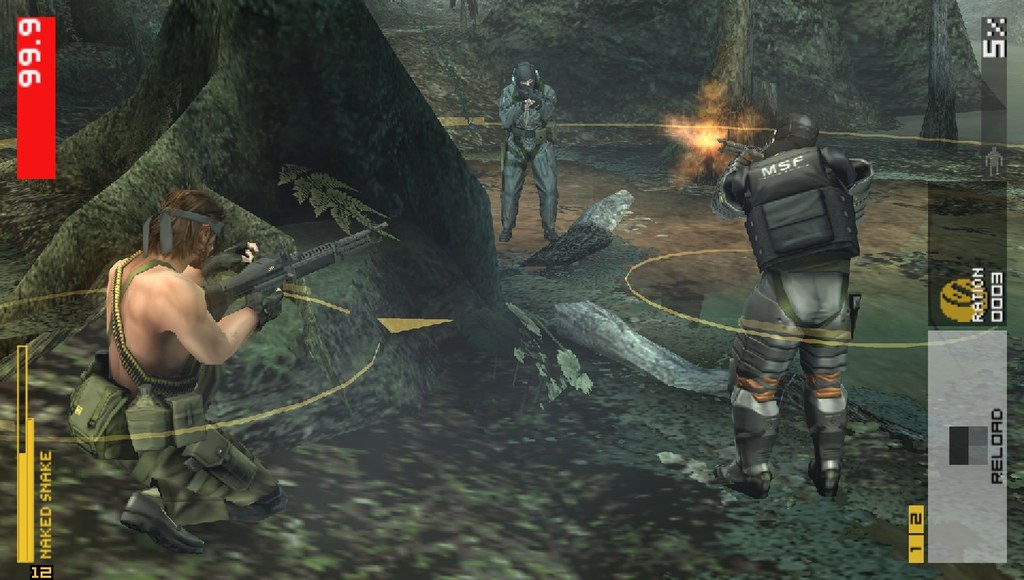
Co-operative play is the other landmark. Two players can tackle the campaign’s missions together by ad-hoc, four can join for the enormous boss encounters — battles against AI weapons and, in a crossover that still delights, monsters from Monster Hunter, fought on a tropical island with Rathalos circling overhead. Versus Ops adds competitive modes. Peace Walker’s solo game is complete and excellent, but its design heartbeat is social: this was Japan’s PSP phenomenon of 2010, played in groups, and the architecture of modern co-op shooters is visible in its blueprints.
Stealth, tuned for a nub
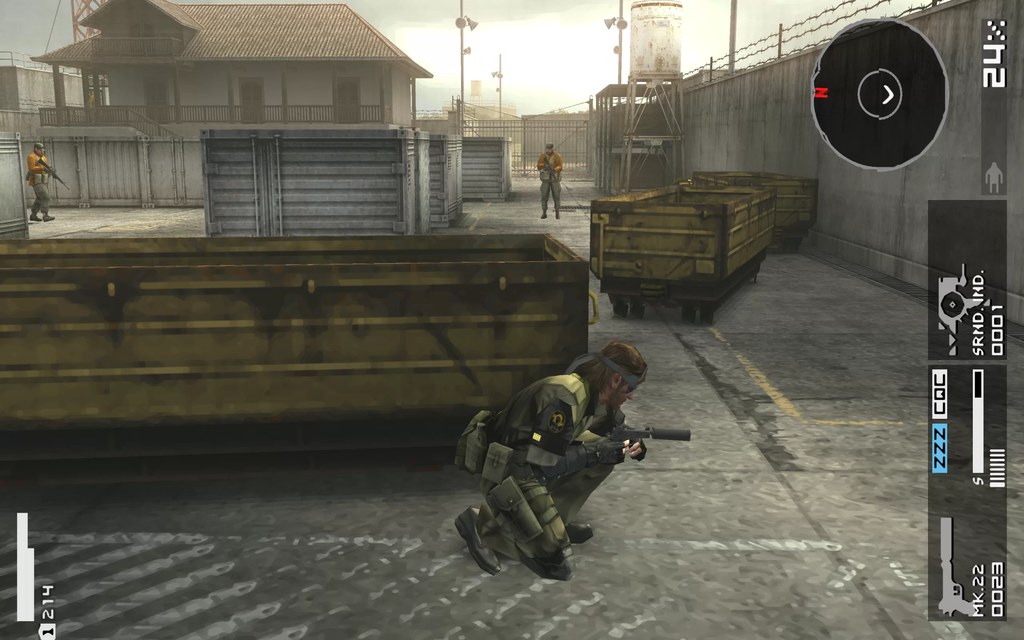
On the ground, the controls solve the PSP’s one-stick problem with the series’ cleverest scheme yet: camera on the face buttons or D-pad depending on layout, aiming refinements over Portable Ops’ shoulders, and a crouch-walking, corner-hugging Snake who finally moves at the speed the player intends. CQC is expanded into throws and holds that feed the Fulton economy, tranq pistols remain the pacifist’s scalpel, and the alert system is honest: Costa Rica’s patrols see what they should see. Missions grade you on time, stealth and recruitment, and the S-rank chase is a game in itself.
Presentation borders on the fraudulent: jungle, rain and a fully voiced cast (in the Japanese edition, a famous ensemble; the English cast is led by David Hayter’s gravel at its most humane) squeezed through the UMD with comic-book cutscenes by Ashley Wood carrying the exposition the engine could not. The theme song, Heaven’s Divide, and a credits-sequence interactive elegy are pure Kojima theatre. Chapter 5 and the true ending hide behind the base-building in a way that frustrated 2010 reviewers; with a decade’s hindsight it reads as the series’ first post-game epic.
The Fulton economy of joy
No mechanic in the game better deserves its afterlife than the Fulton. Every enemy soldier is a person your base might need — a medic, a cook, a genius with a wrench — and the decision to tranq, extract and recruit rather than kill reframes the stealth loop as collection with a conscience. Watching a stunned sniper float skyward under a balloon, bound for a career in your mess hall, is comedy and systems design in one gesture, and The Phantom Pain’s debt to this UMD is total.
Bosses built for four Snakes
The AI weapon encounters — Pupa, Chrysalis, Cocoon and the Peace Walker itself — are spectacles tuned for co-op: attack the pods, mind the escorts, share the supply drops. Solo players get a sterner, lonelier test that the game balances honestly, and the post-story Extra Ops, over a hundred of them, hide the saga’s silliest and hardest content in equal measure, from target ranges to a date at the beach that series historians still cite with a straight face. Content is not this game’s risk. Your calendar’s is.
A soundtrack with a pulse
Akihiro Honda’s score and the vocal themes give Peace Walker an emotional register the portable series had not attempted: this is a game about a man building a country out of grief, and the music knows it. The radio calls — Kaz Miller’s dry logistics, Paz’s schoolgirl brightness, the tapes that let you carry the story in your ears — use the PSP’s headphone intimacy perfectly. Few handheld games have ever sounded this expensive or this sad, sometimes within the same codec call.
The bridge to The Phantom Pain
Revisited today, Peace Walker reads as the saga’s hinge: Mother Base, the recruitment economy, the episodic mission structure and the melancholy of Big Boss’s descent all begin here, in a game sold as a portable spin-off. Ground Zeroes is its direct sequel in plot and tone. That the PSP hosted the hinge — not the PS3, where the series lived — remains one of the great platform ironies, and the strongest single argument that the PSP library is not a supplement to the era’s canon but part of its spine.
Outer Ops and the army that fights itself
The Outer Ops mode — dispatching your combat unit, vehicles and even ZEKE itself on automated missions against other forces — turns Mother Base’s roster into a strategy game you manage between sorties, with casualties that matter and spoils that feed the R&D tree. It is the clearest sign of Peace Walker’s ambitions overflowing its own genre: a stealth game that contains a management game that contains a war game, all of it feeding the same platform in the sea. Later games would sell these layers separately.
A last practical note: play the PSP version for the ad-hoc ghosts of 2010 if you can, or the HD edition for the twin sticks — but know that the original’s mission lengths, sleep-mode rhythm and comic-panel cutscenes were composed for a machine carried through a day, and something of its soul lives in that fit. Peace Walker asked what a portable game could be and answered: a mainline epic, a base, a brotherhood and a hundred extra ops, in a coat pocket, in 2010. Walk for peace. Bring a Fulton.
Verdict
The PSP’s most ambitious game is also one of its best: a stealth epic, a management sim and a co-op phenomenon in one UMD. Peace Walker is not the portable Metal Gear. It is a Metal Gear the consoles later copied.