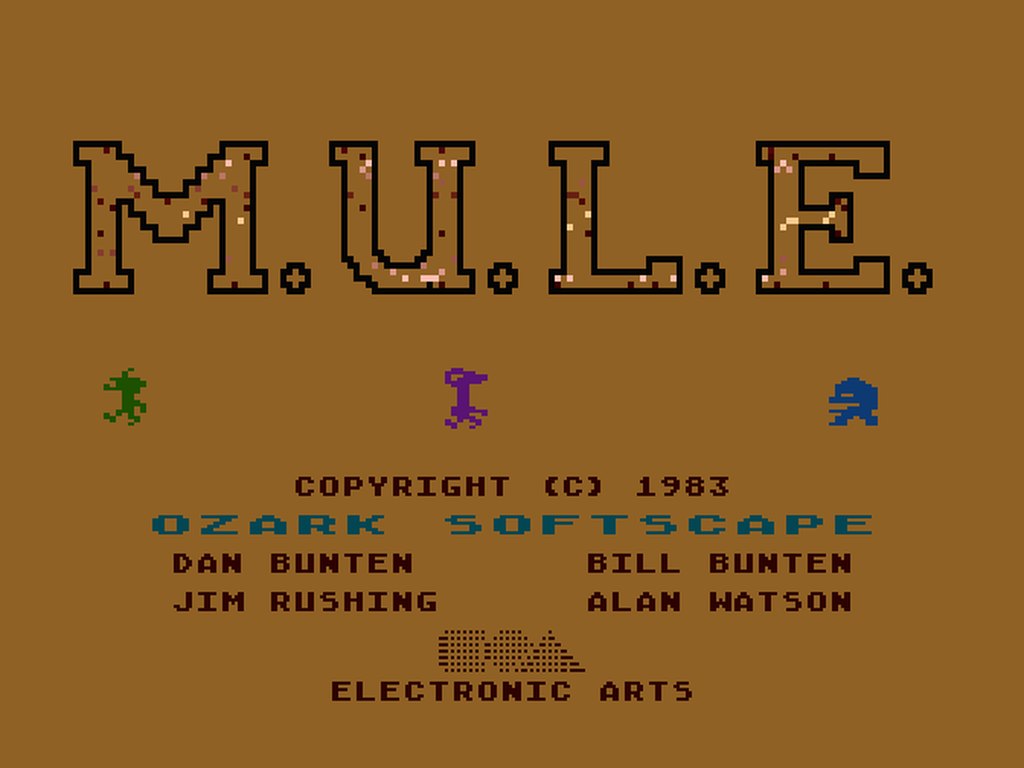
At a glance: M.U.L.E. · Atari 400/800 · Ozark Softscape / Electronic Arts, 1983 · Economic strategy · Score: 9.5/10
There is a short list of games that invented their genre whole, and M.U.L.E. sits near the top of it. Designed by Dan Bunten and the Ozark Softscape team and published by Electronic Arts in 1983, it turned supply and demand — the driest subject in the school curriculum — into the funniest, cruellest, most friendship-testing multiplayer game on any home computer. Four colonists, one empty planet, twelve months to get rich. That is the whole pitch, and more than forty years later almost nothing has beaten it at its own game.
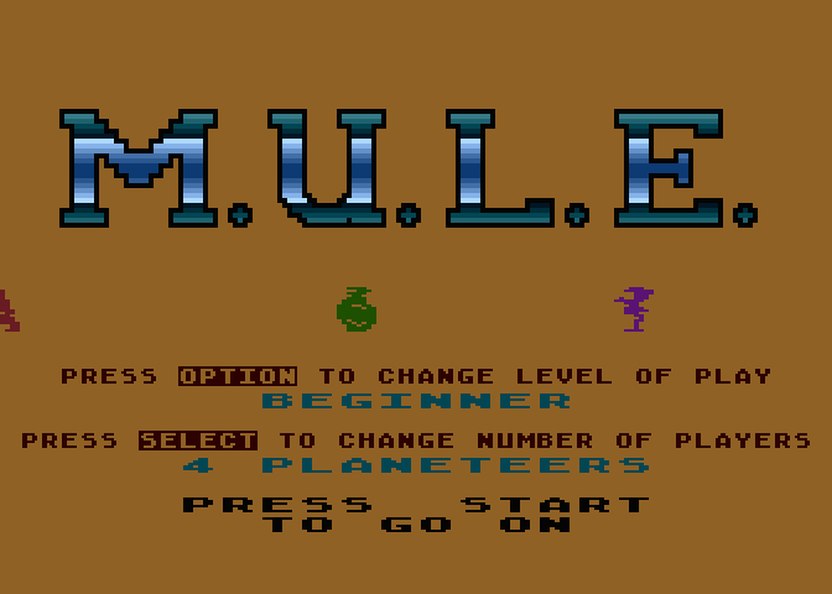
The planet is Irata — read it backwards — and the colonists are a glorious freak show of alien species, from the spider-legged Flapper to the crystalline Leggite, each with a small built-in advantage: cheaper goods here, a production bonus there. Up to four humans can play at once, a genuine revolution in 1983, and the Atari version is the one to have: the 400 and 800’s four joystick ports meant four actual sticks, four actual players, nobody passing a controller around. The computer fills any empty seats, and it plays a sly, competent game.
Land, mules and the shape of a month
Each round opens with the land grant, the purest thirty seconds of tension in early gaming. A cursor tours the map of Irata — river plots, plains and three ranges of mountains — and every player slams their button to claim the plot under the cursor as it passes. You are reading the map like a prospector: rivers grow food, plains soak up energy, mountains hide smithore, and crystite, the real money, hides anywhere and must be assayed to be found. From round two, spare plots go to auction, and the game’s soul reveals itself early: a plot is worth what a desperate neighbour will pay for it.
Then comes development. In the town — a cheerful strip of shops rendered in chunky colour — you buy a M.U.L.E., a robotic pack animal, outfit it for one job (food, energy, smithore or crystite), and lead it out to your plot before your turn timer runs dry. The timer is the game’s quiet genius: your remaining time is governed by your food supply, so a starving colonist literally gets less game. Along the way you can assay a plot for crystite, gamble in the pub (a guaranteed trickle of income that caps out exactly when you need it most), or chase the mountain wampus for a bounty — a twitch mini-game hiding inside an economics sim, because Bunten understood that a great strategy game still needs your hands busy.
The auction is the game
Production rolls in with lovely little weather-and-luck animations — rain on the river plots, sun on the plains, pests and pirates and acid rain arriving as random events that Bunten carefully rigged to help the loser and humble the leader. Then the colony walks its goods to market, and M.U.L.E. becomes a masterpiece. Buyers line up along the bottom of the screen, sellers along the top, and everyone walks their character up and down a price ladder in real time. A deal happens when buyer meets seller. That is all. And from that single rule flows every great economic behaviour: the smithore monopolist naming his price while the store runs dry, the starving player begging at any cost, the bluff, the grudge, the spite refusal that tanks two economies at once.
The store, the game’s central bank, is a player too: its prices respond to scarcity, and a colony that lets smithore run out discovers there are no M.U.L.E.s to buy at any price, because M.U.L.E.s are made of smithore. Whole campaigns die of that sentence. Food and energy are humble goods with murderous leverage — run a surplus colonist’s energy dry and their plots produce nothing. Crystite, worthless to survival, swings wildly in price and makes the fortunes that win games. The scoring at the end of twelve rounds crowns a First Founder, but Bunten, characteristically, also grades the colony as a whole: a rich winner on a failed colony gets a colder salute than the title suggests.
M.U.L.E. teaches economics the way poker teaches probability — by letting you lose real pride to it, in real time, against your friends.
Why the Atari version is the original and best
This is the version the game was designed on and around: four ports, four players, and the planet named for the machine. The graphics are bright, naive and utterly legible — you can read a whole economy off one screen — and the music, a jauntily looping little march, will move into your head and refuse to pay rent. The Commodore 64 conversion is fine, but two of its players share a keyboard. Here, with four sticks plugged into an 800, M.U.L.E. is what it was always meant to be: a board game that does its own arithmetic, at a speed no cardboard could manage.
The Bunten philosophy
Dan Bunten — later Danielle Berry — designed games around a conviction that computers were social machines waiting to happen, and M.U.L.E. is the fullest expression of it. Notice what the game refuses to do. It never eliminates a player. It never lets the leader run away with it: the random events bend, politely and persistently, towards the colonist in last place, and the famous ‘first place gets nothing’ sting of certain events is tuned so that a table of friends stays a table of rivals to the final round. It even scores the colony as well as the colonist, so a victory that starves Irata is recorded as a lesser thing than a shared prosperity. These are not accidents of balance; they are a philosophy of multiplayer that the industry would spend decades relearning, one battle-royale elimination at a time.
It also helps that M.U.L.E. is funny — properly, structurally funny. The wampus drops its bounty with a grin; the pub pays out just enough to keep a desperate colonist gambling; the auction produces, reliably, the single funniest sentence in 8-bit gaming, which is a friend whispering ‘sell to me’ while standing on a price they would not accept from anyone else. The humour is not written in text boxes. It emerges from the market, which is to say from the players, which is to say it is different every single game. Ozark Softscape’s little masterpiece generates stories the way its planet generates crystite: hidden in the ground, waiting for someone greedy enough to dig.
A note on the solo game
One caution for the modern player arriving alone: M.U.L.E.’s computer colonists are competent but they are not your friends, in either sense. The AI will not hold a forty-year grudge about the crystite auction of round nine, will not form the spite-cartel that makes the endgame sing, and will not laugh when the wampus escapes through its legs. Solo M.U.L.E. is the tutorial the game deserves — learn the prices, the terrain bonuses and the auction’s rhythm against the machines — and then go and recruit. Three friends, four joysticks, one 800 with its full set of ports: the finest multiplayer evening the 8-bit era can still provide, unchanged and unimproved upon since 1983.
Verdict
Single-player M.U.L.E. is a fine puzzle against three competent robots. Multiplayer M.U.L.E. is one of the greatest games ever made — a complete economic simulation wearing the clothes of a party game, engineered with a fairness (catch-up events, shared colony scoring, no elimination) that modern designers still study. If you own an Atari 8-bit and three friends, this is the cartridge — well, disk — that justifies the whole collection. Essential is not a strong enough word. Foundational is closer.