
At a glance: Mine Storm · Vectrex · GCE, 1982 (built into every console) · Arena shooter · Score: 8.5/10
Every Vectrex ever sold wakes up as a games console before you have spent a penny on software. Switch the machine on with no cartridge in the slot and, after the cheerful boot jingle, it deals you Mine Storm — the built-in game, burned into the console’s own ROM, waiting inside roughly a million machines whether their owners knew it or not. It is the most-played Vectrex game in history by an enormous margin, the first thing the hardware ever showed most of its owners, and the standard against which every cartridge that followed was quietly measured. The remarkable thing, four decades on, is how well it holds that position. Mine Storm is not a demo, a novelty or a pack-in apology. It is a complete, escalating, genuinely excellent arena shooter that happens to live inside the television.
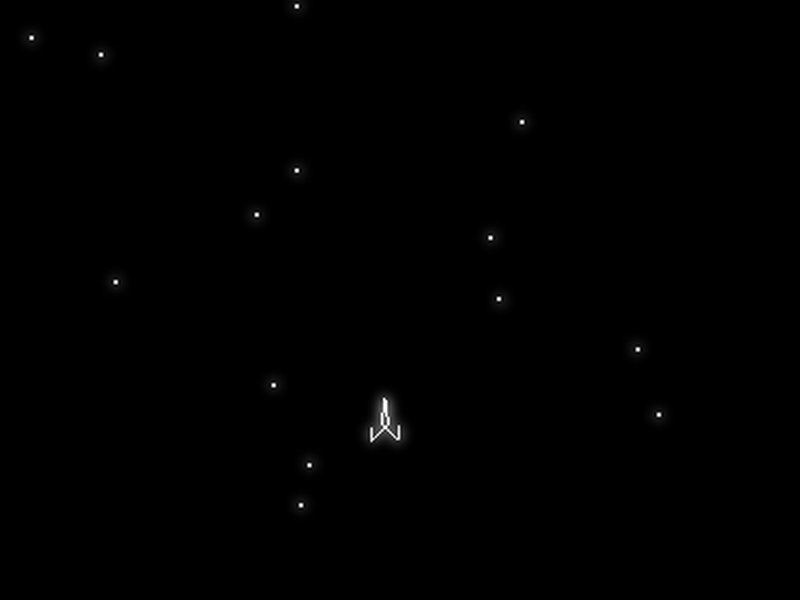
The debt to Asteroids is obvious and entirely honourable. You pilot a small vector ship in open space, free to thrust and rotate in any direction, while a field of mines drifts across the screen. Shoot a big mine and it does not simply die: it sheds smaller, faster mines, and the smallest class of mine has habits of its own. That is where Mine Storm stops being a clone and becomes itself. Where Asteroids offered rocks and saucers, Mine Storm offers a bestiary.

A field of very different mines
Four families of mine share the field, and learning to read them at a glance is the whole game. Floating mines are the innocents: they drift in straight lines, split when shot, and exist mainly to teach you the controls and to get in your way at the worst possible moment. Fireball mines are the first lesson in consequences — destroy one and it spits a fireball straight at your ship, fast enough that the shot that kills the mine can kill you if you are sitting still admiring it. Magnetic mines add pursuit: they sense your ship and bend their drift towards it, turning open space into a closing net. And the magnetic fireball mine, the family’s black sheep, combines both tricks, hunting you down and then shooting at you for good measure. Each type wears a distinct vector silhouette, so the screen is always legible: a good Mine Storm player is not reacting to dots, they are reading shapes.
On top of the mines themselves cruises the minelayer, a command ship that crosses the field at intervals seeding fresh mines behind it. It is worth points, worth shooting, and worth fearing, because a field you had thinned to a manageable drift can be repopulated while you are busy on the far side of the screen. The levels — thirteen minefields in the standard progression, each denser and nastier than the last — are less a campaign than a steadily rising argument about how much chaos one small ship can administer.

Control, drift and the analogue stick
What lifts Mine Storm above its arcade inspiration is the controller. The Vectrex stick is analogue — self-centring, springy, precise — and Mine Storm’s ship answers it beautifully. Rotation is smooth rather than stepped, thrust has weight, and the ship’s drift carries a whisper of inertia that makes every rescue manoeuvre feel flown rather than selected. Asteroids on a button panel is a game of taps; Mine Storm is a game of touch. You learn to feather the thrust, to let momentum carry you past a magnetic mine’s lunge, to spin in place and pick off the small fast mines that swarm after a big split. The four buttons sit under your other thumb for fire and functions, and the whole arrangement makes the built-in game the best possible advertisement for the hardware it came inside: within five minutes, the machine has explained itself.
Mine Storm is not a demo or a pack-in apology. It is a complete, escalating, genuinely excellent arena shooter that happens to live inside the television.
There is no overlay for Mine Storm — it never had a cartridge, so it never had the plastic — and that absence is instructive. On the bare monochrome screen the game is pure white light on black glass, brightness doing the work colour does elsewhere: mines flare as they die, fireballs streak, and the little ship’s thrust flickers with real analogue charm. Owners who later bought the 3-D imager or the colour-starved cartridges sometimes describe the built-in game as plain. Play it in a dark room, on a healthy tube, and plain is the wrong word. It is stark, and stark suits it.
Thirteen fields deep
The deeper fields are where Mine Storm’s design intelligence shows. Early minefields teach the four mine families one at a time, in combinations gentle enough to read; the middle game starts mixing magnetic pressure with fireball crossfire until the screen is a small war of incompatible threats; and the late fields — the game is generally reckoned to bare its teeth from the ninth field onwards — demand a discipline the early game never mentions: restraint. Every mine you shoot breeds smaller problems, so the expert’s skill is target selection. Clear the magnetic mines first, while there is room to be chased; take fireball mines only from an angle, moving, so their dying shot crosses empty space; leave harmless floaters drifting as a buffer rather than splitting them into fast fragments at the worst moment. The minelayer, which a beginner ignores and a novice chases, becomes a scheduling problem — kill it early in a field and the field stays thin; let it seed twice and no shooting speed will save you.
It is worth pausing on how unusual this game was in its moment. In 1982 the built-in game, as a concept, barely existed; consoles shipped with whatever cartridge marketing chose to bundle, and the machine itself was mute without one. GCE instead burned a full, deep arcade game into the console’s ROM, where it cost the owner nothing, could never be lost, lent out or left at a friend’s house, and demonstrated the hardware’s party pieces — the analogue stick, the bright vector drawing, the sound chip’s bark — within minutes of the first switch-on. The famous footnote is the bug: the earliest production run’s Mine Storm misbehaves deep into a long game, in the thirteenth field, and GCE’s fix — a corrected cartridge version, Mine Storm II, sent to owners who hit the fault — is now among the rarest and most valuable items in the entire Vectrex catalogue. The free game, in other words, became a grail. There is a parable about quality in there somewhere.
The verdict
Mine Storm’s limitations are the honest kind. It is one screen, one ship, one escalating idea; there are no bosses, no power-ups, no narrative beyond the rising count of things trying to kill you. A later built-in revision, Mine Storm II, exists as one of the rarest cartridges in the library because the original run of consoles shipped with a bug that surfaced deep into the game — a flaw most players would never reach, fixed in later production, and a reminder that even the free game was engineered seriously enough to be worth correcting. Judged as what it is — the game the Vectrex plays with itself, the zero-cost first impression of an entire platform — Mine Storm is close to perfect. It teaches the stick, shows off the vector glow, respects the player’s intelligence, and scales from a child’s first five minutes to a veteran’s high-score truce with the thirteenth field. Every console since has dreamed of a built-in game this good. Almost none has managed it.
Score: 8.5/10 — The finest pack-in that never needed packing: a sharp, escalating Asteroids evolution that still justifies switching a Vectrex on empty.