
Some actors wait by the phone and hope a famous part finds them. Karl Urban did the opposite with Johnny Cage. When he heard a second live-action Mortal Kombat film was taking shape and that Cage would sit near the centre of it, Urban and his team chased the opportunity down themselves, pushing to reach the director and producers and to get eyes on the script. He loved what Jeremy Slater had written, and he had a personal reason for caring so much: the games were already part of family life at home, something he had discovered by playing them alongside his children. That combination — a role he actively hunted, in a series his own household actually played — is the engine behind almost everything Urban said while promoting Mortal Kombat II in July 2025.
His summary of the sequel, offered to IGN as the first trailer arrived that month, quickly became the line everyone quoted. Urban argued the new film stood in relation to its predecessor roughly as George Miller’s second Mad Max adventure stands to the first one: in his attributed phrasing, it is “what The Road Warrior is to Mad Max.” That is a bold comparison to invite, because The Road Warrior from 1981 is routinely held up as the textbook case of a sequel that does not merely repeat a hit but discovers what the hit was really about. Urban knew exactly how large a promise he was making, and he made it anyway.

Karl Urban, photographed at the Mortal Kombat II panel at New York Comic Con in October 2025 — not a still from the film itself. Photo: Vbrunophotog, via Wikimedia Commons.
A part he went looking for, not one that found him
Urban’s route into the arena began, by his own account, with a gap in his gaming history. When the original arcade game exploded in 1992, he has recalled, he was too broke to take part in that first wave at all. The series reached him properly much later, at home, through sessions with his kids — and, he jokes in retellings of the story, through losing to them. That late, domestic introduction matters because it explains the tone of his campaign for the job. This was never a mercenary booking, a famous face renting himself to a franchise he barely knew. It was a father who had shared controllers with his sons deciding that, if Johnny Cage was finally joining these films, he wanted a genuine shot at playing him.
So his camp made the approach. Once Slater’s screenplay reached him, Urban’s enthusiasm hardened into commitment. He has praised the script in interview after interview, and the attraction is easy to understand on the page: this Cage is not introduced as the finished article, sunglasses gleaming, quipping his way through a tournament he expects to win. The version Urban read starts considerably lower than that.
A Cage who begins with nothing left to brag about
Talking through the character’s arc in July 2025, Urban described a former star at the bottom of the slide. Cage’s career, in this telling, is in ruins. His confidence has drained away. The martial arts training that once underpinned the action-hero image has been neglected, too. Then, at precisely that lowest moment, the call comes — not for another sequel or a convention appearance, but to stand as a champion for Earthrealm in a contest where losing means his home world falls. Urban found that trajectory compelling precisely because it gives an audience somewhere to travel: a man introduced in one condition who is forced, fight by fight, to grow into somebody else.
That reading also explains the homework. Rather than build Cage purely out of game animations and one-liners, Urban went looking for a believable past underneath the persona. He absorbed as much existing material about the character and the wider series as he could, then stepped away from screens altogether and attended karate tournaments, watching young competitors handle victory, defeat and everything in between. He was trying to picture the boy before the movie star — the kid in the hall, long before Hollywood picked him up — because that, he reasoned, is where a grounded version of the man had to start.
The physical side, meanwhile, he has described without any macho understatement. Urban called the fighting work on this production the most demanding he had ever attempted in his career, a steep and unfamiliar learning curve in movement, agility and speed. That admission lands harder coming from an actor whose résumé already runs through The Lord of the Rings, Star Trek, Dredd and The Boys. If this was his hardest physical assignment, the sequel was clearly not planning to let its leading man coast on charisma.
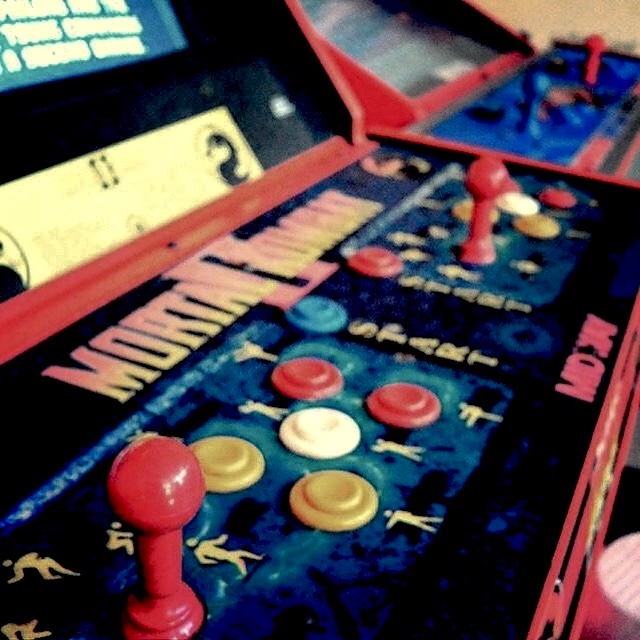
The control layout of a Mortal Kombat II arcade cabinet — the 1993 game whose tournament the films took so long to actually stage. Photo via Wikimedia Commons.
Unpacking that Road Warrior comparison
Sequels usually get sold with adjectives: bigger, bloodier, louder. Urban instead reached for a specific piece of film history, and the choice tells you what he thinks actually improved. The first Mad Max in 1979 was lean, rough and cult-sized. Its successor took the same world and the same wandering lead character and returned with a clearer, harder, far more confident piece of action filmmaking — the one that defined the series for everyone who followed. When Urban says everybody involved here levelled up significantly across the whole production, and calls this the strongest screen representation of these characters and this world so far, he is claiming that kind of leap, not just a larger budget line.
He applied the same point to the basics when discussing the film elsewhere that summer: production craft, photography and the fights themselves were all, in his judgement, raised a notch. Fans of Cage specifically were promised the familiar signature techniques and the small nods that reward long memories, worked carefully into the action rather than pasted on top of it. At the same time, Urban was careful to argue the door stays open for newcomers. His stated aim was a film a martial arts movie fan could enjoy cold — no decades of lore required — which is, again, very Road Warrior: a sequel that deepens a mythology while still working as a self-contained ride.
Why the 2021 film left such obvious unfinished business
To see why a level-up was even necessary, rewind to April 2021. Simon McQuoid’s reboot arrived in the strangest conditions imaginable for a would-be blockbuster: cinemas were only partly back, and in the United States the film opened in theatres and on HBO Max on the same day, April 23, as part of Warner Bros.’ pandemic-era day-and-date experiment. Judged purely on ticket sales it did respectably under the circumstances, grossing about $84.4 million worldwide against a reported $55 million production budget. Judged on streaming, it was a genuine phenomenon — the service’s most successful film launch at that point, sampled by some 3.8 million American households in its first three days and around 5.5 million across its first seventeen days.
Critically and among fans, though, the response split down the middle. Review aggregation put it in the mid-fifties with critics, who tended to praise the performances, the production polish, the fight choreography and the respect shown to the source material while taking aim at the screenplay and its heavy exposition. Audiences were notably warmer. And two creative choices became permanent talking points. First, the story centred on Cole Young, an original character invented for the films, which left many game fans feeling the real roster had been kept waiting in its own movie. Second — and stranger still for a brand named after a contest — the tournament itself never actually happened. The 2021 picture was all prophecy, pursuit and preparation, ending with a recruitment trip and a poster on a wall teasing the one fighter everybody had been waiting for: Johnny Cage. A sequel, in other words, had been promised twice over, once by the plot and once by that closing tease.
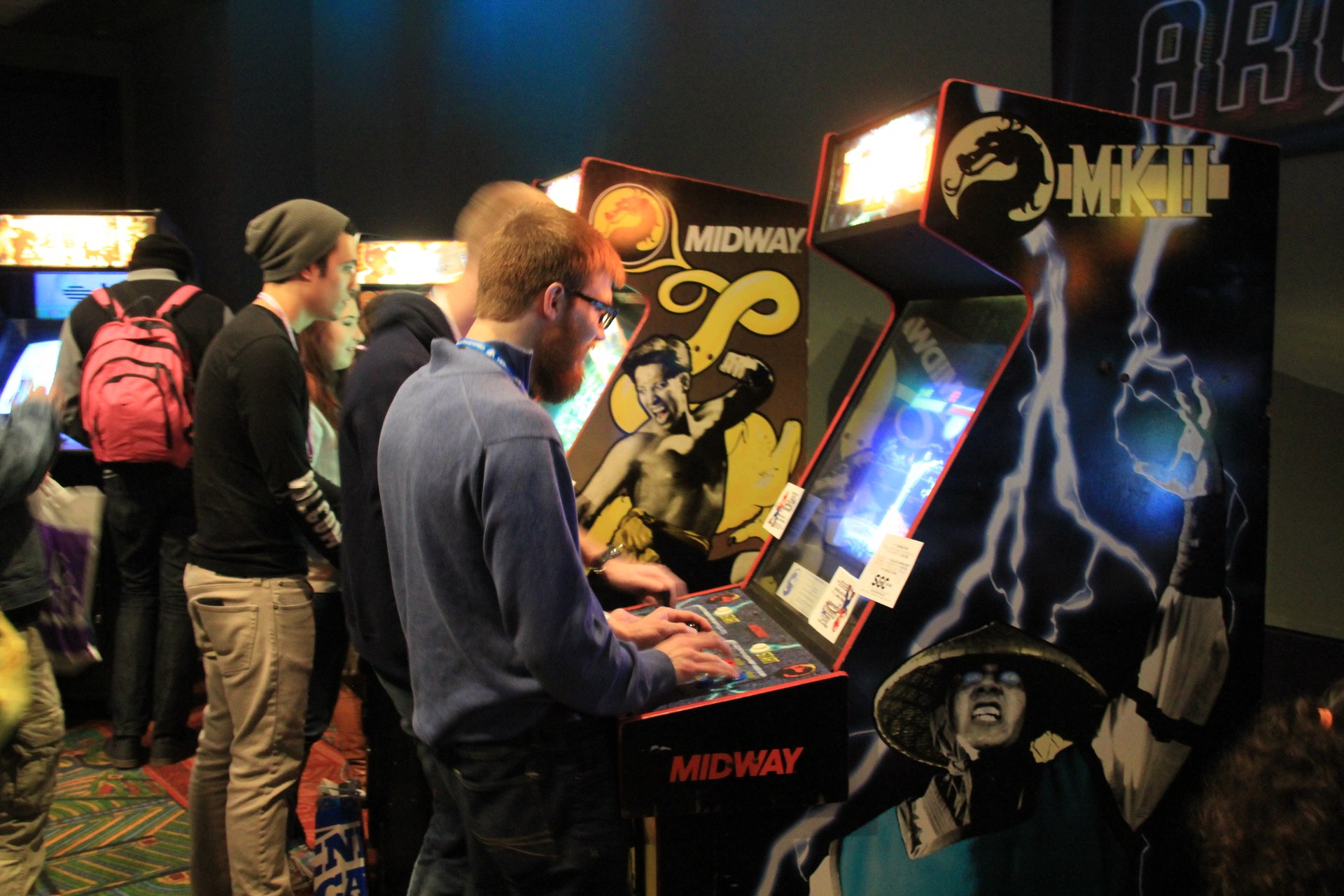
An original Mortal Kombat II arcade cabinet, complete with Raiden side art, photographed at PAX South in 2015. Photo via Wikimedia Commons.
This time, the tournament is the film
The follow-up was confirmed in development in January 2022 and formally greenlit that July, with McQuoid returning to direct and Slater — whose credits include Marvel’s Moon Knight — writing. Cameras rolled at Village Roadshow Studios on Australia’s Gold Coast from June 22, 2023, paused that July when the actors’ strike shut productions down, resumed in November once the strike ended, and wrapped in late January 2024. The premise finally delivers the thing the first film kept deferring: Earthrealm’s champions enter the tournament itself, against Outworld, with the emperor Shao Kahn — played by Martyn Ford — as the power to be beaten and Edenian princess Kitana woven tightly into Cage’s story.
The new faces are chosen to fill the most conspicuous gaps in the first roster. Adeline Rudolph plays Kitana, and she has described the princess’s path as crossing and re-crossing Cage’s throughout the film, the poised, regal fighter set against a champion who is anything but seasoned — a contrast the cast clearly enjoyed playing for both drama and comedy. Tati Gabrielle, Rudolph’s former colleague from Chilling Adventures of Sabrina, joins as Jade, Kitana’s loyal and formidable bodyguard. Around them arrive Damon Herriman as the necromancer Quan Chi — a neat promotion, since Herriman had voiced Kabal in 2021 — plus Desmond Chiam as King Jerrod, Ana Thu Nguyen as Queen Sindel and CJ Bloomfield as Baraka.

Adeline Rudolph, who plays Kitana, photographed at the Mortal Kombat II panel at New York Comic Con in 2025. Photo via Wikimedia Commons.
The returning company is extensive. Jessica McNamee is back as Sonya Blade, Josh Lawson as Kano, Ludi Lin as Liu Kang and Mehcad Brooks as Jax, with Lewis Tan returning as Cole Young in a reduced position now that Cage takes the lead. Tadanobu Asano’s Raiden, Chin Han’s Shang Tsung, Joe Taslim’s Bi-Han and Hiroyuki Sanada’s Scorpion all return, alongside Max Huang as Kung Lao. It is, deliberately, a film that keeps the first cast’s chemistry while demoting none of its new arrivals to decoration — Kitana and Cage were described by the writer as the twin anchors of the story, which is a structural admission that the sequel’s centre of gravity has moved to where the fans always thought it should be.
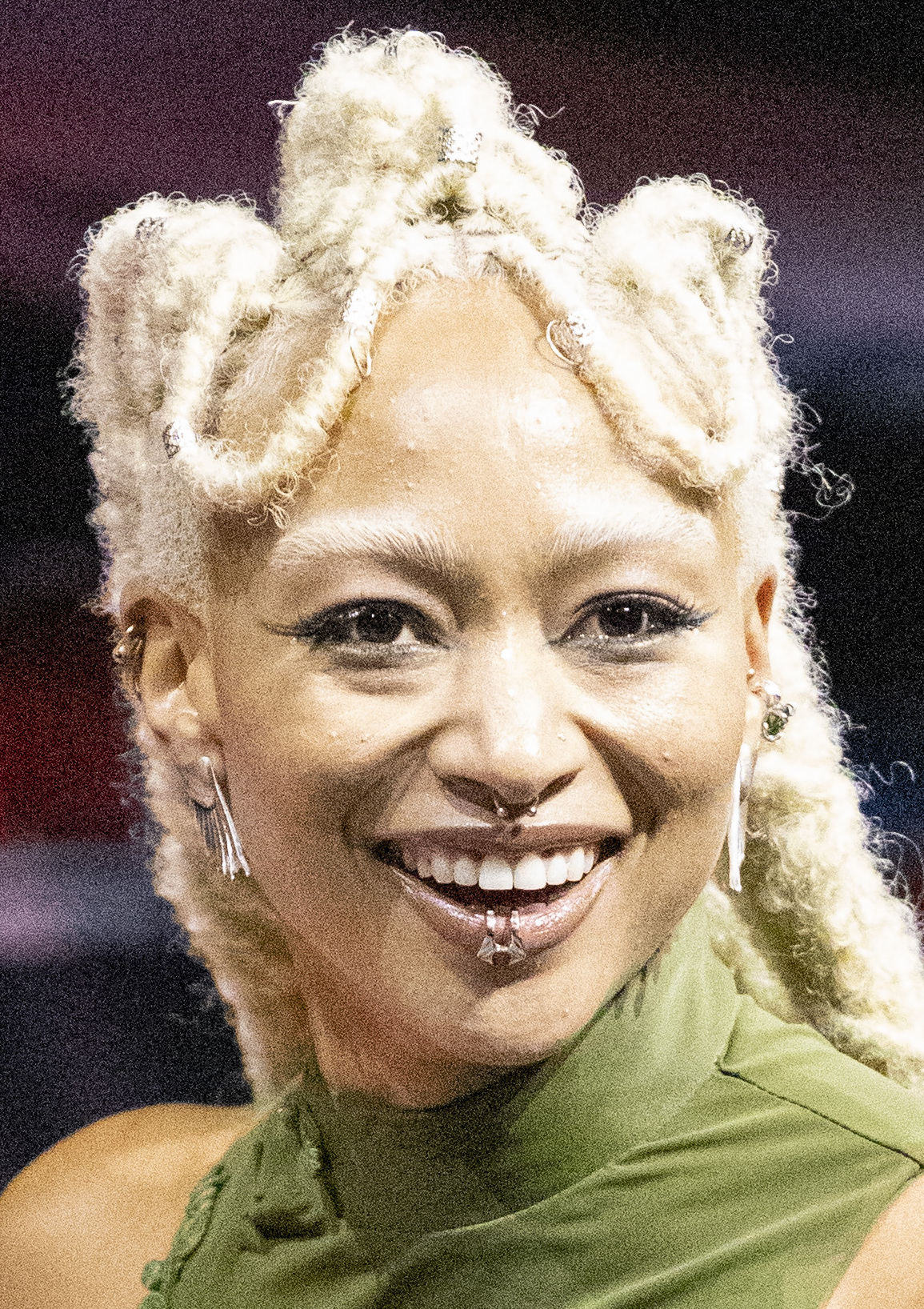
Tati Gabrielle, who plays Jade, photographed at the Mortal Kombat II panel at New York Comic Con in 2025. Photo via Wikimedia Commons.
The release date that would not stay still
For a long time, every interview — including the July 2025 conversation this feature began with — pointed to the same finish line: October 24, 2025. Character posters were printed with that autumn date on them. Then, on August 29, 2025, roughly eight weeks before opening, Warner Bros. and New Line moved the film deep into the following year, announcing May 15, 2026 instead. Reporting by Deadline framed the shift as a box-office calculation rather than a production problem: October was crowded and historically soft around Halloween, while a mid-May slot had just worked handsomely for the same studio family with Final Destination: Bloodlines. Urban himself hinted the studio was treating the sequel as a summer picture after the July trailer drew a reported 107 million views in its first day.
That was not the last adjustment. In October 2025 the date was pulled forward by a single week, settling on May 8, 2026 — the date on which, after a premiere at the TCL Chinese Theatre on April 27, the film was ultimately released in United States theatres. So the accurate version of the story, checked against the latest available record, is a three-step one: an October 2025 launch that never happened, a long delay to mid-May 2026, and a final one-week nudge earlier to May 8, 2026. Anyone still quoting October 24, 2025 is reading the old posters, not the calendar the film actually kept.
A promise that tells you how to judge it
There is a risk in an actor framing his own sequel after one of the most admired action sequels ever made, and Urban, to his credit, never softened the claim in the retelling. But the comparison is useful less as hype than as a checklist. Did the fights improve rather than merely multiply? Did a world sketched in the first instalment become somewhere vivid in the second? Did a character the audience was only promised last time turn out to be worth the wait? Those were the questions Urban’s July 2025 interview set up, armed with karate-hall research, the hardest training of his career and two young co-players at home who had already given him the bluntest review any father can get. He chased this part because his family loved these games. The Road Warrior line was his way of saying he intended to hand it back to them — and to every other household like his — levelled up.