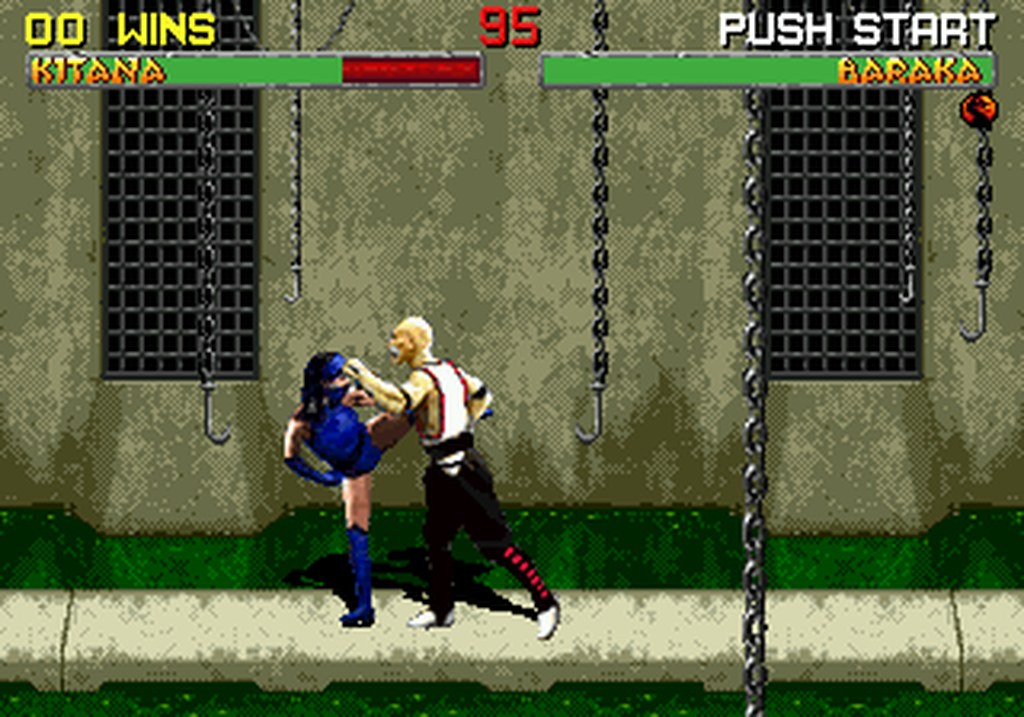
At a glance: Mortal Kombat II · 32X · Probe / Acclaim, 1995 · Versus fighting · Score: 8.0/10
Mortal Kombat II was the event game of 1993 — the arcade sequel that fixed everything about the first: twice the fighters, stage fatalities, friendships and babalities as the culture’s pressure valve, and a darkness the original only flirted with. The home versions split the 16-bit generation down the middle, and the 32X version, arriving in 1995, is the connoisseur’s answer to that old playground war. Built by Probe on the add-on’s muscle, it takes the Mega Drive conversion’s solid skeleton and restores what the base hardware had to cut: bigger, better-animated fighters, fuller sound, more of the arcade in every frame.
The roster is the full twelve — Liu Kang, Kung Lao, Johnny Cage, Reptile, Sub-Zero, Shang Tsung (playable, with his morphs), Kitana, Jax, Mileena, Baraka, Scorpion and Raiden — with Jade, Smoke and Noob Saibot hiding in the game’s secrets and Kintaro and Shao Kahn presiding over the ladder. Every fatality, friendship, babality and stage kill is present, including the Dead Pool’s acid bath and the Kombat Tomb’s spikes, and the digitised fighters are rendered at a size and smoothness the Mega Drive version visibly could not afford.

The add-on difference
What the 32X buys, concretely: sprite frames the base version dropped are restored, so sweeps, spins and morphs flow at arcade cadence; the colour depth lifts the arenas out of the Mega Drive’s murk — the Living Forest’s faces leer properly, the Portal crackles; and the audio gains the announcer’s body and the soundtrack’s menace, ‘FINISH HIM’ delivered with the weight it deserves. Load-free, instant, cartridge-pure — and on a six-button pad, the only sane way to play, every input the arcade panel offered is under your fingers.
The fighting itself is pure MKII: juggle-friendly, projectile-zoned, uppercut-theology, a game of spacing and punishment rather than combo strings. The AI remains the series’ traditional cheat in the upper ladder — input-reading, damage-boosted, a wall that generations of players have cursed and climbed — and the two-player game remains the real content: no fighting game of the era staged a grudge match better, and none filled a room with more noise at a fatality inputted correctly.
Bigger sprites, restored frames, the announcer’s full voice: this is the Mortal Kombat II the Mega Drive always wanted to be.
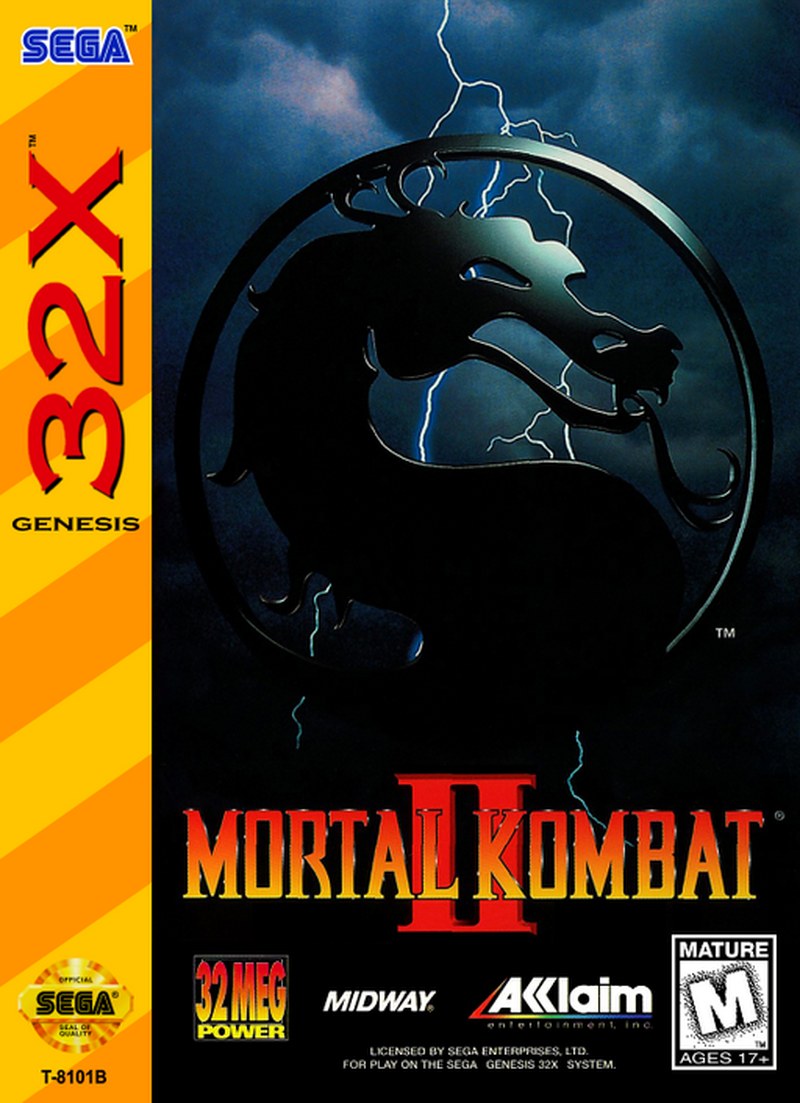
Against the SNES version — the other half of the old war — the 32X port wins on animation fluidity and speed, trades blows on sound, and shares the same content crown. Against the 32-bit versions that followed it lacks CD audio and arcade dimensions, but as a cartridge conversion of the biggest fighting game on Earth, it is the 16-bit generation’s definitive edition.
The 32X version, specifically
Judged as this series judges: the add-on version is the one to own. Probe used the hardware where players could see it — in the fighters’ size and motion — and the result is the rare enhanced port that justifies the enhancement. It is also, not incidentally, one of the best-selling arguments the 32X ever made in schoolyards: this, finally, was the arcade at home.
Verdict: the fullest, smoothest Mortal Kombat II of the cartridge era — a heavyweight conversion that earns the mushroom on its console. Finish it.
Time has sorted the 32X library into the famous, the infamous and the forgotten, and Mortal Kombat II rewards being met on its own terms rather than through any of those reputations. Played today — on a serviced stack, through a clean video path, with the six-button pad the era intended — it is a reminder that the mushroom’s forty games were never its problem. The problem was the calendar they were born into, and calendars cannot be replayed. Games can.
There is also the matter of what Mortal Kombat II says about its machine. The 32X was sold as a bridge to the 32-bit future and remembered as a dead end, but its best cartridges argue a subtler case: that for eighteen months it was simply a good games platform with a small, strange, high-quality library, judged at the speed of a market panic rather than at the pace games deserve. Revisiting it now, without the panic, is the closest thing the platform will ever get to a fair trial — and on the evidence of this cartridge, the defence rests well.
For collectors, Mortal Kombat II sits in the honest middle of the 32X market: neither the loose-change common nor the four-figure grail, but a cartridge that rewards the hunt and justifies its shelf space every time the stack is powered up. In a library this small, every game is a significant fraction of the whole. This one earns its fraction.
What lingers after the credits is how completely Mortal Kombat II belongs to its moment — and how well that moment has kept. The early polygon years are often treated as an embarrassing adolescence for the medium, all jagged edges and experimentation. The best 32X games suggest otherwise: the experiments were the point, the edges were the aesthetic, and a generation of designers was learning 3D in public, at full speed, on hardware like this. Mortal Kombat II is one of their better lessons.
Time has sorted the 32X library into the famous, the infamous and the forgotten, and Mortal Kombat II rewards being met on its own terms rather than through any of those reputations. Played today — on a serviced stack, through a clean video path, with the six-button pad the era intended — it is a reminder that the mushroom’s forty games were never its problem. The problem was the calendar they were born into, and calendars cannot be replayed. Games can.
There is also the matter of what Mortal Kombat II says about its machine. The 32X was sold as a bridge to the 32-bit future and remembered as a dead end, but its best cartridges argue a subtler case: that for eighteen months it was simply a good games platform with a small, strange, high-quality library, judged at the speed of a market panic rather than at the pace games deserve. Revisiting it now, without the panic, is the closest thing the platform will ever get to a fair trial — and on the evidence of this cartridge, the defence rests well.