
At a glance: Motocross Championship · 32X · Artech / Sega, 1994 · Motocross racing · Score: 6.0/10
Motocross Championship is the 32X’s blue-collar racer: no polygon glamour, no licence worth the name, just twelve dirt bikes, a season of rutted tracks, and a willingness to let riders punch and kick each other into the fence. Artech’s game arrived in the launch window with a clear pitch — the Mega Drive’s racing shelf had nothing like a full-field motocross season — and a clear problem: everything it attempts sits slightly beyond what it can smoothly do. The result is a likeable, scruffy, perpetually almost-good racer that its owners remember more fondly than its reviewers did.
The championship structure is the substance: a season across a dozen tracks in three bike classes (125, 250 and the full 500cc), prize money traded for repairs and upgrades, and fields of twelve riders who treat the first corner like a land claim. The tracks are the game’s best asset — proper motocross layouts of doubles, tabletops, whoop sections and mud that visibly slows the unwary line, drawn with scaled sprites over undulating terrain that crests and dips with a real sense of place. Reading a rhythm section at speed, choosing the inside rut or the wide berm, is motocross thinking, and the game teaches it honestly.

Elbows out
Combat is the seasoning. Riders can punch and kick rivals within reach — a Road Rash inheritance that turns mid-pack racing into a brawl on wheels. It is crude, funny and occasionally decisive, and it gives the midfield a texture most racers lack: you are never just following the bike ahead, you are negotiating with it. The AI riders have distinct enough pace to make the season’s classes feel like promotions, and the two-player split-screen, like everything else here, works while working the hardware hard.
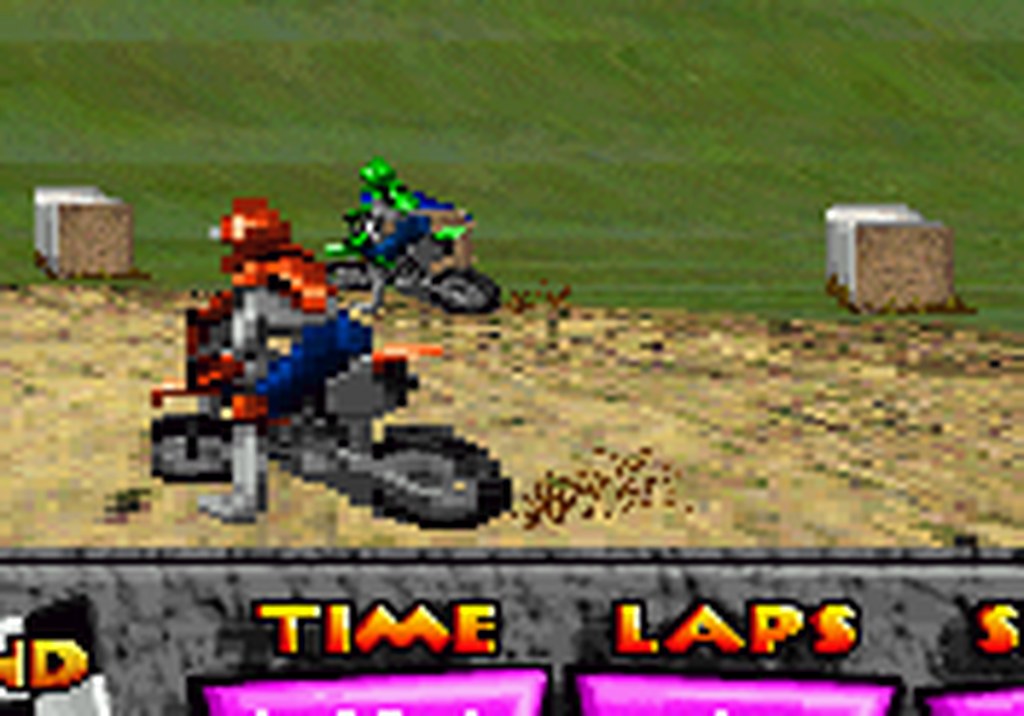
Because the frame rate is the tax on all of it. Twelve large sprites, scaling scenery, split-screen in two-player — the 32X copes, but ‘copes’ is the word: the update stutters in heavy traffic, and the sense of speed, decent in clear air, frays exactly when the racing is thickest. Handling compounds the wobble: bikes slide with a looseness that veterans learn to exploit and newcomers will call unresponsive for their first hour, because it is.
Twelve bikes, dirty elbows and a real season: Motocross Championship attempts more than it can smoothly do, and is likeable for trying.
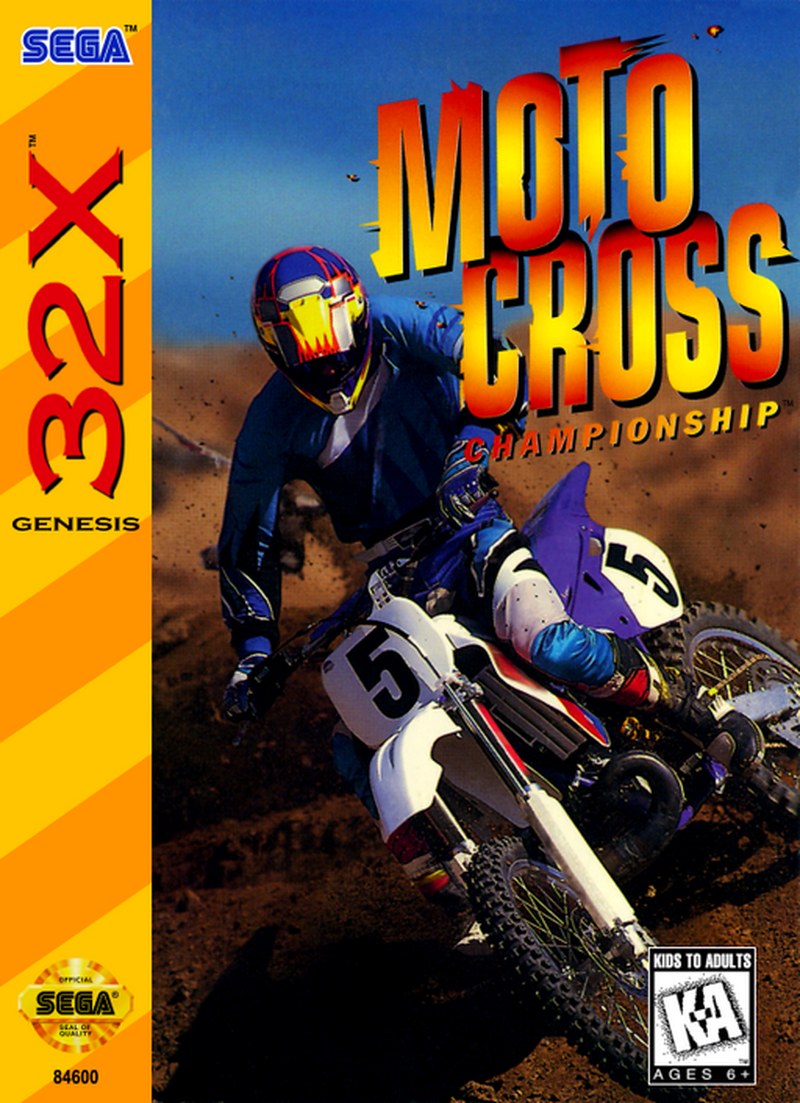
Presentation is period-honest: chunky rider sprites, dust, mud-spattered palettes, an engine soundtrack that will clear a room. The between-race shop and the class ladder give the single player a campaign worth the name, and the password system keeps it portable. What it never quite becomes is essential — Virtua Racing Deluxe, on the same shelf, is faster, smoother and smarter — but as the system’s only dirt-bike game it holds a niche no other cartridge contests.
The 32X version, specifically
A 32X exclusive again — the hardware’s sprite-scaling and extra colour are doing visible work over anything the base Mega Drive attempted in this genre, and the twelve-rider field is the add-on’s head-count flex. Judged against its own ambitions rather than AM2’s, it is a respectable mid-card: a rough-edged season racer with a brawler’s grin.
Verdict: scruffy, ambitious and intermittently great fun — the 32X’s muddiest cartridge, saved by its season mode, its dirty tactics and its refusal to be just another lap-timer.
Time has sorted the 32X library into the famous, the infamous and the forgotten, and Motocross Championship rewards being met on its own terms rather than through any of those reputations. Played today — on a serviced stack, through a clean video path, with the six-button pad the era intended — it is a reminder that the mushroom’s forty games were never its problem. The problem was the calendar they were born into, and calendars cannot be replayed. Games can.
There is also the matter of what Motocross Championship says about its machine. The 32X was sold as a bridge to the 32-bit future and remembered as a dead end, but its best cartridges argue a subtler case: that for eighteen months it was simply a good games platform with a small, strange, high-quality library, judged at the speed of a market panic rather than at the pace games deserve. Revisiting it now, without the panic, is the closest thing the platform will ever get to a fair trial — and on the evidence of this cartridge, the defence rests well.
For collectors, Motocross Championship sits in the honest middle of the 32X market: neither the loose-change common nor the four-figure grail, but a cartridge that rewards the hunt and justifies its shelf space every time the stack is powered up. In a library this small, every game is a significant fraction of the whole. This one earns its fraction.
What lingers after the credits is how completely Motocross Championship belongs to its moment — and how well that moment has kept. The early polygon years are often treated as an embarrassing adolescence for the medium, all jagged edges and experimentation. The best 32X games suggest otherwise: the experiments were the point, the edges were the aesthetic, and a generation of designers was learning 3D in public, at full speed, on hardware like this. Motocross Championship is one of their better lessons.
Time has sorted the 32X library into the famous, the infamous and the forgotten, and Motocross Championship rewards being met on its own terms rather than through any of those reputations. Played today — on a serviced stack, through a clean video path, with the six-button pad the era intended — it is a reminder that the mushroom’s forty games were never its problem. The problem was the calendar they were born into, and calendars cannot be replayed. Games can.
There is also the matter of what Motocross Championship says about its machine. The 32X was sold as a bridge to the 32-bit future and remembered as a dead end, but its best cartridges argue a subtler case: that for eighteen months it was simply a good games platform with a small, strange, high-quality library, judged at the speed of a market panic rather than at the pace games deserve. Revisiting it now, without the panic, is the closest thing the platform will ever get to a fair trial — and on the evidence of this cartridge, the defence rests well.