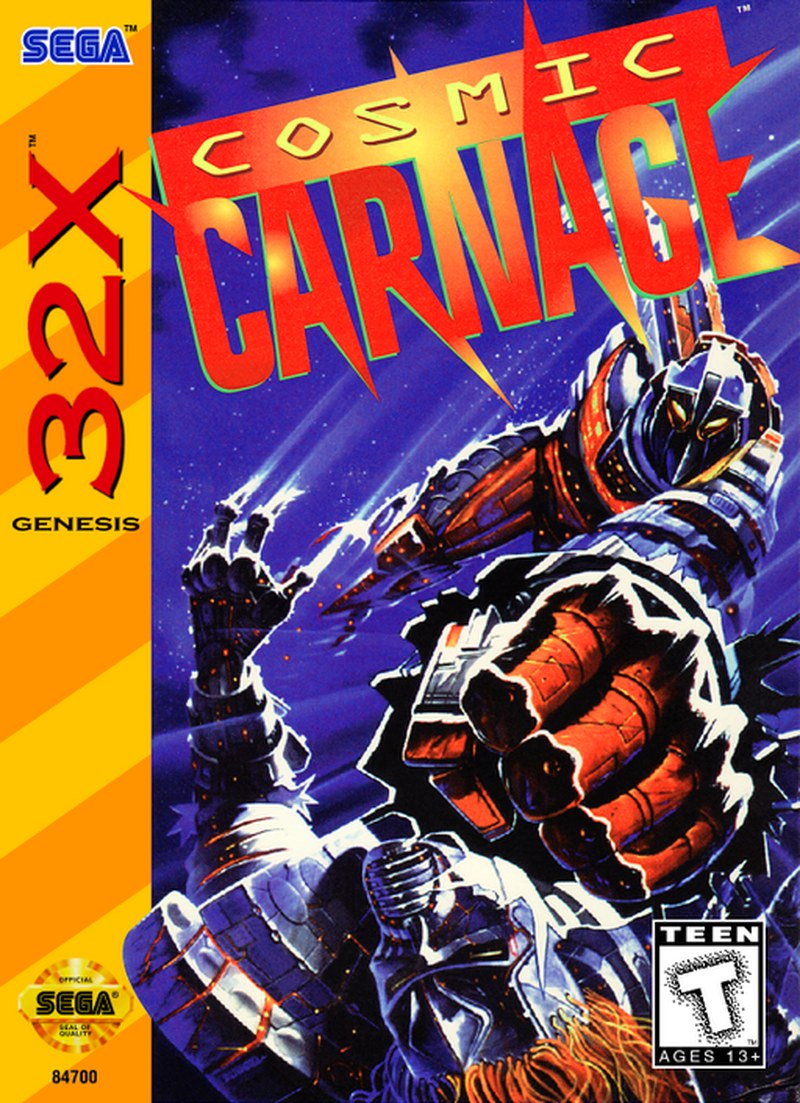
At a glance: Cosmic Carnage · 32X · Givro / Sega, 1994 · Versus fighting · Score: 5.5/10
Cosmic Carnage is the 32X launch title that history treats as a punchline, and the honest review has to start by pleading partial mitigation. Yes, it is clumsy. Yes, it was savaged on release and has been ever since. But inside the clumsiness are three ideas that fighting games would later be praised for — armour that breaks off piece by piece and changes the fight, a camera that zooms dynamically with the action, and finishing moves staged as genuine executions — and the tragedy of Cosmic Carnage is not that it lacked ideas. It is that the fighting underneath the ideas was never given the time it needed.
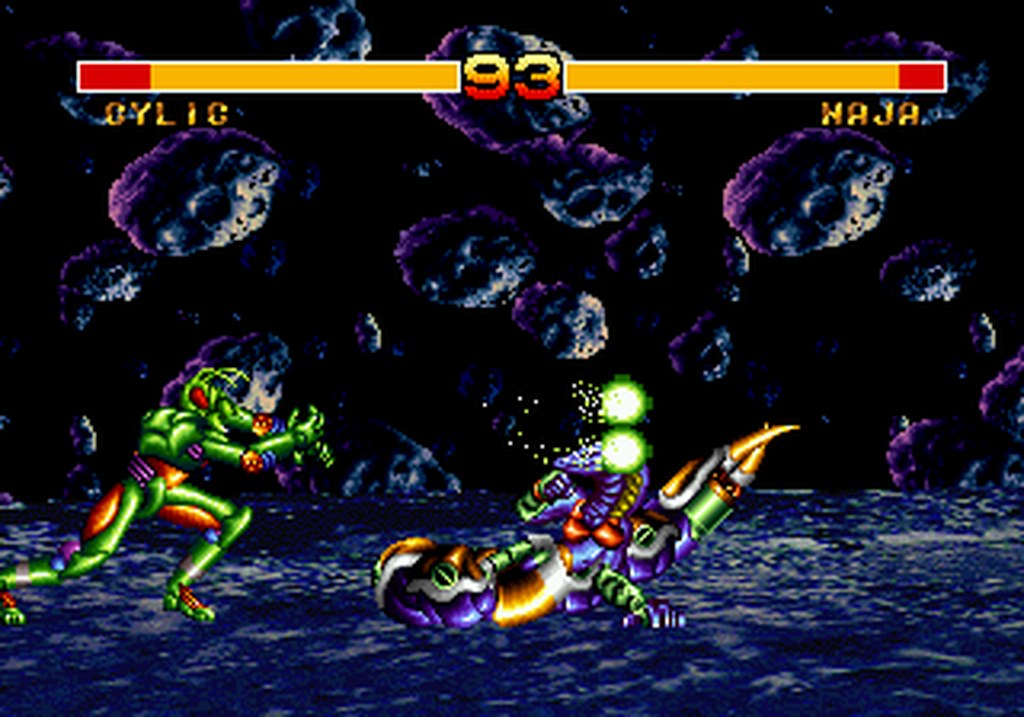
The fiction is a prison ship of alien criminals, eight fighters deep, escaping through each other. The cast runs from the comparatively normal — the soldier Talmac, the renegade Naruto — to a snake woman, a giant ape-thing and a final boss, Zena-Lan, who remains notorious among players who reached her. Each fighter can be armoured before a bout, choosing pieces that add reach, damage or protection, and the armour system is the game’s real design: pieces fly off under punishment, your fighter literally dismantles as a round turns against them, and managing what you can afford to lose becomes the strategy.
Zoom, and the cost of zoom
The camera is the headline technology. As fighters separate, the view pulls back; as they close, it zooms — all the way in, until single sprites swell into enormous, chunky mosaics of pixels. SNK’s Art of Fighting had done a cleaner version of this trick on the Neo Geo; on the 32X the zoom is rougher, the sprites blockier, and at full magnification the art dissolves into abstraction. At mid-range, though, the effect works: fights breathe, distance becomes visible information, and the huge character sprites have a weight most 16-bit fighters never attempted. It is a flawed showcase of a real hardware talent — the 32X scaling and rotating sprites for sport.
The fighting itself is where mitigation ends. Moves are few, special attacks are unreliable to execute, hit detection has moods, and the single-player ladder is a war of attrition against AI that alternates between sleepwalking and sudden perfect counters. Two-player versus, between two humans equally lost in the system, is significantly better fun — the armour-breaking creates genuine mid-round drama — but set beside Virtua Fighter on the same hardware, Cosmic Carnage is simply outclassed in every department except novelty.
Armour that breaks, a camera that zooms, executions as finales: Cosmic Carnage had 1997’s ideas in 1994 and 1989’s execution underneath them.
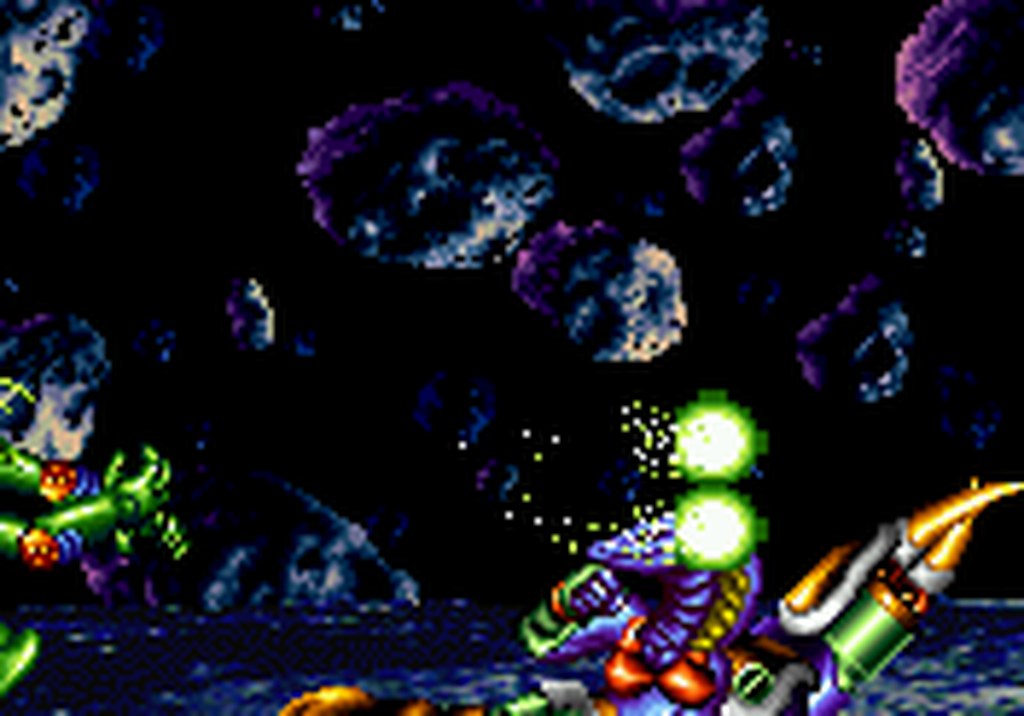
The presentation swings wildly: interplanetary backdrops that range from striking to sparse, a soundtrack with real menace in places, and between-round taunts that have not aged a day in the wrong direction. As a launch title it was asked to demonstrate hardware, and the demonstration — the zoom, the sprite scaling — worked in the shop window. It is at home, across long evenings, that the questions start.
The 32X version, specifically
There is only this version (the Japanese release, Cyber Brawl, is the same game in regional dress), and it belongs to the small class of launch games whose reputation understates their interest. Judged as a fighter it fails against its own stablemate; judged as a design document it is fascinating, a rough draft of mechanics the genre later adopted wholesale. Both judgements are true, and the score splits the difference with emphasis on the playing.
Verdict: not the disaster of legend, not a hidden gem either — a brave, broken experiment whose best ideas were stolen by better games. Play it for the armour, the zoom and the history; reach for Virtua Fighter for the fighting.
Time has sorted the 32X library into the famous, the infamous and the forgotten, and Cosmic Carnage rewards being met on its own terms rather than through any of those reputations. Played today — on a serviced stack, through a clean video path, with the six-button pad the era intended — it is a reminder that the mushroom’s forty games were never its problem. The problem was the calendar they were born into, and calendars cannot be replayed. Games can.
There is also the matter of what Cosmic Carnage says about its machine. The 32X was sold as a bridge to the 32-bit future and remembered as a dead end, but its best cartridges argue a subtler case: that for eighteen months it was simply a good games platform with a small, strange, high-quality library, judged at the speed of a market panic rather than at the pace games deserve. Revisiting it now, without the panic, is the closest thing the platform will ever get to a fair trial — and on the evidence of this cartridge, the defence rests well.
For collectors, Cosmic Carnage sits in the honest middle of the 32X market: neither the loose-change common nor the four-figure grail, but a cartridge that rewards the hunt and justifies its shelf space every time the stack is powered up. In a library this small, every game is a significant fraction of the whole. This one earns its fraction.
What lingers after the credits is how completely Cosmic Carnage belongs to its moment — and how well that moment has kept. The early polygon years are often treated as an embarrassing adolescence for the medium, all jagged edges and experimentation. The best 32X games suggest otherwise: the experiments were the point, the edges were the aesthetic, and a generation of designers was learning 3D in public, at full speed, on hardware like this. Cosmic Carnage is one of their better lessons.
Time has sorted the 32X library into the famous, the infamous and the forgotten, and Cosmic Carnage rewards being met on its own terms rather than through any of those reputations. Played today — on a serviced stack, through a clean video path, with the six-button pad the era intended — it is a reminder that the mushroom’s forty games were never its problem. The problem was the calendar they were born into, and calendars cannot be replayed. Games can.