
At a glance: Mr. Do! · ColecoVision · Coleco/Universal, 1983 · Digging action · Score: 9.0/10
There is a strong argument that Mr. Do! is the best arcade game of 1982, and the ColecoVision version is where most home players got to make it. Universal’s masterpiece gives you a clown, a field of earth, and total freedom: dig your own tunnels in any direction, harvest the cherries planted in rows, and deal with the monsters hunting you using the only weapons a digging clown needs — a bouncing power ball, and gravity, in the form of apples balanced in the soil waiting to be undermined. It is Dig Dug’s psychedelic cousin and, in the ways that matter, its superior. The ColecoVision conversion is the one the eighties played, and it is excellent.
Each level is a fresh field. Cherries sit in clusters through the dirt; collect them all, or eliminate every monster, to clear the stage. Monsters emerge from a central hatch and — crucially — can only travel through tunnels you have dug or the pre-cut paths, until the late-stage desperation move when they transform and start eating through earth themselves. Your power ball bounces down tunnels, takes out the first monster it meets, and then needs time to regenerate, leaving you briefly defenceless in a hole of your own digging.
Apples do the heavy lifting
The apple system is one of the great risk-reward engines in arcade design. Apples sit embedded in the soil. Dig the earth from beneath one and it wobbles, then falls — flattening anything in its path, including you, if your greed outruns your legs. A falling apple that cracks open may reveal a diamond, and diamonds are the keys to the game’s second scoring layer: the EXTRA letters. A monster carrying a letter appears periodically as an Alphamonster; defeat the right ones in the right order and you spell EXTRA for an extra life, the arcade’s most honest reward for mastery. Every element interacts: tunnels route monsters, monsters chase through tunnels, apples guard tunnels, and the ball must be spent like a single bullet in a revolver.
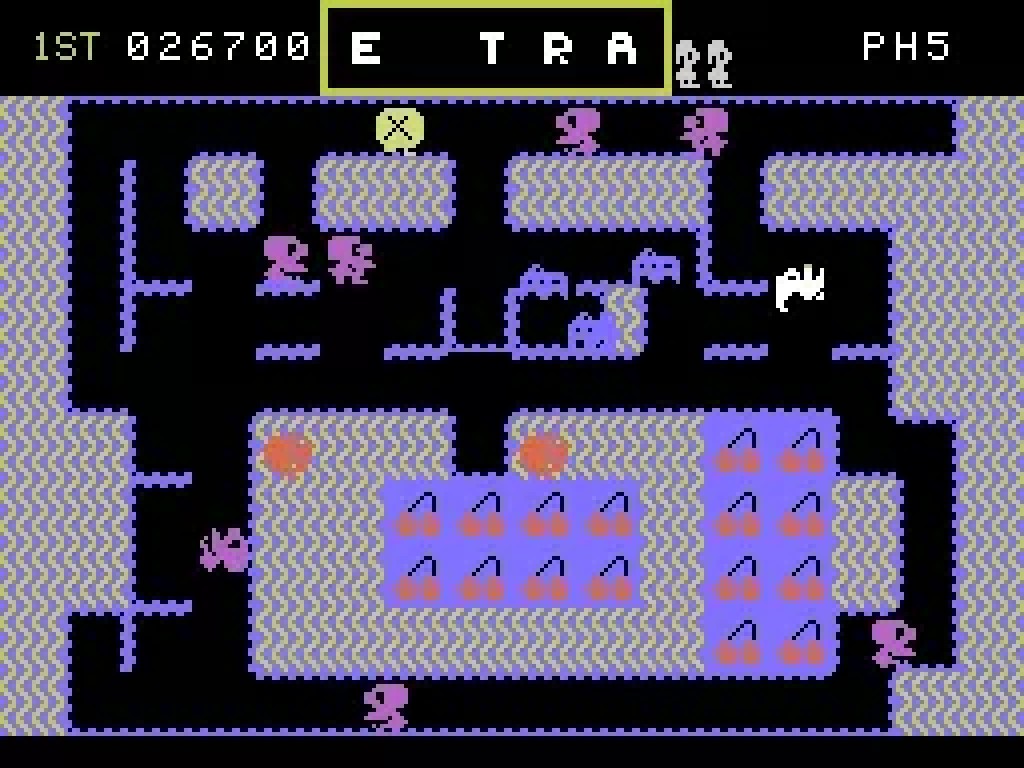
The ColecoVision version understands the assignment. The digging is smooth, the cherry fields are the arcade’s colours, the bad guys — the red Badguys and their meaner digger variants — behave as they should, and the apples wobble with the correct menace. The intermission scenes between scenes — the little cartoon tallies of your progress — give the game its music-hall rhythm. Most importantly, the pace is right: early levels are a tutorial in tunnel craft, and by the fifth field the game is demanding genuine strategy about which cherries to take first and where your escape shafts need to be.
Playing the clown at home
The pad copes well because Mr. Do! is a four-direction game with commitment: once digging, you move at full speed through earth and slightly faster through open tunnel, and the skill is in the planning, not the twitch. The fire button throws the ball, and learning its bounce geometry — it follows tunnels faithfully, turning corners like a bloodhound — is the difference between defence and decoration. One period-authentic frustration survives intact: the ball’s regeneration pause after a kill or a miss, during which the game becomes pure evasion. It is not a flaw. It is the heartbeat.
Scoring depth is where the cartridge earns its keep for months. Cherry chains, apple kills at increasing combo value, diamonds, letter monsters, the end-of-level calculations — a good Mr. Do! score is a portfolio. The game also deals fairly: extra lives are earned through the letter system rather than handed out at round numbers, and the difficulty curve, while steep, never cheats the player out of information. Everything that kills you was visible, wobbling, or digging towards you in plain sight.
The home version that mattered
Mr. Do! reached several home systems, but the ColecoVision version was the reference port — the one that looked right, played right and kept the structure whole, arriving while the arcade game was still a living presence in arcades and chip shops. For the console’s library it added something unique: neither a maze chase nor a shooter, but a digging game with a physics toy at its centre. Shelved beside Lady Bug, its Universal stablemate, it shows how strong Coleco’s relationship with the second-tier arcade makers really was. The famous licences sold the machine; games like this are why owners kept it plugged in.
What the ColecoVision version does differently
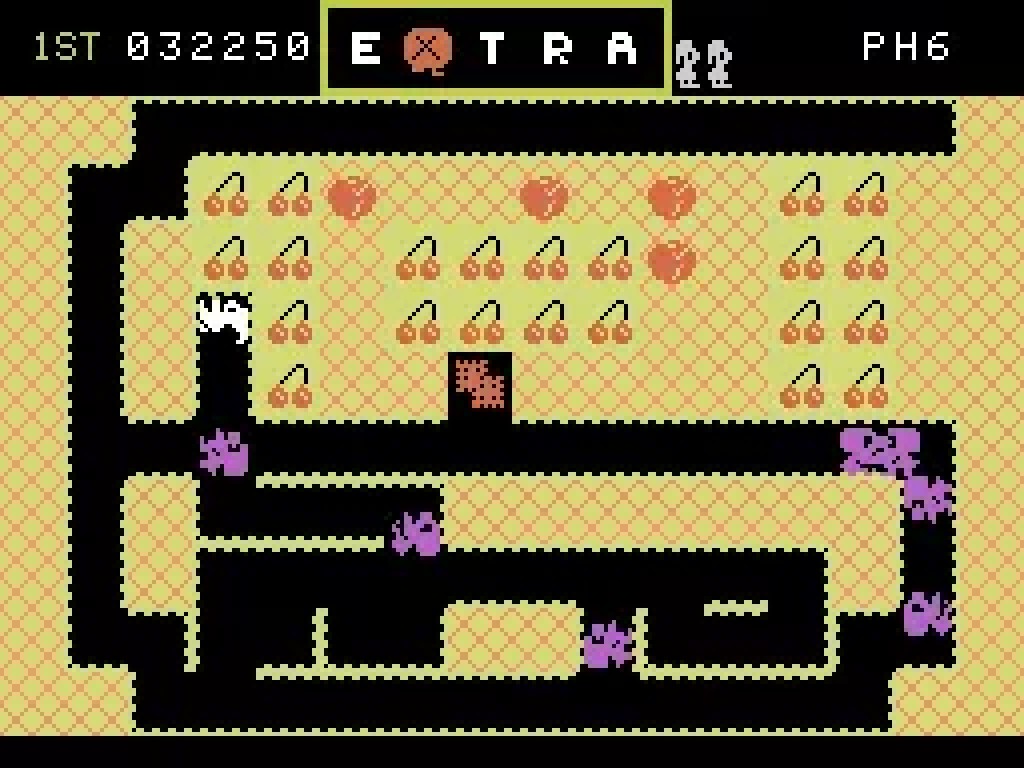
Version-spotters will enjoy the local details, which the ColecoVision edition’s own manual documents proudly. The Alphamonster system works to its own rules here — the letter monsters and their escorts behave with small, learnable differences from the coin-op, including how the blue digger monsters interact with the orchard’s scenery and cherries — and the skill selection is broader than most home versions offered, running to eight game options across one- and two-player games, with the upper settings explicitly pitched at and beyond arcade difficulty. The phases themselves, as the screenshots on this page show, wear a different colour scheme per level — green, purple, grey, pink, gold — with the EXTRA register displayed permanently at the top of the screen, so your long campaign towards the extra life is always in view. It is a version with its own identity, made by people who expected it to be played for months. It was.
The orchard after hours
Longevity is the final test of any arcade conversion, and Mr. Do! passes it in a way few 1983 cartridges do, because its challenge is systemic rather than memorised. The fields are fixed, yes, but the monsters’ behaviour, the ball’s bounces and the apples’ physics produce unscripted situations indefinitely — every phase is the same orchard and a different emergency. Two-player alternating games turn it into a rivalry with a memory, the EXTRA chase gives a single session a narrative arc, and the diamond — rare, sudden, worth a fortune — keeps even a mastered phase electrically alive. Coleco’s library is thick with very good games. Mr. Do! is the one its owners, polled across forty years, most consistently describe with the word “perfect” — and on this evidence, the orchard earned it.
For collectors and first-time diggers
The Mr. Do! cartridge is common — it sold as a star should — and its manual, with its cast list of Badguys, Diggers and Chompers and its cheerful instruction to “mow a path to the cherries”, is one of the system’s most charming documents, worth the small premium a complete copy commands. New diggers should take the manual’s other advice and begin on the opening skill settings, where the orchard teaches ball control and apple geometry at a pace a human can absorb; the game’s famous difficulty is a staircase, not a wall, and its upper settings were designed for players with months in the tunnels. Everyone, meanwhile, should play at least one session with the sound up and the lights low: the orchard’s jingles, the ball’s return, the wobble of a loosened apple — it is the sound of 1983 at its most confident, and it has not dated a day.
The verdict
Mr. Do! on ColecoVision is an arcade masterpiece in a faithful, generous conversion: dig, lure, drop, spell, survive. It belongs in the first rank of the system’s library and in any serious conversation about the best games of its year, on any platform.
Score: 9.0/10 — Digging’s finest hour, apples included, converted with love.