At a glance: Smurf: Rescue in Gargamel’s Castle · ColecoVision · Coleco, 1982 · Platform adventure · Score: 7.5/10
Not every launch-window cartridge needs to be an arcade conversion, and Smurf: Rescue in Gargamel’s Castle was the ColecoVision’s proof. Built on the licence every child in 1982 already loved, it casts you as a lone Smurf crossing the countryside — village, fields, forest, cave and finally Gargamel’s castle — to rescue Smurfette from the wizard’s clutches. There are no guns, no scores built on destruction, and barely any enemies that fight back. There are fences. So many fences. And the small matter of one of the most famous difficulty settings in early console history.
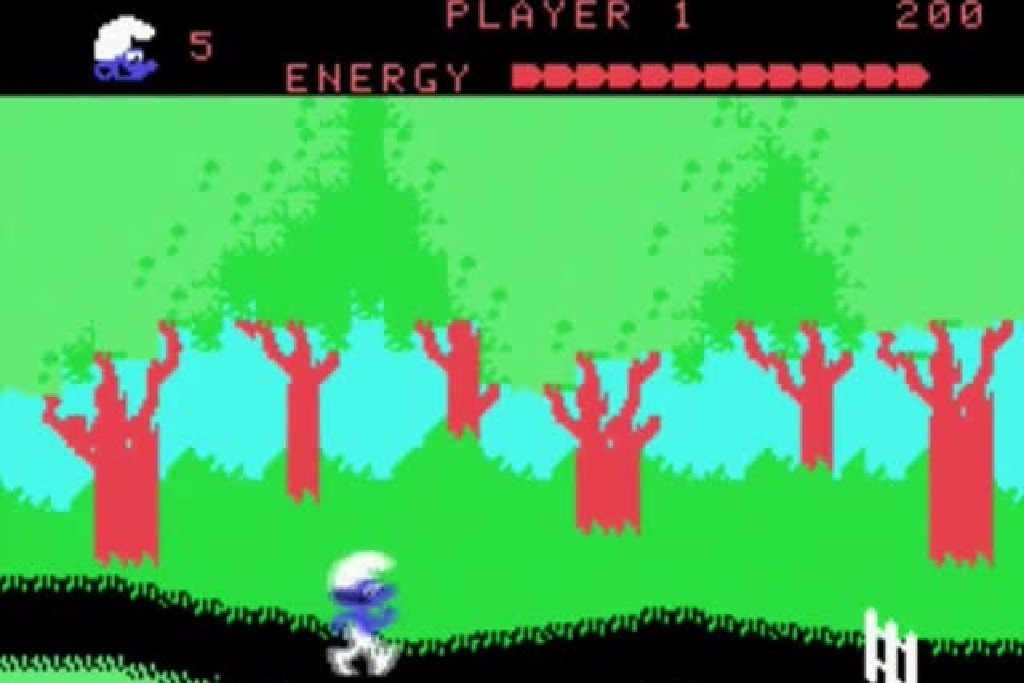
The game is a side-scrolling journey in single screens: walk right, screen by screen, from the Smurf village to the castle. Your Smurf can duck and can jump in two heights, and the world is a gentle obstacle course of fences, gates, streams, hedgehogs, spiders, snakes and birds. Touch anything hazardous and the Smurf sits down, thoroughly flattened in spirit, while the game sighs. Reach the castle, climb to Smurfette’s window, and the rescue is complete — then the journey begins again, harder.
The fence problem is the game
Smurf’s notoriety rests on its jumping. On the lower skill levels, the double-height jump clears the endless fences comfortably. On the higher settings — and this is the part everyone who owned it remembers — the timing tightens until hopping a simple fence becomes a precision exercise, with the Smurf’s jump needing to start at the exact right distance. It is the rare children’s game whose challenge is almost entirely in one mechanic, performed hundreds of times. Whether that reads as charming simplicity or magnificent stubbornness depends on your generation, but nobody who played it has forgotten it.

Between fences, the game is a small tour of set pieces: a river to leap, a cave with its own hazards, the castle approach, and Gargamel himself looming in the castle sequence. An energy meter drains steadily as you travel — dawdling is punished, and bonus items along the way top it up — so even a gentle game has a clock in its pocket. The skill levels restructure the journey meaningfully, adding hazards and shortening your margin, which gives the cartridge more longevity than its simplicity suggests.
A cartoon you could play
The presentation was the sensation in 1982. The Smurf is a proper little character sprite, the backgrounds scroll through distinct, colourful scenes — mushroom houses in the village, open country, the dark of the cave, the castle’s gloom — and it all moves with a smoothness that home games rarely managed. The soundtrack is built on a classical-flavoured melody that loops cheerfully through the journey. Set against the black-background arcade ports that filled the launch library, Smurf looked like a cartoon had wandered into a video game, and for the console’s youngest owners it was very often the favourite cartridge in the house.
Honesty about its limits is only fair. By modern standards — and even by the standards of the platformers that arrived within a few years — Smurf is thin: one route, one core action, hazards that repeat, and a rescue that loops rather than concludes. Its audience was never the arcade veteran. It was the family the ColecoVision’s box was also pitched at, and as an early example of a licence treated with care rather than contempt, it deserves its place in the library’s story. The ColecoVision sold itself on arcade quality; Smurf demonstrated the machine could do warmth as well.
Playing it today
Modern players should start on a middle skill level, learn the jump distances screen by screen, and treat the game as what it is: a short, pretty journey game from the moment before platformers found their grammar. It takes minutes to finish a rescue once learned, which makes it an ideal cartridge for younger retro newcomers — and a strangely relaxing one for veterans, right up until a fence on skill level four reminds them who is boss.

The skill levels are four different games
The cartridge’s structure rewards a proper tour of its settings. The opening level is the storybook version: fences are formalities, hazards keep a polite distance, and a first rescue can be completed in a single sitting by a complete beginner — which, for its intended audience of young players in 1982, was exactly the point, and a design generosity few of its contemporaries attempted. Each step up then re-choreographs the same journey: hazards multiply and quicken, the energy allowance tightens its grip on your pace, and the fences — the famous fences — move from scenery to examination. The top setting transforms the game entirely, into a precision platformer where the double jump’s exact take-off distances must be learned screen by screen, like a golfer learning a course. Judged as four games in one cartridge, Smurf’s content offering looks rather different from the “simple children’s game” shorthand it usually receives.
A landmark in licensed games
Smurf also deserves its footnote in licensing history. The early eighties were the era of the cynical licence — famous names pasted onto unrelated templates, sold on recognition alone — and this cartridge is the opposite: a game designed around its property’s actual world, with the village, the forest, Gargamel and the rescue built as the game rather than draped over one. It reviewed well, it sold the console to families the arcade ports did not reach, and it showed a path the industry would take another decade to learn properly. That Coleco, the toy company, understood this instinctively is one of the neater ironies of the period. For collectors, complete copies with their overlays and manuals are the prizes; the loose cartridge, happily, is everywhere, and it still does its gentle work on new players within a minute of the first fence.
For collectors and first-time travellers
The Smurf cartridge remains one of the easiest ColecoVision games to find in any condition you like, from loose-and-loved to boxed-and-bright, and it makes an ideal first cartridge for a newly acquired console precisely because it is gentle on untested hardware sessions and instantly readable on any television. A suggestion for veteran players returning after decades: play it once on the easiest setting, for the journey and the music, exactly as you did when the cartridge was new — then put it on the hardest setting and meet the game your childhood somehow never introduced you to. The distance between those two experiences, inside one small blue cartridge, is the most charming surprise in the system’s library, and it costs nothing but pride at a fence you have cleared a hundred times. Some of those fences, it turns out, were load-bearing.
It is fitting, finally, that the game ends not with an explosion or a score tally but with a reunion at a castle window — a small, sincere payoff that 1982’s arcade conversions rarely attempted. The ColecoVision’s library is remembered for difficulty and spectacle, and rightly; Smurf is the cartridge that remembers the console also sold to people who wanted a story with a happy ending, and wanted to walk there themselves.
The verdict
Smurf: Rescue in Gargamel’s Castle is the ColecoVision’s gentle giant: simple, beautiful for its year, and remembered by everyone who ever owned the console. It will not trouble the system’s best-games lists for depth, but for charm per cartridge it is near the top — fences and all.
Score: 7.5/10 — A little blue stroll with a legendary jump, and charm to spare.