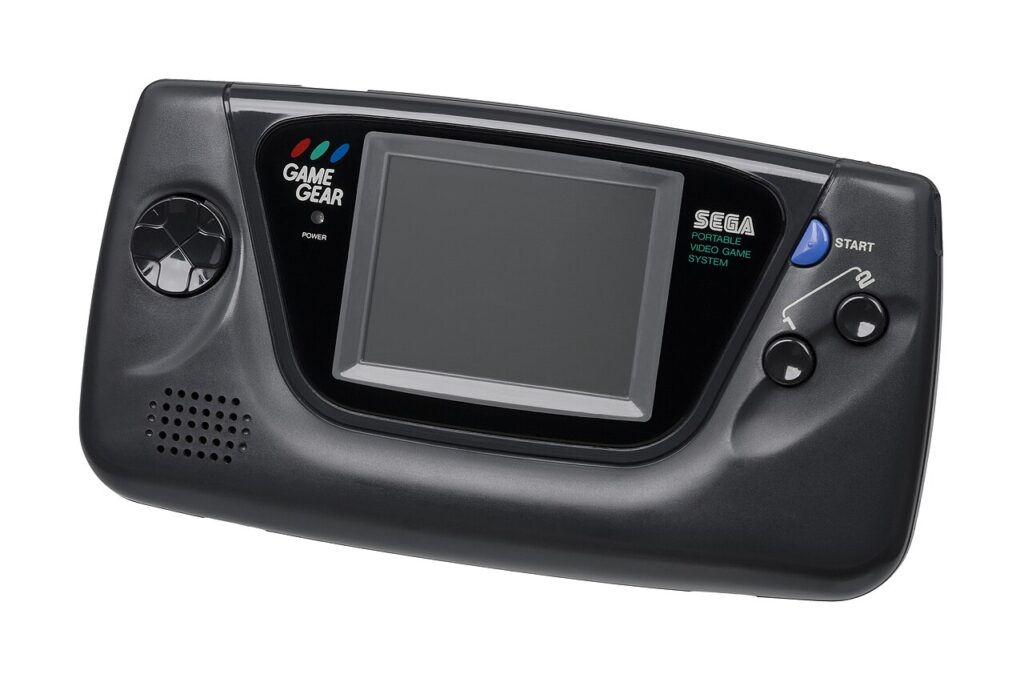
Of all the hardware projects the MSX scene has produced, the GGMSX remains one of the most gloriously improbable: an adapter, announced in 2015, that lets a Sega Game Gear play MSX cartridges. Not emulated, not recompiled — the actual ROM carts from a 1983 Japanese computer standard, slotted into a 1990 color handheld. It sounds like a bar bet. It is actually a family reunion.
Why It Works at All
The secret is genealogy. The Game Gear descends from Sega’s Master System, whose video hardware evolved directly from the TMS9918 family of video chips — the very chip at the heart of the original MSX standard. Both machines are built around the Z80 processor, both speak closely related video languages, and both read their games from cartridges mapped into the same kind of memory space. To an engineer, the Game Gear is not a stranger to the MSX; it is a cousin that moved away and got into television. The GGMSX adapter exploits that kinship, bridging the cartridge formats so MSX1 software can run on the handheld’s screen.
What Plays, What Doesn’t
The scope is honestly drawn: this is an MSX1 device. The first-generation library — the arcade conversions, the early Konami classics, the puzzlers and platformers that defined the standard’s first years — is the hunting ground. Games that lean on the keyboard are an obvious awkward fit on a handheld with two buttons and a D-pad, and anything requiring MSX2’s upgraded video hardware is out of the question entirely. Sound is the other compromise written into the silicon: the MSX sings through a Yamaha AY chip, the Game Gear through Sega’s PSG, and while the adapter can route the experience convincingly, purists will hear the difference in games built around the AY’s particular voice.

The Real Appeal
Nobody pretends the GGMSX is the practical way to play MSX games — the standard’s own hardware is plentiful, and emulation is flawless and free. The adapter’s appeal is the same one that powers the whole retro hardware scene: the pleasure of an impossible object that works. An MSX library, much of it never released outside Japan and Europe, suddenly becomes portable on period Sega hardware with a glowing color screen. For collectors who own both machines, it collapses two shelves into one experiment; for everyone else, it is a reminder that the 8-bit era’s machines were far closer relatives than the marketing of the time ever admitted.
A Curiosity That Proves a Point
The GGMSX never became a mainstream accessory, and it was never going to — it is a small-run piece of scene engineering for an audience of enthusiasts. But it deserves its footnote. In an age when compatibility is something software grants or withholds, the adapter makes the opposite argument: that the similarities between these old machines are physical, electrical facts, waiting for someone stubborn enough to solder them together. Somebody was. The MSX library on a Game Gear is real, and it is wonderful nonsense of the highest order.
The Family Tree, in Full
It helps to lay the ancestry out. Texas Instruments’ TMS9918 video chip powered a generation: the TI-99/4A, the ColecoVision, Sega’s SG-1000 — and, in evolved form, the MSX standard, which paired it with the Z80 and a Microsoft BASIC. Sega kept refining the design through the Master System, whose VDP added the colors and scrolling the earlier chip lacked, and the Game Gear inherited that video hardware nearly intact. So when an MSX cartridge wakes up inside a Game Gear, the screen it draws on is a direct descendant of the screen it was written for — three hardware generations removed, but family. Engineers in the scene had remarked on the kinship for years. The GGMSX’s maker simply decided to see how far it went.
An Adapter’s Honest Compromises
Adapters are arguments made physical, and every argument has its terms. The GGMSX’s are these: MSX1 software only, so the standard’s second-generation exclusives stay home. Games designed around a full keyboard — and the MSX, being a computer, has plenty — play awkwardly or not at all. The sound chips are cousins, not twins, so the music arrives translated rather than intact. And the Game Gear’s screen, while gloriously backlit, shows the MSX’s picture at the handheld’s own resolution rather than the television’s. None of that dents the achievement. Compatibility projects are never about perfection; they are about demonstrating that the wall between two platforms was always thinner than it looked.
The Scene That Builds Such Things
The adapter also says something about who builds MSX hardware now. The commercial industry left the standard decades ago; what replaced it is a distributed workshop of enthusiasts — in Japan, Spain, the Netherlands, Brazil and beyond — who design cartridge hardware, disk replacements, sound expansions and video upgrades for a machine the market declared finished. Their projects share a philosophy the GGMSX wears openly: the hardware is the hobby. Anyone can download an emulator; it takes a particular kind of devotion to design a board, source the parts, and make a Sega handheld run Japanese computer cartridges because the family tree says it should be possible.
That devotion is why the MSX remains, forty years on, one of the most interesting platforms to follow. Consoles get nostalgia products; the MSX gets engineering. Somewhere in that ecosystem there will always be a project as cheerfully unreasonable as a Game Gear running MSX carts — and a small crowd of people ready to explain, at length and with diagrams, exactly why it had to exist. The GGMSX is their kind of artifact: impractical, educational, and quietly delightful. If retro hardware has a folk-art tradition, this is it.
And if you ever see one demonstrated — a Game Gear on a table, MSX cartridge standing proud of its slot, a 1984 arcade conversion running on the little color screen — do not walk past. That is the 8-bit era’s whole story in a single object: rival machines, shared blood, and somebody who refused to let the story end.
What It Takes to Build One
Consider the engineering honestly for a moment. The adapter must present the Game Gear’s cartridge slot with signals translated into MSX expectations — address lines, memory mapping, the cartridge select logic that differs just enough between the two formats to matter — while physically accepting a cartridge designed for a slot with different dimensions and pin spacing. It must do this passively, reliably, at 1980s voltages, without cooking either machine. Projects like this fail in a dozen invisible ways before they work once, and the ones that reach demonstration have usually consumed a year of evenings. That a working adapter was shown at all — running real MSX software on the handheld’s screen — places it in the small class of scene hardware that graduated from forum theory to physical fact. The MSX and the Game Gear were never meant to meet. The GGMSX introduced them anyway, and the family resemblance did the rest.
Verdict, then, from the vantage point of a decade later: the GGMSX was never about convenience, and judging it by convenience misses it entirely. It is a demonstration — that the 8-bit world’s bloodlines run where the genealogy says they run, that a cartridge is a conversation between two pieces of hardware, and that some conversations suppressed by competing manufacturers in 1985 could still be held, fluently, thirty years later by hobbyists with soldering irons. As a way to play Penguin Adventure on the bus, it is absurd. As a piece of living technical history, it is close to perfect.