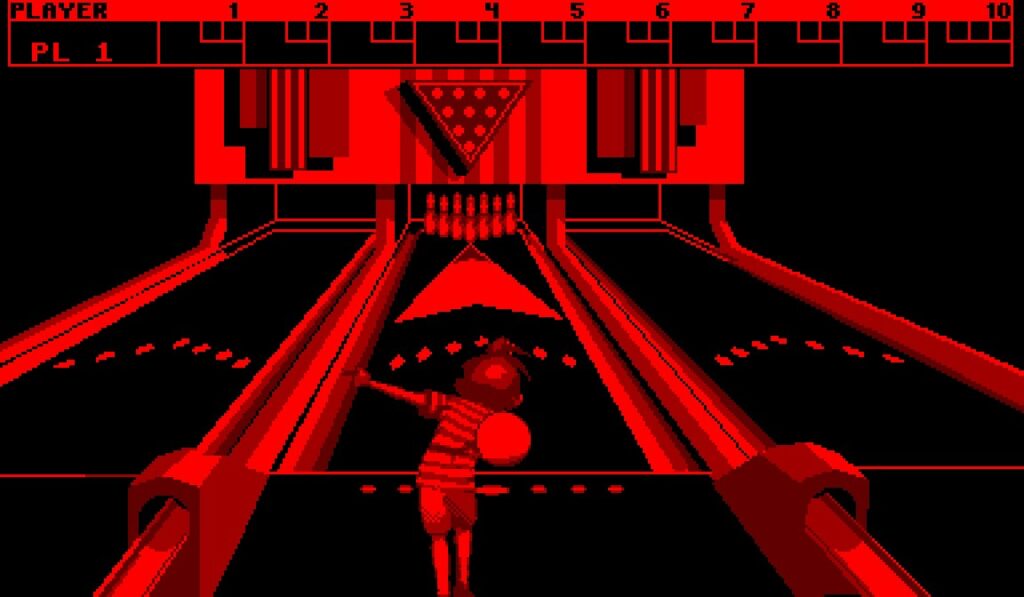
Nester was Nintendo Power’s comic-strip mascot — the cocky kid of the Howard & Nester strips, a piece of magazine furniture for a generation of readers — and in 1996 he received his one starring role, in a Virtual Boy bowling game developed by Seta and published by Nintendo as the system’s life was ending. Nester’s Funky Bowling is a better game than that biography suggests. It is a compact, likeable bowling sim with honest physics, a genuine sense of humour and the misfortune of arriving at a console’s funeral.

The bowling itself is done properly. You choose a ball by weight, position your stance, and throw with a metered system governing direction, power and spin — and spin matters, because the lane is a physical place with oil patterns the game actually models in its simple way. The stereoscopic view down the lane is the system’s one great bowling trick: you watch your ball travel the full sixty feet in genuine depth, see the hook bite, and read the pin action as it happens in front of and behind the pocket. It is the rare Virtual Boy effect you would miss if it were removed.
Funky by name
The ‘funky’ is a mode and an attitude. Funky Bowling proper adds gutter bumpers angled to chaos — no gutter balls, wild bounces, pin action like a pinball table — and it is the game’s best party trick, turning a straight sim into something closer to bowling crossed with pachinko. The standard modes are complete: practice, a tournament against computer bowlers, and the essential two-player alternating play on one machine, one of the few genuinely social experiences in the whole Virtual Boy library, pass-the-headset and all.
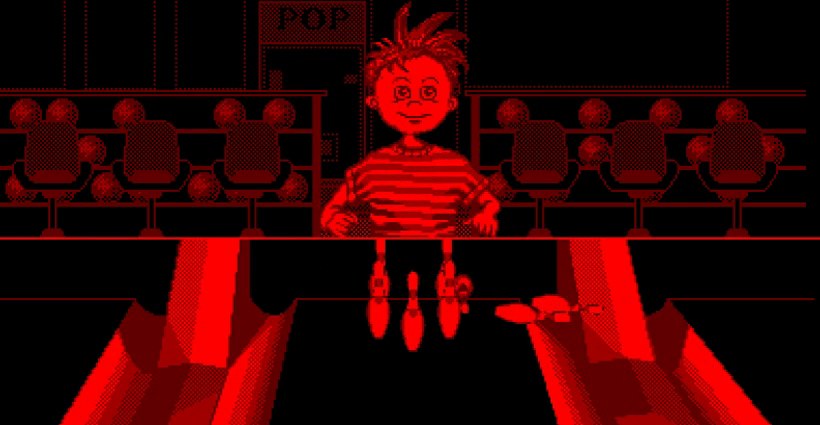
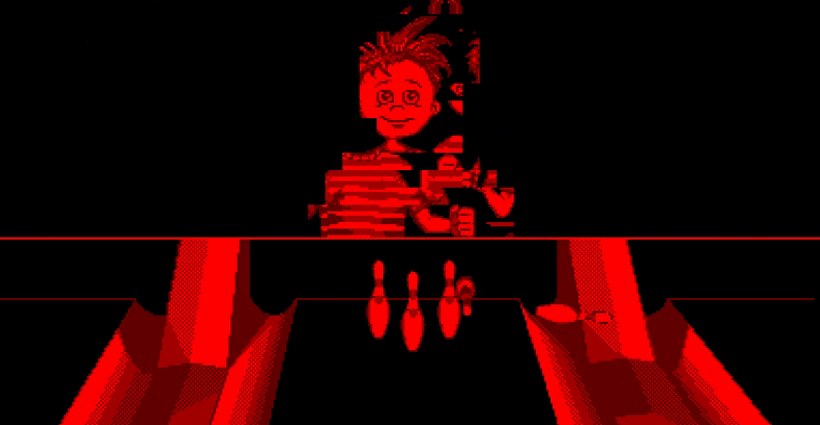
Nester himself is present throughout, needling and celebrating, joined by his sister Hester in the game’s small cast. The character work is charming in the magazine’s spirit — this is a game that knows its star is a brat and loves him for it. Presentation is clean and readable, the pins have real presence at the end of that long red lane, and the sound design gives the ball a satisfying rumble-and-crack that sells every strike.
Short frames
The limitations are scale and variety. There is one lane environment, a small roster, and once you have mastered the meter — a matter of hours, not weeks — the computer opposition stops asking hard questions. Bowling games live on feel, and the feel here is good, but the shelf life is measured in evenings. Nor does the game push its hardware beyond the lane view: menus and interludes are flat and plain, and the whole production has the economical air of a title finished as its platform’s budget vanished, because it was.
Context, though, is kind. Nester’s Funky Bowling was one of the last North American Virtual Boy releases, in February 1996, and it represents the library’s second wave at its modest best: focused, characterful, content to do one thing well. It also remains a small monument to a media era — a magazine mascot, from a comics page, headlining a console game, a pipeline between print and cartridge that today’s Nintendo would never build.
A mascot out of print
Nester deserves his footnote in Nintendo history. Created for Nintendo Power’s Howard & Nester comic — the strip that taught a generation of American children how to think about game secrets — he was the magazine’s id: boastful, shortcut-obsessed, forever certain he could beat any game and occasionally right. By 1996 the strip was gone, but Nester remained a piece of Nintendo of America’s own mythology, which is what makes this game fascinating as an artefact: it is a first-party mascot platform built from a magazine character, a piece of transmedia from before the word existed, starring in a bowling game because bowling was the game Seta brought to the table. His sister Hester, introduced as his rival bowler, exists only in this game’s little world. The whole production is a time capsule from the moment Nintendo’s American publishing arm could still make decisions this charmingly strange.
The bowling engine underneath the mascot work is Seta’s, and Seta knew the genre — the company had bowling form on other platforms, and the physics model here is theirs at its most considered: ball weight changes the roll’s character, the spin window rewards precision rather than punishing deviation, and the pins behave with a consistency that lets good players build real technique. There is a competitive structure with a point to it and opponents who improve. Strip Nester’s face off the box and the game still stands; that is more than most mascot vehicles of 1996 could claim.
The social Virtual Boy
The two-player alternating mode deserves emphasis, because sociability is the rarest commodity in the Virtual Boy library. The machine was a single-player object by construction — one visor, one viewer — and almost its entire catalogue accepts that solitude completely. Nester’s Funky Bowling is built around defying it: one headset, passed back and forth, frames alternating, the drama of a bowling night compressed into a red lane and a running argument. In the Blockbuster rental era, this was one of the few Virtual Boy games that made sense at a gathering. Played today, in emulation or on hardware, it remains the library’s best argument that the machine’s isolation was a choice its catalogue made, not a law its hardware imposed.
It is also, not coincidentally, one of the games that benefits most from modern play options. Bowling is a score-and-technique game; save states, instant restarts and the comfort of a modern headset dissolve the original’s session friction and leave the physics and the funk. As a late, slight, charming release, it is the library in microcosm: better than its reputation, stranger than its genre, gone before it started.
It is worth recording, too, how completely Nester’s Funky Bowling has been rehabilitated by time. In 1996 it was a punchline’s punchline — a mascot nobody outside magazine subscribers recognised, in a bowling game, on a dying console. In the decades since, the Nintendo Power generation grew up, the magazine became a sacred text of American gaming childhood, and Nester became a genuinely beloved ghost. The game did not change at all; the culture caught up with it. Judged now, on its physics and its funk rather than its timing, it is exactly what this review has called it: a good bowling game with a great mascot, arriving thirty years early to its own appreciation.
Set beside its Athena-built counterpart on the same shelf, Nester’s also clarifies what ‘funky’ was buying: accessibility as a design value. Everything in Seta’s game is tuned to get a first-time player striking within the hour — the meters are readable, the physics forgiving at the edges, the mascot cheering the learning curve along. In a library full of games that assume commitment, that hospitality is a genuine distinction, and it is why this slight, late, half-forgotten bowling game keeps being the one handed to Virtual Boy newcomers. It asks nothing and gives an evening. Not every classic can say as much.
Verdict
A good bowling game with one great trick, wearing a beloved mascot’s face. Nester’s Funky Bowling is thin but honest fun, and its lane view is a miniature lesson in what the Virtual Boy was for.
Nester’s Funky Bowling — 6.5/10. Real physics, real charm, not much of either to spare. The library’s friendliest game, and its best argument for pass-and-play.