
Waterworld arrived on the Virtual Boy carrying two reputations, neither earned by the game itself. Its parent film was 1995’s favourite symbol of Hollywood excess, and the game — developed by Data Design Interactive and published by Ocean late that year, in North America only — became the Virtual Boy title collectors would one day pay the most to own, simply because almost nobody bought it at the time. Scarcity, however, is not a game design. What is actually on the cartridge is a thin, repetitive arena shooter wrapped around a film it has little to say about, and the honest review must start there.

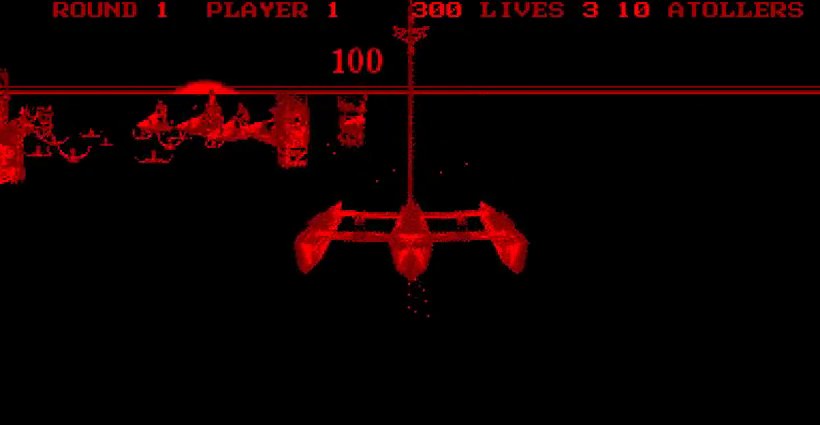
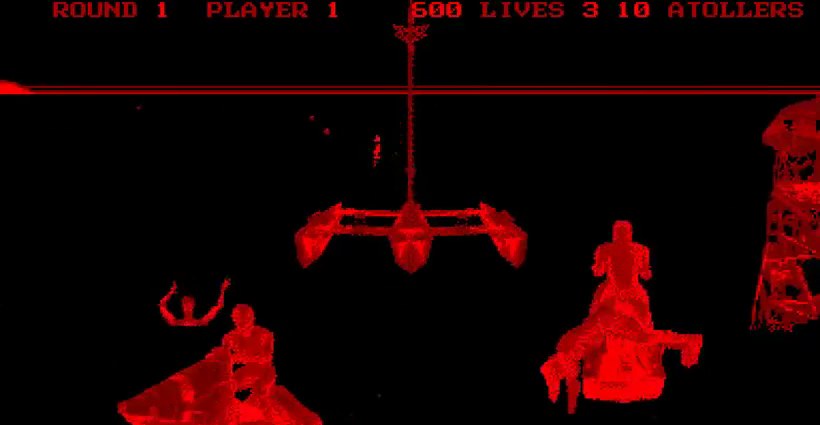
You are the Mariner, alone on a jet ski, defending an atoll of floating survivors from waves of Smokers — the film’s petrol-worshipping raiders — who approach in boats and on jet skis of their own. The view is from behind and above your craft, the sea a black plane, the enemies red sprites that grow as they close. Shoot them before they reach the atoll, rescue survivors they dislodge, repeat. There is a between-level shop for upgrades, and there are bonus diversions, and that — across a campaign that recycles its single idea — is substantially the whole of it.
One idea, no depth
The damning thing is how little the game uses its machine. This is a title built around distance — enemies approaching across open water — on the one console that could render distance natively, and the stereoscopy is little more than a backdrop treatment. The playfield could be, and in feel essentially is, a flat shooter with scaling sprites; nothing in the design needs the second screen, the mirrors or your left eye. Movement is loose, aiming is approximate, and the waves differentiate themselves mainly by arithmetic: more Smokers, faster Smokers, Smokers again.
Presentation compounds the monotony. The sprites are small and characterless, the sea offers nothing to look at between attacks, and the soundtrack — the one element with genuine reputation among enthusiasts, a moody synth score better than its game — plays over action that never rises to meet it. Difficulty comes from attrition and numbers rather than design, and the upgrade shop, the game’s one structural idea, mostly sells you the firepower the later waves assume you already have.
In defence, briefly
Fairness demands the small print. Waterworld is not broken: it controls adequately, its frame rate holds, and in five-minute bursts — one wave, one shop visit — it has the dumb momentum of a fairground rifle range. As a period artefact it is fascinating: a full-price licence game for a dying platform, released into a market that had already left, from a film that had already become a punchline. And its music genuinely deserves the afterlife it has found among chiptune listeners. But a review is not an auction listing, and judged as a game to be played in 2026 rather than shelved, it is the weakest full-price experience in the North American library.
Its collectibility deserves one clear sentence: Waterworld is valuable because it is rare, and it is rare because it sold terribly, and it sold terribly because the Virtual Boy was dying and the game gave nobody a reason to save it. None of that is an argument about quality in either direction. The argument about quality is on the screen, in the waves, and it does not take long to make.
Ocean, Data Design and the licence economy
To understand how this game happened, remember the 1995 licence economy. Ocean Software had built an empire on film tie-ins, and Waterworld the film — whatever its production troubles, it was a major summer release with a merchandising programme to match — was licensed across every platform that would take it. The Virtual Boy version was farmed to Data Design Interactive, a studio with a long CV of workmanlike ports, and the result bears the marks of the arrangement throughout: the film’s iconography is present (the Mariner, the Smokers, the atoll, the jet ski), its story is essentially absent, and the game design is a single arena loop stretched across a full-price cartridge. Other platforms received racers, platformers and adventures from the same licence. The Virtual Boy, the smallest market of them all, received the smallest idea.
Even the structure tells the story of a production in a hurry. The waves escalate by quantity rather than invention; the bonus elements arrive and vanish without development; the upgrade economy, the one system with promise, is balanced so loosely that it functions as a difficulty dial the player turns rather than a strategy they make. None of this is incompetence — the fundamentals all work, collisions are honest, the frame rate is stable — it is absence. Absence of time, of budget, of any reason for anyone in the chain to demand more from a cartridge for a console that was visibly ending.
The soundtrack that escaped
The one department that demanded more was the music. Waterworld’s score — composed within Data Design’s audio orbit in the British chiptune tradition — is moody, melodic work that has been repeatedly singled out by Virtual Boy enthusiasts as among the system’s best, an judgement this review endorses without hesitation. It plays, throughout, like the soundtrack to a more atmospheric game: minor-key, ocean-going, faintly mournful. Listening to it while the Smokers trundle in for the ninth identical wave produces the game’s defining sensation — the feeling of a better Waterworld existing somewhere just out of reach, in the music’s imagination if nowhere else.
And so the verdict writes itself, with the respect due to a game whose failures are all institutional. Individual craftspeople did good work on Waterworld; the soundtrack proves it. What the cartridge lacks is a game design equal to its licence, its hardware or its price, in 1995 or now. The collectors who pay fortunes for it are buying the story — the flop film, the dying console, the tiny print run — and the story, at least, is genuinely priceless. The game is what it is: a footnote with excellent music.
A mercy, to finish: Waterworld is short. Its campaign does not outstay even the welcome it never quite earned, and a determined player can see everything it contains — every wave, every upgrade, the whole red ocean — in a couple of sittings. For the completionist collector, that brevity is the game’s one unambiguous gift: the library’s most expensive cartridge is also its quickest to finish honestly. Play it once, for the story and the soundtrack, and then return it to the shelf where its value lives. The waves will not notice. They never did anything else.
Played today in a single sitting — the recommended dose — it even acquires a kind of documentary charm: this is what the licence industry did to dying platforms, preserved in red aspic. As a game it fails. As evidence, it is Exhibit A.
Verdict
Not the disaster of legend — disasters are at least memorable — but a thin, repetitive shooter that ignores everything interesting about its hardware. The library’s most expensive game is, as a game, close to its least essential.
Waterworld — 4.5/10. A fairground shooter in licence-game clothing, saved from the bottom by a fine soundtrack and sheer historical oddity.