Of all the revival announcements that drifted across retro gaming in the first days of January 2019, one of the strangest concerned a machine most players had filed away as a punchline a quarter of a century earlier. A homebrew developer working under the name Gameblabla had a new title in the works for the Philips CD-i — yes, that CD-i, the multimedia box forever associated with ill-fated Nintendo spin-offs and hotel-room video — and its name was Super Quartet. It was not a joke, it was not a mock-up, and, as the surviving files would later prove, it was a great deal closer to finished than the words “currently in development” suggested. This is the story of a small puzzle game, the tiny community that made it possible, and what actually became of it.
The Console That Refused Every Easy Label
Compact Disc Interactive arrived at the start of the 1990s carrying ambitions far grander than gaming. Philips, working from the format’s Green Book specification, pitched the CD-i player as a single silver box for the living room that could handle music, films, encyclopaedias, training material and, almost as an afterthought, games. The first consumer model reached North America in December 1991 at a steep price, and the hardware underneath was modest even then: a Motorola 68000-family processor running at 15.5 MHz, a single megabyte of RAM, and an operating system, CD-RTOS, derived from OS-9.
The machine never settled into a clear identity. It excelled at practically nothing a games player wanted, its standard controller was a television remote with ambitions, and its most famous software — Link: The Faces of Evil, Zelda: The Wand of Gamelon and Hotel Mario, produced under a licensing deal born of Nintendo’s abandoned CD partnership with Philips — became bywords for how badly licensed games could go wrong. Philips wound the format down in 1998. By any sensible commercial measure, that should have been the end of the CD-i story. Homebrew, however, has never been a sensible commercial measure.
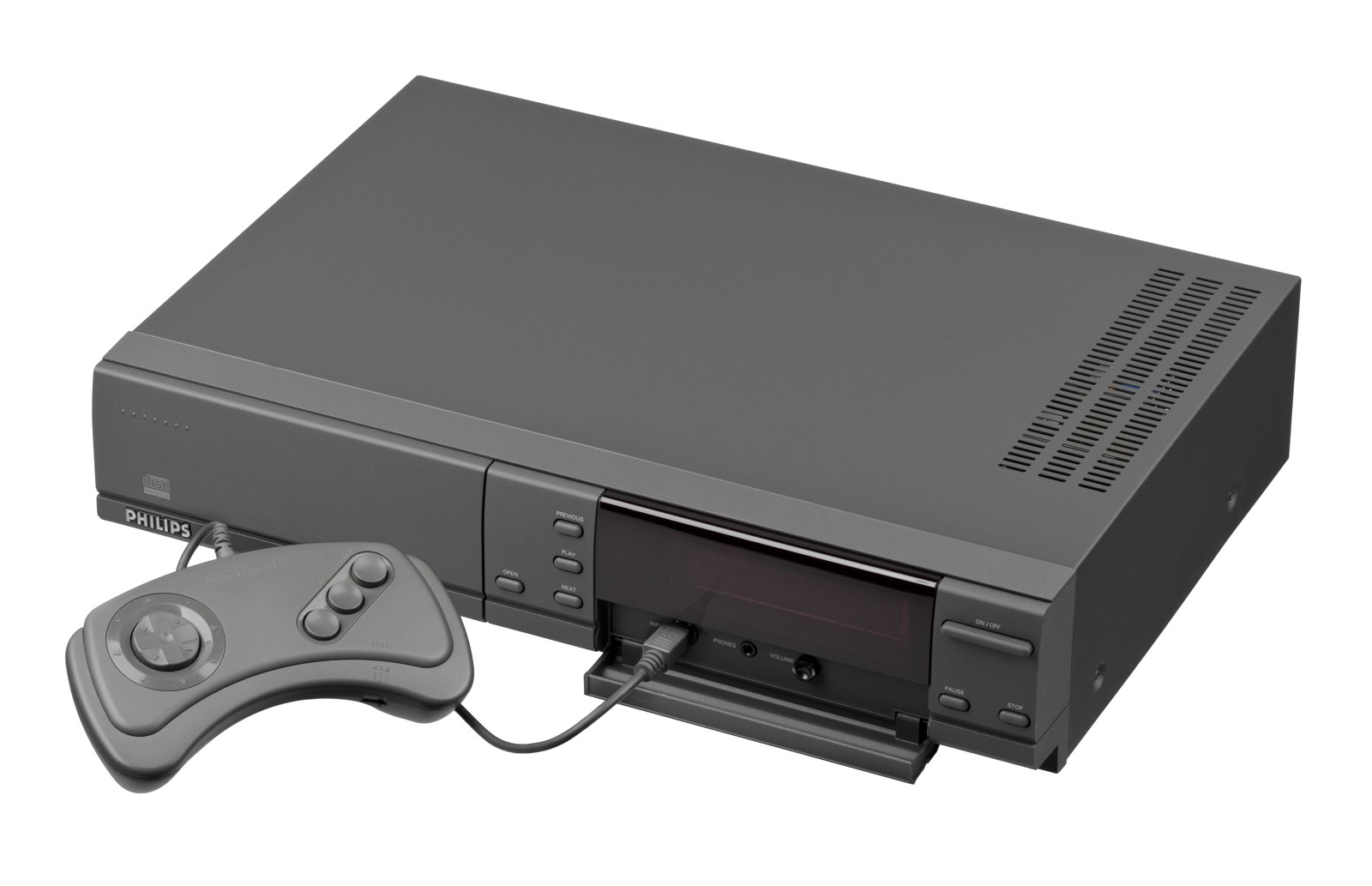
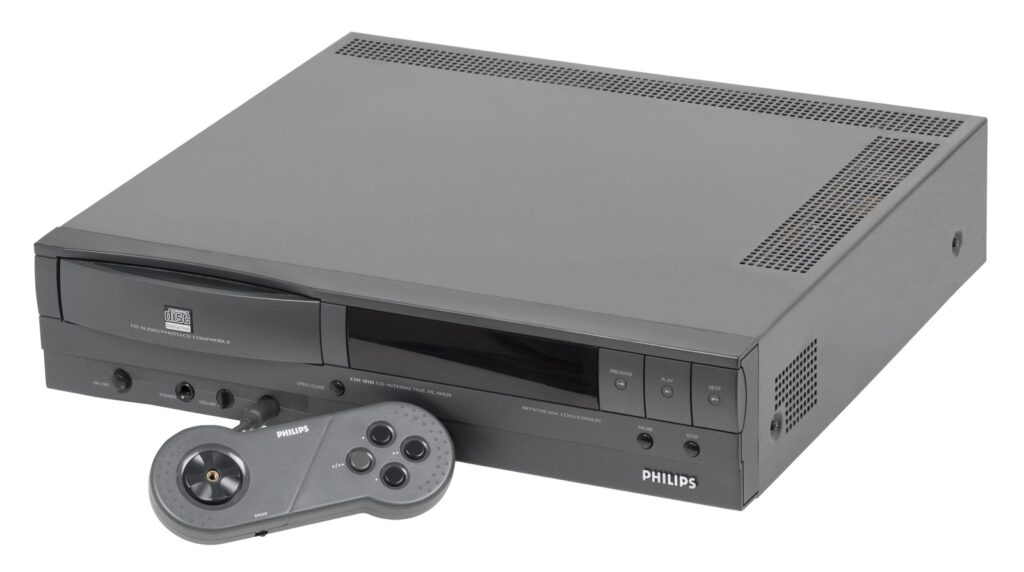
A Philips CD-i 220 player with its game controller — the kind of machine Super Quartet was written to run on, two decades after Philips left the format behind. Photo: Evan-Amos, via Wikimedia Commons.
Four Quarters, Not Four Games
Given the title, the natural guess is that Super Quartet bundled four separate games onto one disc. It did not, and clearing that up matters, because the real explanation is more interesting. Super Quartet is a CD-i port of Gameblabla’s puzzle game Killminds, renamed for its new home. Killminds, in turn, was his take on SupraKillMinds, a fast little puzzler descended from Quartet — so the “quartet” in the name refers not to a compilation but to the number four at the heart of the game’s design.
Play unfolds around quarters of a square. A quarter-piece appears and you must despatch it in one of four directions, into one of four fields, where it settles into the correct corner of that field. Complete a field with four quarters and it clears for points, with the richest rewards for building a gem entirely from pieces of a single colour. The catch is the clock: you have only a couple of seconds to decide each move, the allowance shrinks as your score climbs, and sending a piece into an occupied space costs one of your five lives. It is a think-fast arcade puzzler in the Tetris lineage of ideas — simple to grasp, increasingly frantic, and sensibly chosen for the CD-i, because a single static screen asks nothing of the hardware that the hardware cannot give.
For the port, Gameblabla worked from his older 3DO and NUON source code rather than the PC version of Killminds — fitting, since he had already bundled versions of his games together for the 3DO under the cheerfully self-deprecating title Gameblabla’s Crappy Compilation. The CD-i was simply the next unlikely machine on a list that already included some of the most obscure hardware ever sold.
Built on Borrowed Bones
No CD-i homebrew developer starts from a clean slate, because there is barely a slate to start from. Gameblabla’s own notes for Super Quartet thank two people, and those two names map almost the entire technical foundation of CD-i homebrew. The first is Cdifan, the community’s long-serving low-level expert, whose graphics setup code circulated among the handful of people who ever tried to program the machine. The second is Charles Doty of RasterSoft, credited as “cdoty”, who shared source code from Frog Feast.
Frog Feast is the other fixed point in this history. Doty’s affectionate clone of the 1978 arcade game Frogs — two frogs on lily pads, competing to catch flies with their tongues — first appeared in 2005 for the Neo Geo CD and Sega CD, and reached the CD-i in July 2007 through publisher OlderGames. For years it stood essentially alone as proof that an outsider could get new software running on Philips’ orphaned format at all. That Super Quartet, arriving more than a decade later, still had to be built partly on Frog Feast’s incomplete surviving source tells you everything about the scale of this scene: not an industry, not even really a community of developers, but a relay race in which each runner hands the next a partial map of very hostile territory.
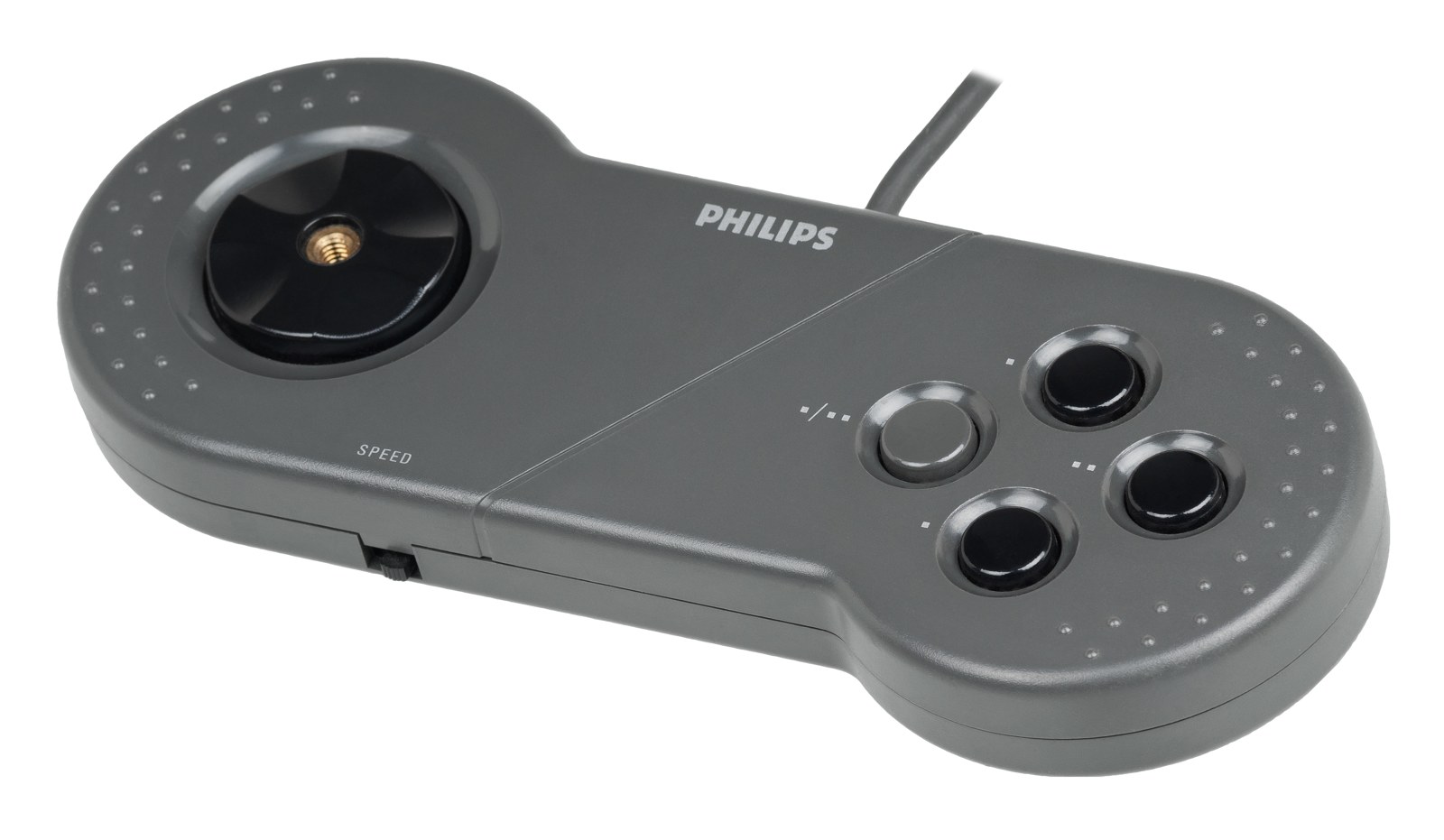
The CD-i gamepad, Philips’ belated concession that a television remote was no way to play games. Super Quartet’s four-direction play was designed with controls like these in mind. Photo: Evan-Amos, via Wikimedia Commons.
Why Would Anyone Program the CD-i?
Gameblabla answered that question himself, a few years later, with disarming honesty: he made Super Quartet “in hopes of reviving interest in the CD-i” — and added, with a smiley, that it sort of succeeded. But his technical writing reveals the deeper attraction, which is the same one that draws programmers to every awkward machine: the CD-i fights back. It offers programmers little more than a framebuffer, where most consoles of its era provided dedicated sprite hardware. Its operating system has to be bypassed as far as possible, not least because routing input through it produces the very lag that plagued so many official CD-i releases. Compatibility between players is a minefield, since Philips licensed the format widely and third-party machines differed in ways that could break features as basic as sampled sound.
There is also a paradoxical kindness to the platform. Philips never built the kind of copy protection or region locking into the CD-i that frustrates homebrew distribution elsewhere, so a finished game on a burned CD-R simply plays. For a certain kind of programmer — the kind who ports his puzzle game to the NUON, the Gizmondo and the TI-Nspire as a matter of principle — a hostile machine with an open door is irresistible. The CD-i was not chosen despite being a failure. It was chosen because conquering a failure is the whole game.
So Was Super Quartet Ever Finished?
Here the record needs care, because the sources disagree in tone. When this site first reported the game in January 2019 it was described, reasonably enough, as currently in development. The World of CD-i’s encyclopedia still catalogues it that way: producer Gameblabla, genre board, one player, publisher and year both listed as “2019 UNDER DEVELOPMENT”, with no cover art and no screenshots on file. An interview on the same site, conducted with the developer TwBurn, likewise describes Super Quartet as made in 2019 but “still under work”, needing its sound and other minor issues solved. Wikipedia’s CD-i article, meanwhile, lists it plainly among the format’s homebrew releases with the year 2018.
The primary evidence explains the confusion. The build Gameblabla distributed from his own website is dated 11 December 2018, and its read-me is explicit: this is a port of Killminds, renamed Super Quartet; “it is playable although there are still some issues with sound effects so they are disabled for now”; and he hoped he could fix it. In other words, Super Quartet was finished enough to ship — a complete, playable game that owners of real CD-i hardware could burn and play — but it shipped in a deliberately compromised state, silent where it should have chirped and beeped, with its author openly treating it as a work in progress.
What the record does not show is the second act. No later, sound-restored final version has surfaced in the catalogues, no physical edition followed, and the trail of updates simply stops, leaving the December 2018 build as the game’s definitive form. The baton, instead, passed on: TwBurn — the very developer interviewed about Super Quartet’s unfinished sound — went on to complete Nobelia, the top-down, bomb-throwing adventure released for CD-i in 2022 to genuine acclaim, helped by a newer GCC toolchain for the machine and by Cdifan’s knowledge, the same well Super Quartet had drawn from. Judged as a product, Super Quartet stalled at “playable, sound pending”. Judged by its author’s own stated goal, it worked: it proved the door was still open, and someone else walked through it.
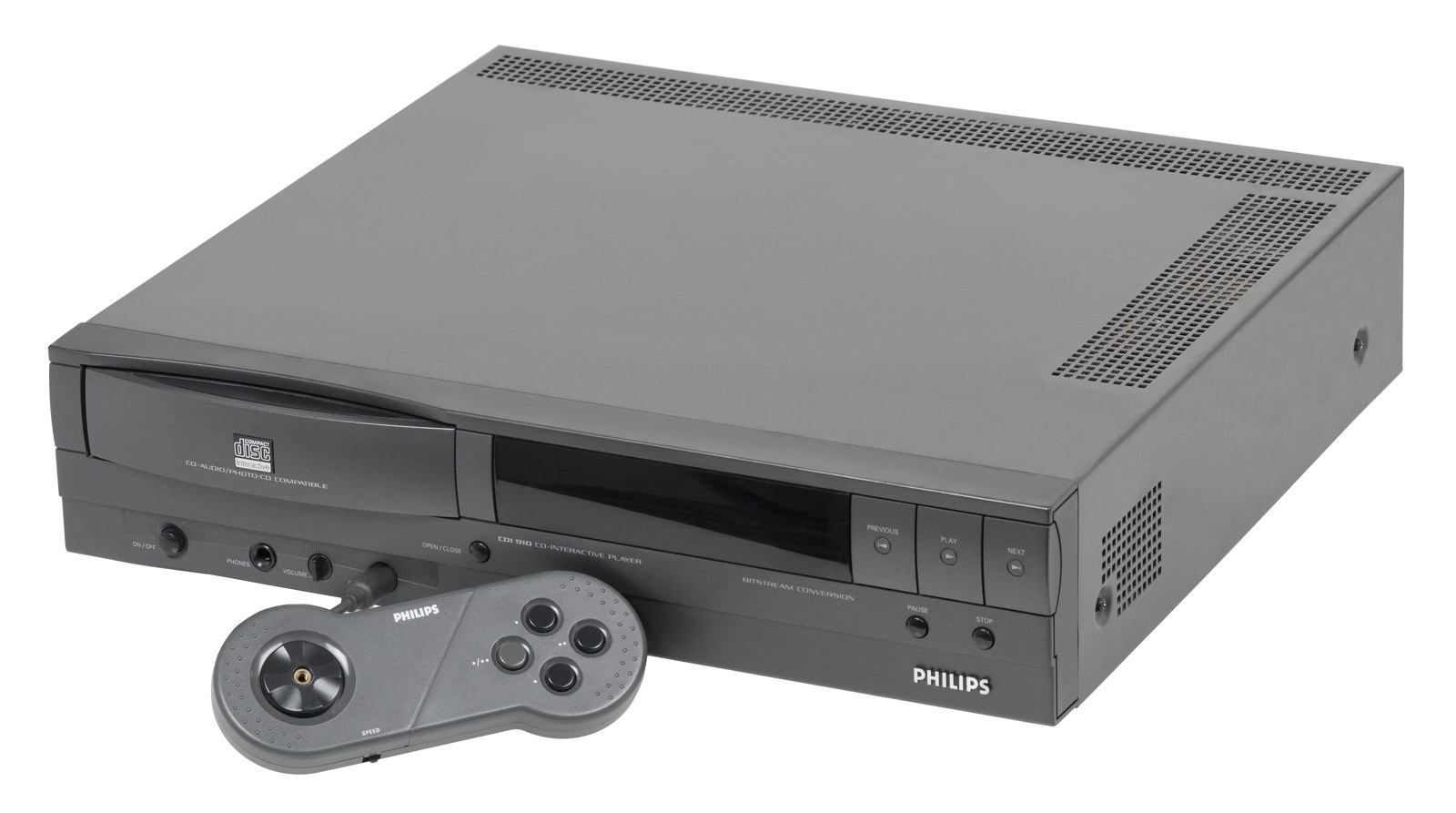
The original Philips CD-i 910, the first consumer player, with its touchpad controller. Machines like this one were still receiving new software twenty years after launch. Photo: Evan-Amos, via Wikimedia Commons.
The Point of a Pointless Console
It is easy to laugh at the CD-i, and the internet has rarely resisted the invitation. But there is something quietly admirable in its afterlife. The Atari 2600, the NES and the Mega Drive attract homebrew because millions remember them fondly; the CD-i attracts it for almost the opposite reason — because almost nobody does, because the documentation is fragmentary, the tools are hand-me-downs and every finished game is a small act of archaeology performed in reverse. Super Quartet will never trouble any list of the format’s essential titles, not least because the format hardly has one. It matters for a different reason: in December 2018, twenty years after Philips gave up on its machine, a lone developer looked at the least fashionable console in history and decided it deserved one more game. Four quarters, one field at a time, he made it whole — nearly. The sound, as far as the record shows, is still pending.