
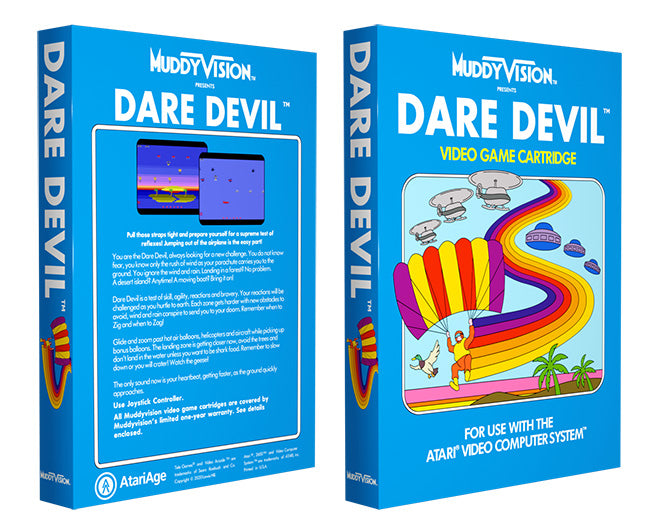
It began as a few late nights over the 2018 holidays — a quick test build of a Parachute tribute for the Atari 2600. Within a year, Lewis Hill’s Dare Devil was a finished cartridge with award nominations to its name; within five, it was on sale in the modern Atari VCS store. This is the homebrew that kept falling upwards.
A holiday experiment that wouldn’t sit still
Some games are planned for months. Dare Devil was more like an accident that refused to stop happening. Lewis Hill — “Muddyfunster” on the AtariAge forums, releasing his games as MuddyVision — had been working on another project, SpaceBank, when, over the 2018 holidays, he knocked together a quick test build: a homage to Parachute, the old 2600 game of guiding a falling parachutist safely down to earth.
The test, in Hill’s own telling, “turned into a few late night coding sessions… and then into a full project.” SpaceBank went on the back burner. A work-in-progress thread opened on the AtariAge forums on December 30, 2018, test ROMs were shared with the community as development rolled on, and this site reported the game as a promising work in progress a few days later. The promise, for once, was kept quickly: Dare Devil was completed during 2019.
That development-in-public rhythm is worth pausing on, because it’s how the modern 2600 scene actually builds its games. A WIP thread is part sketchbook, part focus group and part pit crew — players test builds on real hardware and emulators, report what breaks, and argue about how a game should feel. Dare Devil was shaped in that open air from its first late-night build to its final cartridge.
Mind the balloons, watch the vane
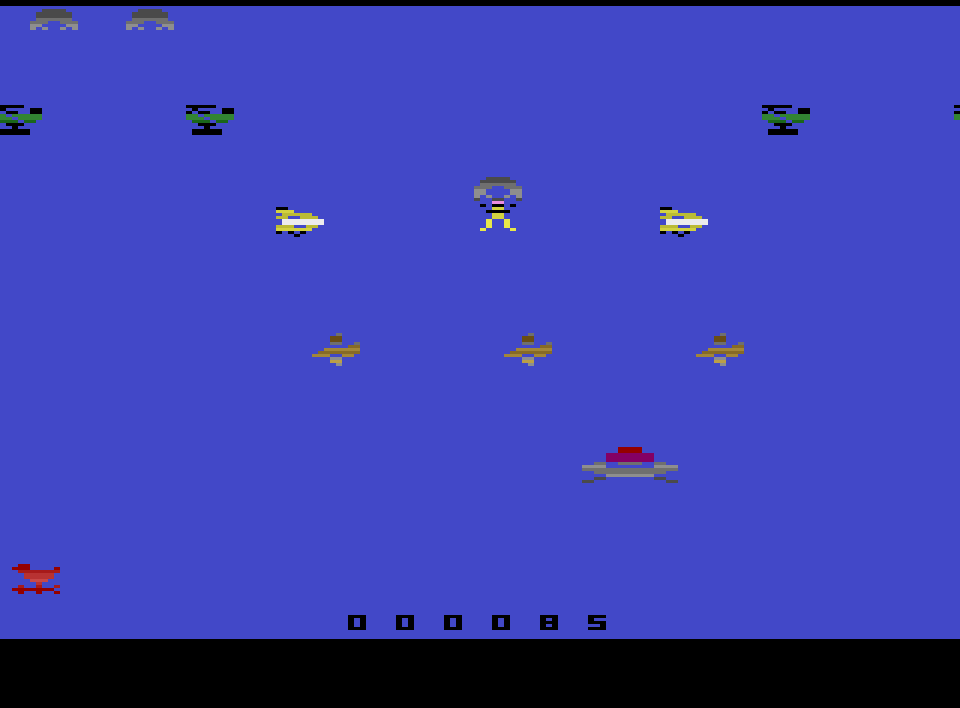
The idea is beautifully simple, and the execution is anything but. You are in free fall, and the sky is busy. Hot air balloons and aeroplanes are hard obstacles, to be dodged at all costs. Birds are softer hazards — they won’t end your run, but they’ll knock you off your flight path, which matters, because where you land is the whole game.
A weather vane at the bottom-left of the screen shows the wind, which is constantly pushing you around on the way down. The target is a landing circle: touch down inside it, gently, for maximum points. Come in too fast and, in the game’s cheerful phrasing, you “splatter.” Eight levels take you through the gauntlet, after which the game loops around and runs faster, and Easy and Hard modes separate the cautious from the committed. It is, in the best 2600 tradition, a thirty-second loop that somehow eats an evening — every descent takes seconds, while the argument with yourself about just one more go takes considerably longer. There is no story mode, no unlock tree, nothing between you and the ground but gravity, wind and nerve.
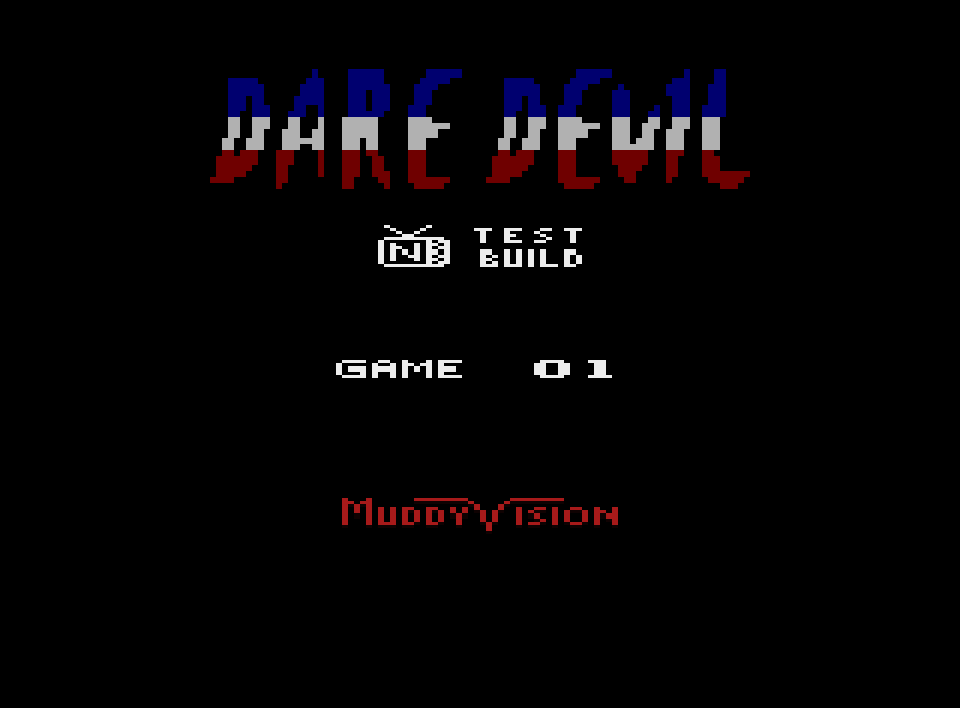

Under the hood, the game is written in batari Basic using the DPC+ kernel — the modern toolchain that lets a programmer work in a high-level language and still produce an arcade-feeling 2600 game. It comes with very modern headaches of its own: the development thread spends real time on Harmony Encore and DPC+ driver compatibility for the ROM builds its readers were testing. And batari Basic was no booby prize of a tool — at the first Atari Awards in early 2019, Space Game took the Best batari Basic Homebrew prize outright, as our history of the Atari Awards records. Dare Devil was built with award-winning instruments; it just had to go and win some recognition with them.
Why it worked
Plenty of homebrew projects die of ambition — scoped for a console that exists in the programmer’s head rather than the one on the desk. Dare Devil survived because its ambitions were aimed in exactly the right direction. The concept fits in one sentence, because it descends from Parachute, a game from the era when one sentence was all a 2600 game got. The depth is all in the execution: the wind you have to read on a tiny vane, the traffic stacked between you and the ground, the difference between a landing that scores and a landing that splatters. Eight levels, two difficulty modes, and a loop that speeds up rather than a game that pads out — it is a design that respects both the hardware and the player’s evening.
There is a lesson in the timeline, too. From first test build to finished game took roughly a year, most of it in public, with the community playing the intermediate builds. The holiday experiment had a finish line short enough to see from the start — and a developer disciplined enough to put his other game down and actually cross it.
Nominations, a cartridge, and a second landing
The finished game arrived with honours. At the 2019 Atari Homebrew Awards, Dare Devil was nominated for Best Homebrew, Best Graphics and Best Music & Sound, credited to “Lewis Hill ‘Muddyfunster’ (MuddyVision).” That is fine company in any year — and it was a particularly fine year to be nominated, since the Music & Sound prize was won by Champ Games’ Wizard of Wor Arcade, another graduate of the same work-in-progress season that this site had been watching since 2018.
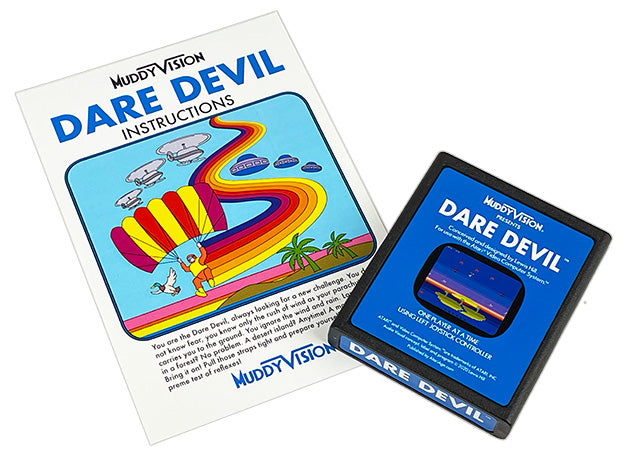
The physical release followed through the AtariAge Store, where the cartridge was listed at $35 on MuddyVision’s store page — manual, box art, the full treatment the scene now expects of its finished games. And then Dare Devil performed its neatest trick of all. On September 8, 2023, it landed on the store of the modern Atari VCS — Atari’s 2021 console — alongside Hill’s Tyre Trax, published by MuddyVision and AtariAge. A game written for a machine from 1977, sold for a machine from 2021, by way of a Christmas coding session in 2018. It has also earned a place in Seth Abramson’s ranked Top 500 Atari 2600 Homebrews list, which is no small shelf for any homebrew to sit on.
The VCS release deserves a beat of its own. AtariAge began as the scene’s archivist and forum; by 2023 it was acting as a publisher, placing its community’s games in front of the modern Atari’s own audience, on hardware sold by the company that started the whole story in 1977. Dare Devil arriving there — next to its stablemate Tyre Trax, with MuddyVision sharing the publisher credit — is the homebrew ecosystem working exactly as its founders would have hoped: make the game, prove it on cartridge, and the doors keep opening. Ranked lists like Abramson’s Top 500 serve as the scene’s long memory; a storefront like the VCS is its shop window. Dare Devil, improbably, ended up in both.
Closing
The Atari 2600 homebrew scene is full of grand announcements that quietly evaporate; this site’s archive is a graveyard of them. Dare Devil is the opposite story — a holiday doodle that kept picking up speed until it hit the ground running: on cartridge, at the awards, and finally on Atari’s own modern hardware. If you want to know what the scene does at its very best, watch where this one landed — and how far it travelled to get there.