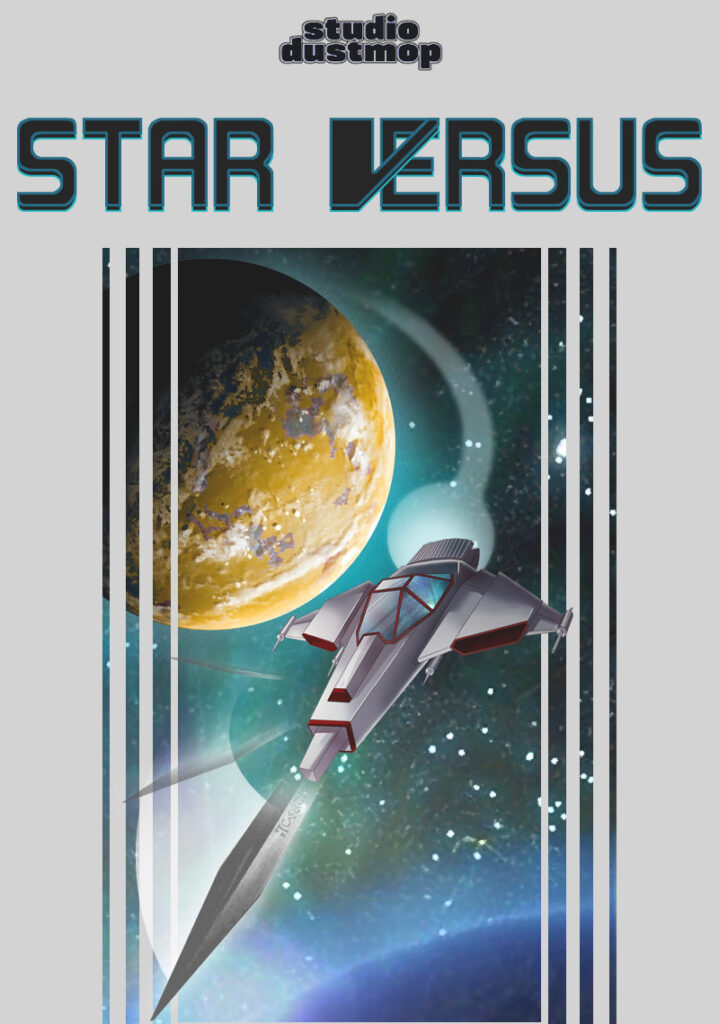
A Duel Among the Stars: Star Versus Turns the NES Into a One-on-One Arena Shooter
Most NES homebrew of the modern era imitates the platform’s golden-age genres: the platformer, the puzzler, the side-scrolling shooter built for one player and a high score. Star Versus, released on physical cartridge by Studio Dustmop in late March 2015, did something rarer. It treated the NES as a fighting-game machine. Two starships, one arena, and a combat system built entirely around out-thinking the person sitting next to you — or, failing that, the computer. When this article first reported the cartridge’s release, Star Versus was Studio Dustmop’s very first game. A decade on, it remains one of the most distinctive designs in the NES homebrew catalogue, precisely because it ignored what NES games were supposed to be.
Four Fleets Go to War
The fiction, laid out on the cartridge’s box, is pure Saturday-morning space opera. After an age of peace, the inhabited galaxy has dissolved into open war between four powers: the Gaius Battalion, fighting to preserve its way of life; the Creepy Soloid Agents, terraformers guarding ancient technology; the Hivvon Swarm, which wants to consume everything in its path; and the Bactre Armada, in it for the glory of building the fiercest army ever known — with another, unnamed enemy waiting in the shadows, too terrifying to name. Each faction supplies one of the game’s four playable fighters, and the box’s warning is blunt: choose carefully, because defeat could mean extinction for your entire race.
Star Versus was designed and programmed by Dustin Long, working as Studio Dustmop, with hardware production by Andrew Reitano, a music engine by the prolific chiptune toolsmith Shiru, music composed by Luke Silas, and a printed manual illustrated by Christophe Richard with layout by Rachel White. That credit list matters: in 2015, a boxed, manualled, professionally produced NES cartridge from a first-time team was still a novelty, and Star Versus arrived as a complete physical product rather than a ROM file and a promise.

A Fighting Game in a Spaceship’s Clothing
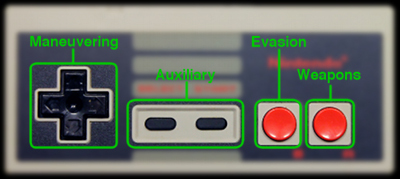
The heart of Star Versus is its one-versus-one combat, and it is considerably deeper than “shoot the other ship.” Your basic weapon is the vulcan cannon — weak but dependable, and capable of a burst shot if fired while initiating forward motion. Layered over it is a small, interlocking system of attack and defence that the manual sets out like a fighting game’s move list. Bombs home in on your opponent and explode; they cost energy from your power meter, and their real value is that they disable shields. The celestial sword is a melee weapon that deals heavy damage with knockback, deflects incoming bombs, disables shields and smashes asteroids. The shield absorbs cannon fire completely — and even splits your own outgoing cannon shots into bursts — but it is disabled by any physical contact, and an opponent who activates their shield at the right moment can cancel yours. Each character also has a unique special attack, drawing on the same power meter. Movement completes the system: a double-tap dash grants a burst of evasive speed, and holding a button lets you strafe, or circle-strafe around a locked-on opponent.
It adds up to a genuine rock-paper-scissors played at speed: shields beat cannons, bombs beat shields, swords beat bombs, and positioning beats everything. Matches are frantic and fearsome, in the developer’s own phrase — quick to pick up, and built to reward the kind of mind games that only emerge after dozens of rounds against the same rival. For players without a rival on the couch, a single-player campaign pits you against the computer, and the versus mode offers handicaps and an options menu to rebalance a mismatched pairing.

There is a design lesson in why the formula holds together under pressure. Because every tool answers another tool, no single strategy dominates: a player who hides behind a shield surrenders the initiative and invites a bomb; a player who spams bombs starves the power meter their special attack depends on; a sword rush wins exchanges but loses to distance and patience. Random bonus items drift into the arenas to punish campers and reward the pilot willing to break formation. Matches therefore swing — a round that looks lost can turn on one reflected bomb or one mistimed dash into the Sol-7 sun — and that volatility, inside rounds that rarely outstay their welcome, is what made the cartridge a word-of-mouth favourite in homebrew circles rather than a curiosity played twice and shelved.
Four Arenas, Four Ways to Die
The battles take place across four arenas, each with its own hazard. The Asteroid Starfield fills the screen with drifting rocks that only a sword strike can destroy. The Galaxy Observation Deck scatters structural blocks that serve as both obstacles and defensive cover. The Sol-7 Orbit Band orbits a miniature sun whose touch destroys your ship instantly. And the Deep Nebula X-Zone removes the screen wrap-around that space shooters train you to rely on: in the X-Zone, there is no escape off the edge, because there is no other side. Arena choice is a strategic decision, not a backdrop — a sun in the middle of the field changes every dash and every bomb trajectory into a risk calculation.
The Menu That Maxed Out the NES
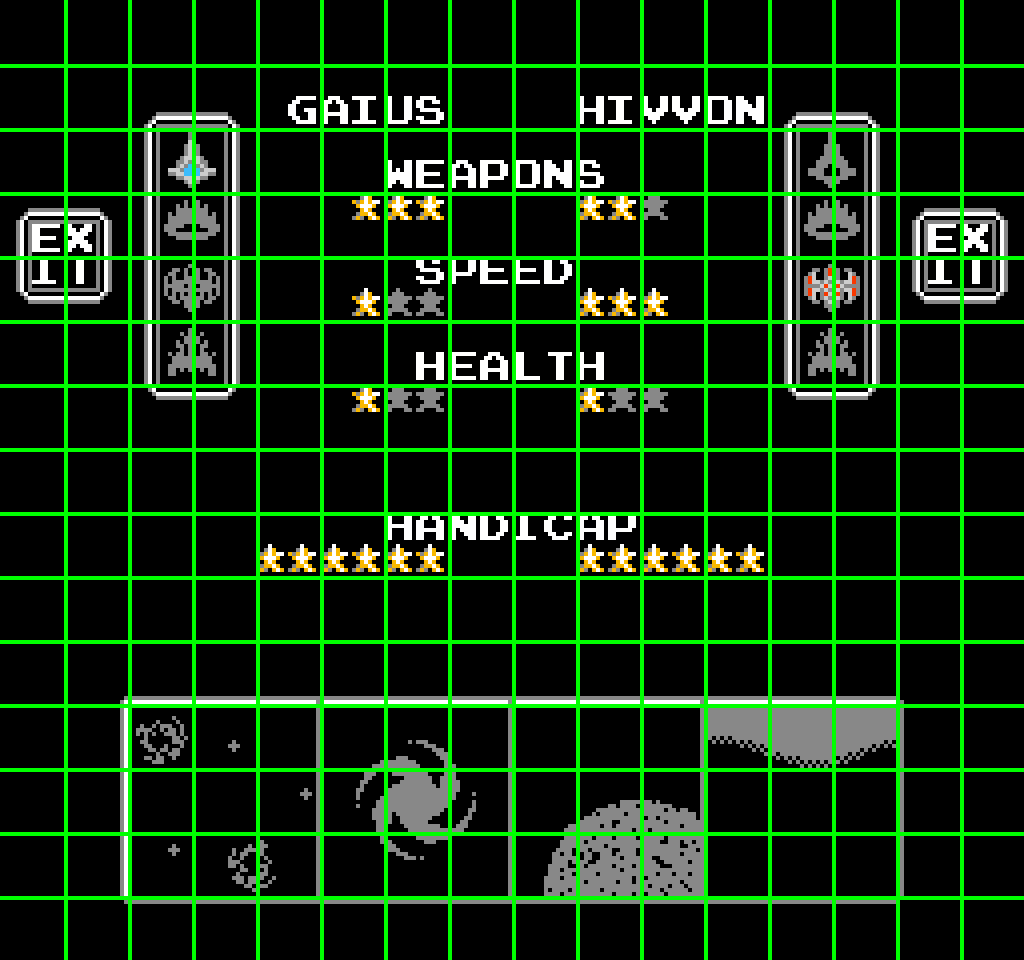
Perhaps the most telling detail about Star Versus’s craftsmanship is one most players never noticed: its ship-and-arena select screen. In a technical post-mortem on his blog, Long broke down what that innocuous menu costs the hardware. It uses every available palette on the system, all sixty-four hardware sprites, and at one point places eight sprites on a single scanline — the NES’s absolute maximum. Arena previews are dynamically recoloured as the cursor moves, unselected ships are rendered as sprites in a dedicated “disabled” palette, and the borders between arena windows are built partly from sprites and partly from background tiles wherever the palette arithmetic allows. The totals land exactly: twelve sprites for borders, thirty-two for the eight ships, twenty for the arena cursor — sixty-four, with none left over. It is a selection screen engineered like a boss fight, and a fair emblem for the whole project: a small team squeezing a 1983 machine until it confessed to abilities its designers never advertised.
Hindsight
Star Versus landed in a NES homebrew scene that was maturing quickly — Battle Kid had proven years earlier that new NES games could be both substantial and commercial, and the mid-2010s brought a steady flow of boxed releases from small teams. Even in that company, a competitive arena shooter built for two players was an outlier, and collectors noticed: the game has kept a durable reputation in homebrew circles, surfacing in retrospective rankings of indie NES games long after its small cartridge run. Its afterlife has extended beyond the cartridge, too — the game later became playable through the Piepacker online platform, carrying its couch-versus design to players without a couch partner. But the 2015 cartridge remains the definitive artefact: proof that by 2015 the NES was no longer merely being revived, it was being asked new questions — and answering them at sixty-four sprites a screen.