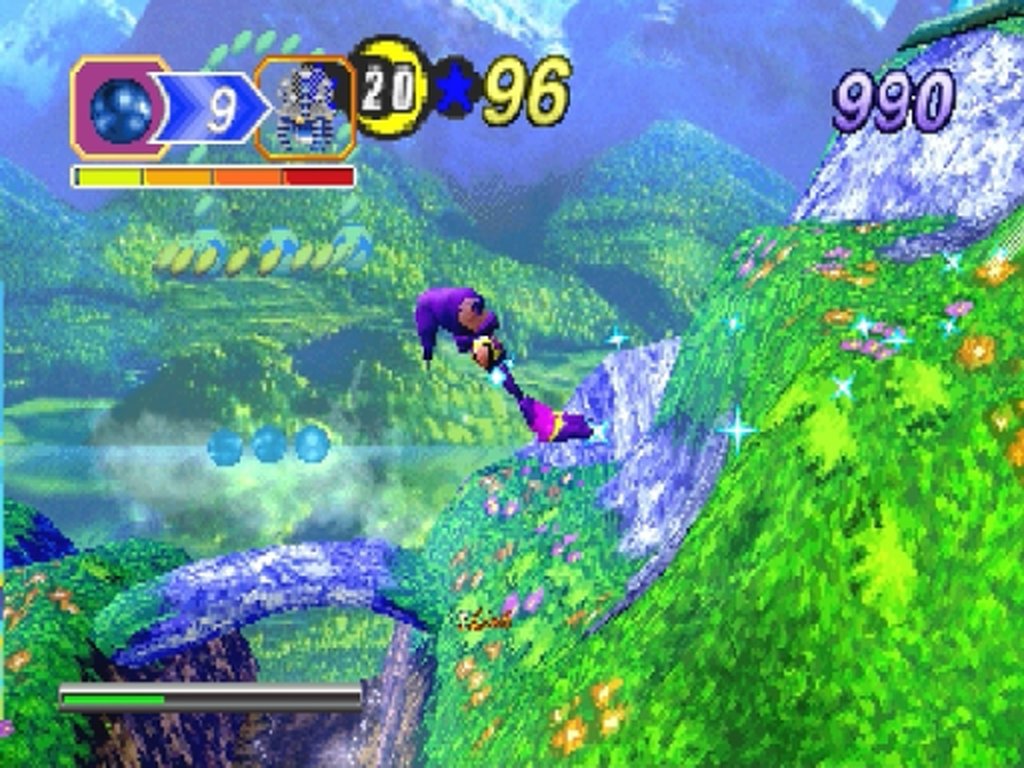
At a glance: NiGHTS into Dreams · Sega Saturn · Sonic Team / Sega, 1996 · Flight action / score attack · Score: 9.0/10
Most games ask you to win. NiGHTS into Dreams asks you to fly beautifully, and then it grades you for it. Sonic Team’s 1996 Saturn showcase is a strange, weightless thing: part platformer, part racing line, part dream diary, built around a purple jester who moves through the air the way a thought moves through a sleeping mind. Nearly three decades on, there is still nothing quite like it, and the Saturn original — designed hand in glove with the 3D Control Pad, the analogue controller Sega built for this one game — remains the version that explains what all the fuss was about. It is short. It is occasionally opaque. It is also one of the most joyful games on the system.
The setup takes seconds to grasp and hours to understand. Two children, Elliot and Claris, dream their way into Nightopia, where the jester NiGHTS has rebelled against the nightmare lord Wizeman. On foot, the children are slow and vulnerable; merged with NiGHTS, you take to the air on a fixed, looping course through each dream — Spring Valley’s green hills, Splash Garden’s fountains, Mystic Forest’s mist, and stranger places beyond. The flight is on rails in the gentlest sense: the camera and the course curve in two dimensions, but within that ribbon of sky you are free to carve, climb, dive and loop as you please. You are chasing score, always. Collect blue chips to arm the Ideya Capture, steal back the stolen dream energy, then spend the rest of your lap threading rings, grazing stars and chaining links for the multiplier that separates a C grade from the coveted A.

That scoring heart is what gives the game its spine. A first run through a course feels like a pleasant swoop; a tenth run is a memorised line, a racing driver’s lap flown at the edge of the timer. Every course is four laps, called mares, and the difference between bumbling through and mastering one is the difference between watching NiGHTS and becoming NiGHTS. The loop-the-loop is not decoration: a full circle draws a trail of stars, the paraloop can vacuum up chips and enemies, and the drill dash turns the jester into a corkscrew of pure speed. Bosses close each dream — a bouncing clown, a sinister cat, the dragon Gillwing — and they are graded too, with a multiplier that punishes dawdling. The whole game can be finished in an afternoon. Getting good at it can happily eat a year.
The controller that dreamed with it
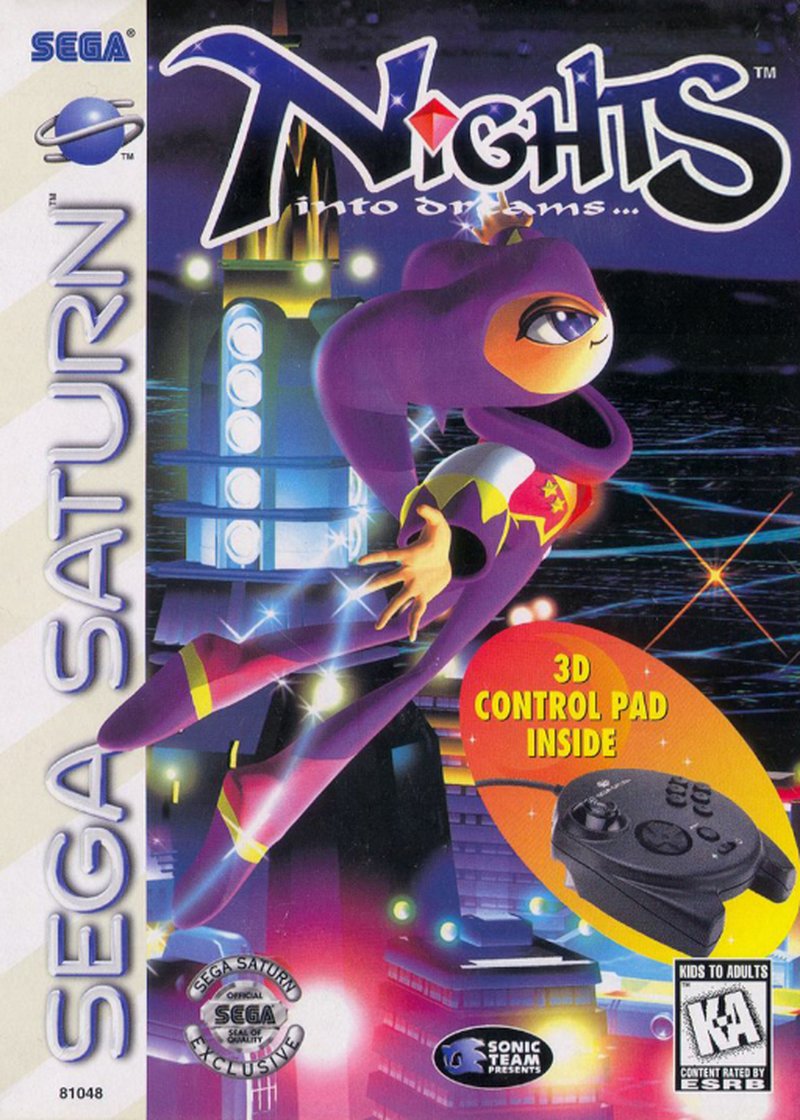
Judging the Saturn version means judging the 3D Control Pad, because NiGHTS was its reason to exist. The pad’s analogue stick — a plump, thumb-cradling disc years before analogue became standard furniture — turns flight from digital nudging into something genuinely balletic. Small tilts bank the jester; full throws carve the tightest arcs; the triggers spin and dash. Played on a standard Saturn pad the game is still lovely, but it is a translation. On the 3D Pad it is the original language. Saturn owners in 1996 were being handed the future of game control inside a game about dreams, and the pairing still feels faintly miraculous. The pad went on to serve other Saturn games, but nothing else was written for its curves the way this was.
NiGHTS does not reward the finish line. It rewards the line you draw getting there — the game is a signature written across the sky, graded in gold letters.
Technically, this is Sonic Team showing the Saturn a kindness few developers managed. The dreamscapes are built from soft, saturated polygons that lean into the hardware’s strengths: huge draw distances for the era, rolling hills that deform like quilted fabric, water that shimmers, and a sky that changes character from course to course. The frame rate holds its nerve through all but the busiest paraloop scrums. Most famously, the game watches the Saturn’s internal clock: Nightopia’s inhabitants — the little Nightopians, whose moods and breeding form a primitive artificial-life garden — react to seasons, and at Christmas the whole package famously becomes Christmas NiGHTS on the separate sampler disc. The A-Life system, ancestor of the Chao garden, means the dream remembers you. Musically it is sublime: Tomoko Sasaki’s score swings between music-box lullaby and full carnival, and the end theme, Dreams Dreams, sung by children, lands its sentiment without flinching.

Honest frictions
The flaws are real and worth naming. On foot, Elliot and Claris control like they are walking through the dream’s treacle — deliberately, since the game wants you airborne, but the forced march back to NiGHTS after a time-out still stings. The camera’s fixed ribbon can hide a chip or a ring behind scenery until you have memorised the course, which some players will read as depth and others as homework. Seven courses is a slim count even with two children and harder remixes, and a player immune to score attack will see the credits and wonder where the rest of the game went. The answer — that the rest of the game is the grades, the links, the perfect lap — is a genuine answer, but it is one the player has to accept on faith before the game proves it.
Context matters too. NiGHTS arrived in the summer of 1996, weeks from a console war turning brutal, and it was Sega’s strangest possible champion: no mascot platformer, no hedgehog, just Yuji Naka’s team following a dream logic of their own. It sold respectably, reviewed warmly and confused a good slice of its audience, which is usually the biography of a future classic. Its influence runs quietly everywhere — in score-attack design, in analogue-first control, in games that trust mood as a mechanic. The Saturn original has one more virtue no re-release can copy: the slight softness of its picture through the console’s own video output, the dream rendered at the resolution of sleep.
Learning to dream in grades
One system deserves a closer look before the verdict, because it is where NiGHTS quietly becomes a different game: the Nightopians. The little cherubic inhabitants of each dream breed, mutate and react as you play — paraloops and collisions change their moods, eggs hatch into new generations, and the dream’s music subtly shifts with the population’s happiness. It is, in embryo, the virtual-pet artificial life that Sonic Team would grow into the Chao gardens of Sonic Adventure, and on the Saturn in 1996 it was startlingly ahead of the industry’s thinking: a game world keeping a small, persistent diary of your presence. Combined with the internal-clock features — the dreams acknowledging the date, the seasons turning in Nightopia — NiGHTS builds a sense of place that its seven courses have no obvious right to sustain. Add the two-player split-screen race mode, a modest extra that turns the flight lines into direct competition, and the package’s slim course count looks less like poverty and more like concentration: everything here is in service of the dream, and the dream, once learned, does not expire at the credits. It just asks, politely, whether you can fly it better tomorrow.
Verdict
NiGHTS into Dreams is the Saturn at its most Sega: technically audacious, commercially baffling and artistically fearless. As a Saturn game specifically, it is inseparable from the 3D Control Pad, from the console’s clock, from an era when a flagship could be a flight through a child’s subconscious graded like an exam. Learn its lines and it stops being a short game at all — it becomes an instrument you practise. Few games on any system reward grace this directly, and none reward it in quite this voice. Fly it on the hardware it dreamed on, with the pad it dreamed for, and the grade it earns is easy to give.