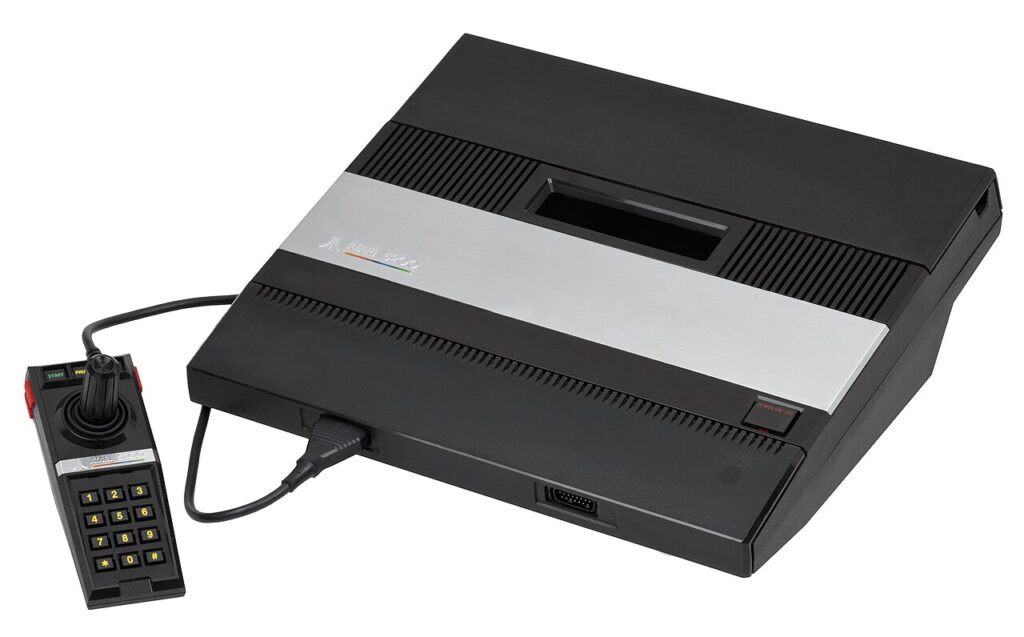
The Atari 5200 SuperSystem was the most powerful games console of 1982, built from the proven silicon of Atari’s home computers, wrapped in a vast black wedge with storage for its controllers and a single cable that handled power and picture at once. It sold about a million units and was dead in eighteen months, having never been given the fair fight its specification deserved at all. The 5200’s story is the industry’s purest cautionary tale: a machine undone not by weak technology but by a controller that could not steer, a launch that demanded players abandon the largest games library in the world, and a market collapse that spared nothing at all. This is the complete story of the SuperSystem that couldn’t steer, told in full at last.
A 400 in Console Clothing
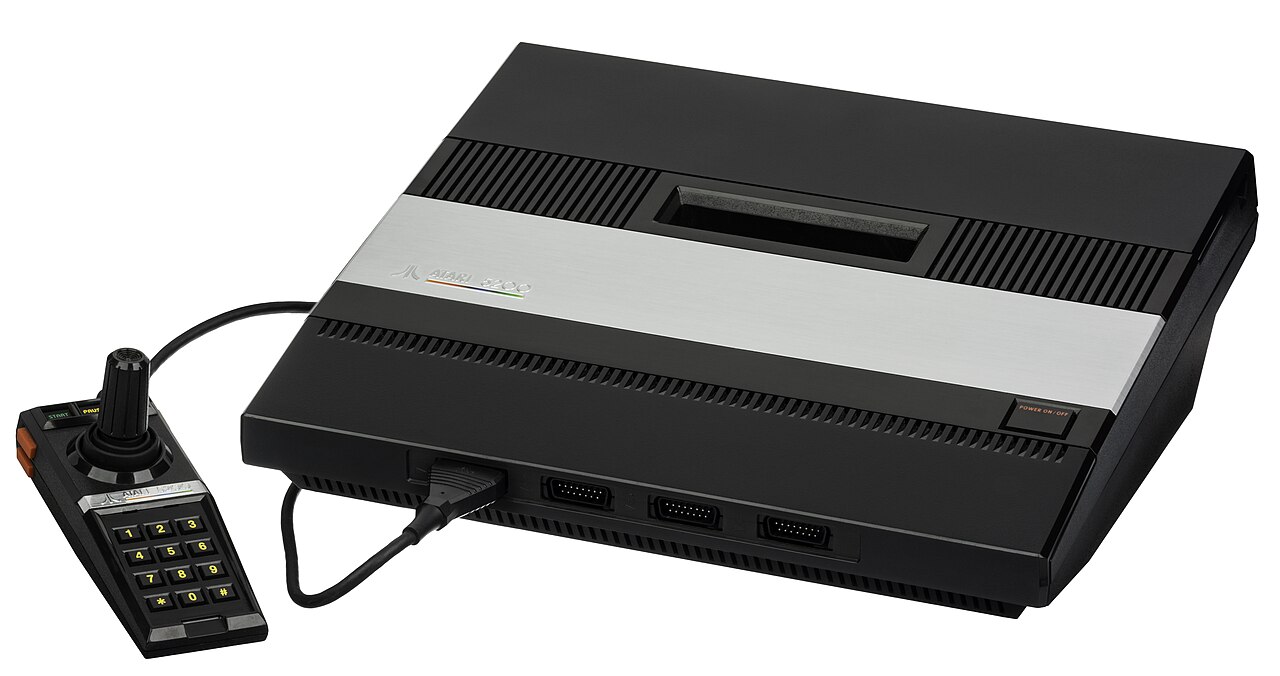
By 1982 Atari had a problem shaped like success. The 2600 was four years old and printing money, but Mattel’s Intellivision was mocking its graphics in prime-time commercials (George Plimpton, sneering politely), and Coleco was preparing something stronger still. Atari’s answer was already on its shelves: the Atari 400/800 computer line, whose custom chips (ANTIC and GTIA handling graphics, POKEY handling sound and controllers) were years ahead of the 2600’s tired TIA. The 5200, developed under the codename Pam, repackaged that architecture – a 6502 processor, the A8 graphics and sound set, 16KB of RAM – into a console. The industrial design announced ambition: an enormous wedge with a rear storage bay that swallowed both controllers, four controller ports at a time when two was standard, and, on the original four-port model, a genuinely pioneering single-connection system – one cable to an automatic switchbox that carried both power and RF signal, switching the television by itself. No console had integrated the hookup so elegantly, and the two-port revision that followed quietly reverted to a conventional separate power supply, as revisions do. At $269 in November 1982, the SuperSystem was priced and positioned as the future of the medium – arriving, with an almost literary sense of timing, at the exact moment the North American market began to fall apart.
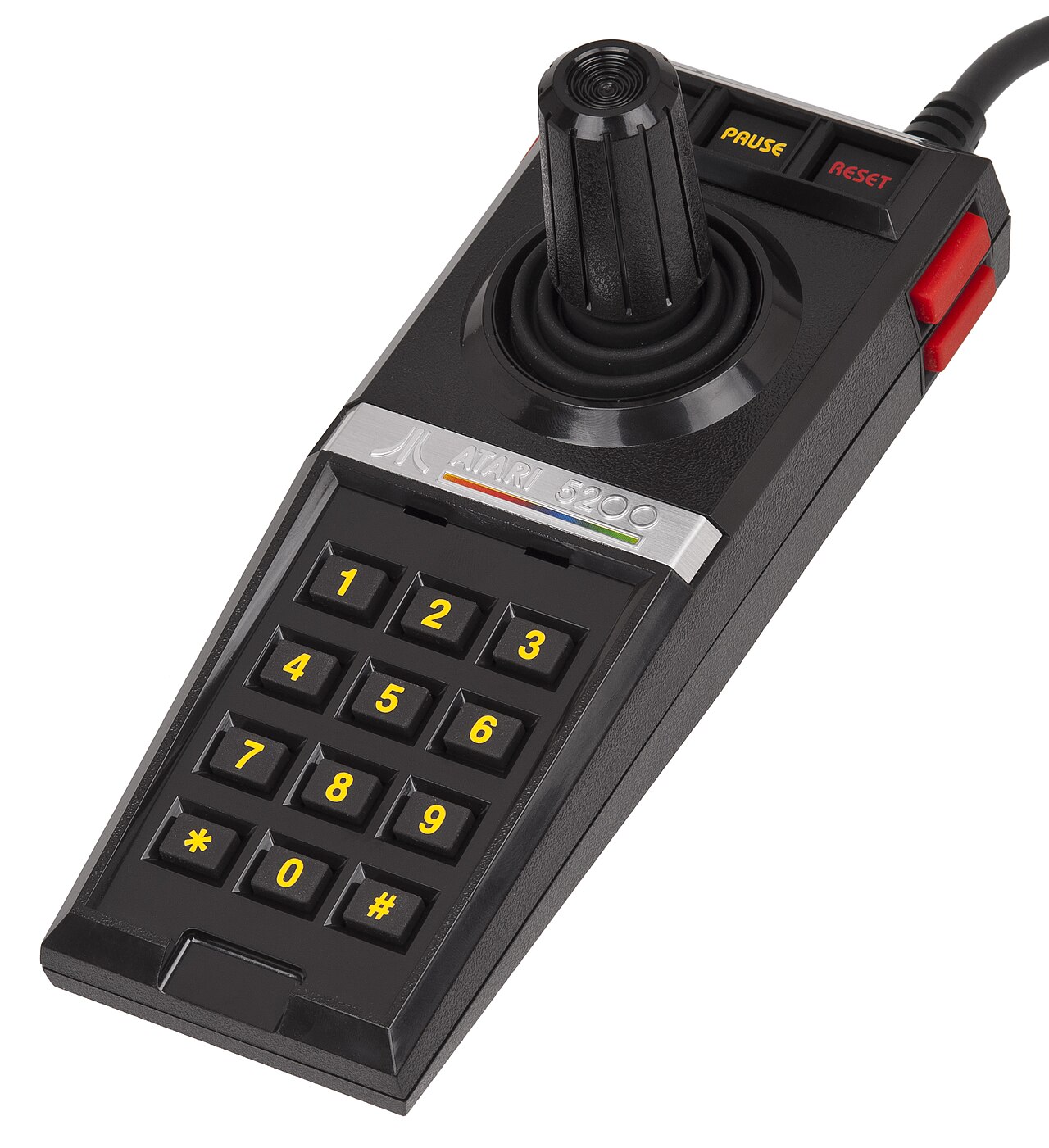
The Controller Catastrophe
The 5200’s controller, the CX52, reads in specification like a dispatch from 1995: a 360-degree analog joystick, a twelve-button numeric keypad (for overlays, strategy inputs and the computer heritage showing through), and – a console first – Start, Pause and Reset buttons on the controller itself. As an object in the hand it was a rolling failure. The stick did not self-centre: release it and it stayed, slumped, wherever it had been pushed, which made the digital-era arcade catalogue – Pac-Man above all – an exercise in fighting the interface; drivers of Pole Position steered with a tiller that had no home position. Worse, the construction was delicate past the point of farce: a rubber boot and membrane flex-circuit arrangement whose button contacts degraded within months, so that the pads failed in the field at rates that became legend while the system was still on sale. The combination was fatal to the platform’s word of mouth: the games were demonstrably better than the 2600’s, and the means of playing them demonstrably worse. Atari’s mitigations were partial (the CX53 Trak-Ball, an optional controller for applicable games, was genuinely excellent and remains sought after) and the real fix was never shipped – leaving the 5200, uniquely, a console whose aftermarket repair and rebuild culture began during its commercial life and has never stopped: gold-contact refurbishment kits, modern reproduction innards, and a cottage industry devoted to making the CX52 the controller it was drawn as.
The Library That Deserved Better
The bitterest part of the 5200’s story is that the games justified the hardware. Drawing on the Atari 8-bit catalogue, the SuperSystem hosted what were routinely the finest home versions of their day: a Pac-Man that redeemed the name after the 2600 edition’s infamy, excellent Ms. Pac-Man, Dig Dug, Pole Position, Qix, Joust, Kangaroo and Vanguard, the tank-action exclusive Countermeasure (a genuine cult piece), and Robotron: 2084 solved for twin sticks by the most 5200 solution imaginable – a plastic coupler that joined two CX52s side by side, one to move and one to fire. The system’s happiest claim on history is cinematic: Lucasfilm Games’ first two titles, Rescue on Fractalus! and Ballblazer, were developed for the Atari computers and the 5200, and the console shared in their debutante glory in 1984. The strategic wound was not quality but continuity. The 5200 could not play 2600 cartridges – and the eventual adapter, when it arrived in 1983, worked only with the two-port revision, stranding the early adopters who had bought the flagship four-port model. Coleco, meanwhile, shipped its Expansion Module No. 1 and played the entire 2600 library on day one; Atari sued, lost, and watched its rival advertise compatibility with Atari’s own catalogue. The lesson – that a successor which orphan’s the customer’s shelf starts the race hobbled – would be relearned by later generations at greater expense.
The Hardware Tour: Wedge, Switchbox and Two Revisions
The 5200 rewards a close look, because its details keep confessing its parentage. Open the case and the motherboard is recognisably the Atari 400’s architecture rearranged – the ANTIC display processor and GTIA interface chip generating graphics that, with their 256-colour palette and hardware sprites, humiliated the 2600 and edged the Intellivision; POKEY supplying four-channel sound (and reading those four controller ports); a 6502-family processor at 1.79MHz. The cartridges were scaled to match: tall, broad slabs with a dust-shuttered connector, closer to computer media than to the 2600’s pocketable carts. The two production revisions tell the platform’s whole biography in miniature. The original four-port model (1982) embodied the ambition – four players, the automatic single-cable switchbox (a powered unit that detected the console’s signal and flipped the TV from antenna to game without a slider being touched, a small domestic miracle in 1982) – and its hubris: the 2600 adapter, when it came, physically could not work through that model’s power arrangement without modification. The two-port revision (1983) was the retreat: half the ports, a conventional wall-wart supply, lower cost, and full adapter compatibility – the better buy and the confession that the flagship specification had overshot what the market would wire up. Between the two sits the CX53 Trak-Ball, a full-size arcade trackball controller of real quality, and the dual-controller coupler for Robotron: peripherals that assumed an enthusiast owner the crash was in the process of liquidating.
The War Room: 1982’s Three-Way Fight
The 5200 did not fail in a vacuum; it lost a specific war, against specific opponents, on a field that dissolved beneath all three. Its first enemy was Mattel’s Intellivision, whose comparative advertising (the patrician George Plimpton demonstrating, side by side, how shabby 2600 games looked) had spent two years making Atari’s flagship look old – the wound the 5200 existed to close. Its second enemy was sharper: the ColecoVision, launched in August 1982, three months before the SuperSystem, with arcade-grade graphics and the single most valuable pack-in of the era – Donkey Kong, licensed from a Nintendo that had not yet learned what it owned. Against that pairing the 5200’s launch games, however polished, were yesterday’s arcade: Space Invaders and Super Breakout in the box, in a year when the arcades themselves were moving on. The third enemy was the 5200’s own family: Commodore’s price war drove full computers toward console prices through 1983, and the SuperSystem’s selling point – “it’s an Atari computer underneath” – invited the fatal question of why not simply buy the computer, keyboard, BASIC and all, especially once the 400 itself was discounted below the console’s launch price. And over everything hung the crash’s arithmetic: retailers, stuffed with unsellable stock, returned and cancelled indiscriminately; Atari’s losses became the business story of the year; and a premium console launched in November 1982 had perhaps six good months before the floor of the entire category gave way. In that light the million units look less like failure than triage – the SuperSystem sold respectably into a catastrophe, and its post-mortem should be filed alongside the era’s other well-built casualties, distinguished only by the fact that its wound – the controller – was self-inflicted before the market ever got its vote in.
The Rescue Attempts: Adapter, Price Cuts and the Lost Games
Atari did not let the 5200 die unassisted. Through 1983 it cut the price in steps from $269 toward double digits, shipped the VCS Cartridge Adapter (and offered a mail-in modification so four-port owners could use it, an apology rendered in solder), and kept the first-party pipeline moving into 1984 – Millipede and Final Legacy among the last official releases. The era’s archaeology is unusually rich, because the crash froze a working library mid-stream: a 5200 conversion of Tempest was substantially built before cancellation, survived as a prototype, and was finished decades later by its original programmer, Keithen Hayenga, for release through the collector channel; Jr. Pac-Man’s completed 5200 version similarly surfaced to an afterlife its makers never saw. One more quirk completes the record and helps explain the machine’s mystique gap outside America: the 5200 was never officially released in Europe, where the Atari 8-bit computers carried the same software to the same audience in keyboard form – so the SuperSystem remained, unusually for an Atari flagship, a purely American tragedy, played out between November 1982 and July 1984 with a beginning, a middle, and no international editions to soften the end.
Ten Cartridges That Define the Shelf
The 5200’s small official library – around seventy releases – compresses well, because so much of it represents its era’s arcade at home-console best. The essentials: Pac-Man, the redemption port, everything the 2600 version was not. Countermeasure, the exclusive tank-action game whose two-player mode justifies the four ports’ ambition. Robotron: 2084, twin-stick purity via the coupler, the system’s most ingenious hour. Rescue on Fractalus! and Ballblazer, Lucasfilm’s twin debut, fractal mountains and one-on-one future sport, still startlingly modern in feel. Star Raiders, the Atari 8-bit’s founding epic, keypad and all. Missile Command and Centipede with the Trak-Ball, the closest the living room came to the arcade’s physical controls. H.E.R.O. and Pitfall II, Activision’s craft at its peak, in versions collectors rate at or near the top of their home editions. And Gremlins, the licensed oddity completed in 1984 and released in small numbers two years later, the shelf’s famous rarity. Add the homebrew and recovered catalogue – the finished Tempest, the AtariAge releases, the curling – and the 5200’s playable legacy is richer than several consoles that outsold it five to one.
Eighteen Months: The Crash, the Sale and the Orphaning
Context finished what the controller began. The 5200 launched into the opening act of the great North American video game crash: retailer confidence collapsing through 1983, Atari posting losses in the hundreds of millions, and its parent Warner Communications looking for an exit. The SuperSystem also fought a civil war – Atari kept selling and supporting the cheaper 2600 alongside it, so the 5200’s most dangerous competitor sat on the same shelf with a library sixty times its size, and stores, burned by the glut, had shrinking patience for a third Atari line. The end, when it came, was administrative: in May 1984 Atari announced its next console, the 7800, and that July Warner sold the consumer division to Jack Tramiel, whose new regime discontinued the 5200 outright. Roughly a million units in eighteen months: not the decade’s worst failure, but its most instructive, because its causes were all decisions. The architecture it was built from outlived it twice over – the A8 computer line continued to 1992, and Atari itself tried the computer-console fusion once more with the XE Game System in 1987 – but the 5200 nameplate joined the short, sharp list of machines remembered as warnings.
What the 5200 Taught the Industry
The SuperSystem’s failures were so cleanly separated that they became curriculum. Lesson one: compatibility is strategy. The 5200 demanded a new library while its rival played the incumbent one, and every generation since has treated backward compatibility as a launch weapon – the PlayStation 2’s ability to play the entire PS1 catalogue was the single most powerful feature of the most successful console ever sold, and it is the 5200’s error read backwards. Lesson two: the controller is the platform. A machine can survive mediocre graphics, a thin launch and hostile press; it cannot survive an interface that fights the player and then breaks, and the CX52 stands at the head of a lineage of hardware-trust scandals the industry has been re-living ever since. Lesson three: the computer-console hybrid is an eternal temptation – the 5200 tried it in 1982, Atari retried it with the XEGS, Commodore with the CD32, Sony and Microsoft built empires partly on it – and its success each time has depended on the two things the 5200 lacked: a controller designed for the couch, and a library that honoured the customer’s existing shelf. The SuperSystem was not a stupid machine. It was a smart machine whose three mistakes were each worth a fortune to the competitors watching it make them.
Afterlife: The SuperSystem Reconsidered
Time has been kinder to the 5200 than 1984 was. Its rehabilitation rests on the library, which collectors now argue – with the controllers fixed – represents the best way to play a swathe of early-eighties arcade games at home: the A8-derived ports are simply stronger than their 2600 and Intellivision counterparts, and the exclusives (Countermeasure, the Fractalus/Ballblazer debut, the recovered Tempest prototype completed by its original programmer and released through AtariAge decades later) give the shelf real distinction. The community around the machine is correspondingly devoted: homebrew development continues on AtariAge (new physical releases, including the RealSports Curling story told elsewhere on this hub), the controller is serviced by a mature ecosystem of rebuild parts and modern substitutes – the fix this site’s own archive documents in the best-read 5200 feature we carry – and Atari’s modern compilations treat the system with unusual respect, presenting its games with their context intact. The 5200’s verdict, then, is the one its specification sheet always promised: a genuinely advanced machine, carrying the best chips of its moment, that demonstrates in a single product cycle that consoles are not won by silicon. They are won by the controller in the hand, the library on the shelf, and the calendar on the wall – and the SuperSystem, tragically, lost on all three, in public, in eighteen months, at the exact moment its parent company could least afford the lesson it was teaching everyone else.