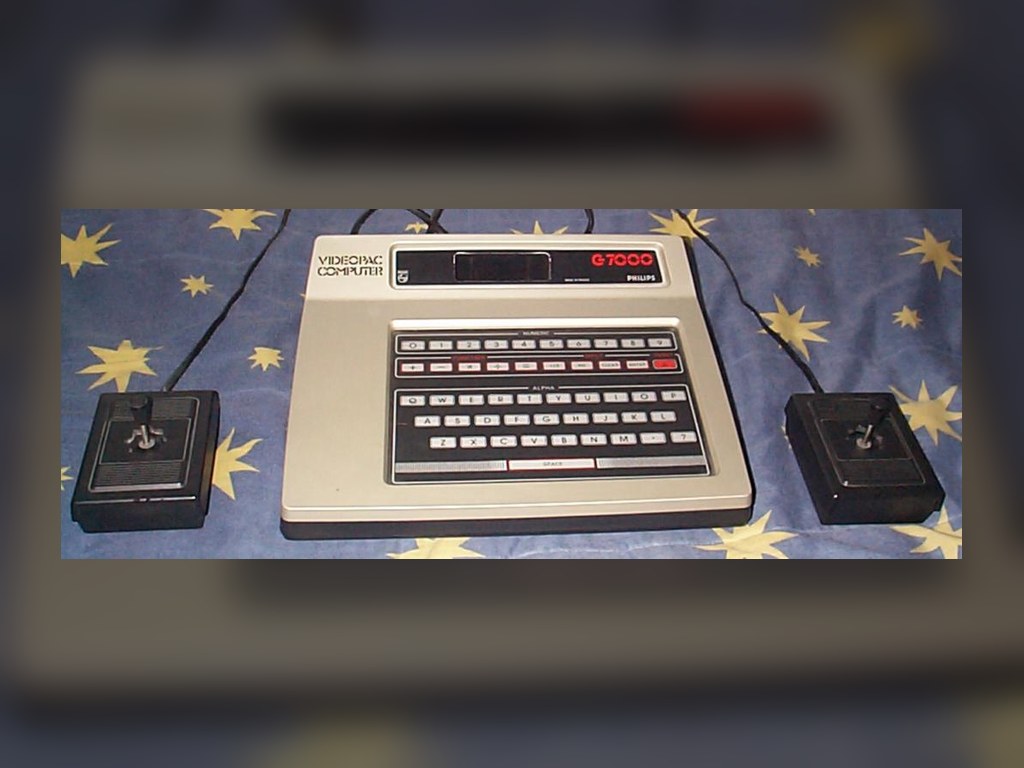
The Odyssey 2’s biography changes at the Atlantic. In North America, Magnavox’s console ran third behind Atari and Mattel and exited with the crash. In Europe, sold by Philips — Magnavox’s parent — as the Videopac G7000 from December 1978, the same hardware was a leading system, marketed as the Videopac Computer, sold under a thicket of regional badges (Philips Videopac C52 in France, Radiola Jet 25, Schneider 7000, Siera G7000), and supported long enough to receive hardware the United States never saw. Collectors who only know the American story know the smaller half of this console’s life.
The European library wore numbers. Where American cartridges carried titles and exclamation marks, Philips numbered its Videopac releases in sequence — Race, Pairs, American Football and onward past sixty — a system that makes European collecting satisfyingly completable and gives the same game two bibliographies: K.C. Munchkin! in America is Munchkin, Videopac 38, in Europe; UFO! is Satellite Attack (34); Attack of the Timelord! became Terrahawks (51), renamed for a television licence. Packaging differed too, evolving from black cardboard boxes to the plastic cases with colour fronts that define the European shelf look.

The games that stayed in Europe
Europe’s library is not America’s library in translation. Philips published a run of Videopac titles with no US release — among them Backgammon (48), The Mousing Cat (47), Air Battle (58), Neutron Star (55), Loony Balloon (54), Nightmare (53) and Blobbers (57) — while the traffic ran the other way only rarely: just three American games, Nimble Numbers Ned!, Power Lords and Sid the Spellbinder!, never crossed to Videopac, largely because two of them depended on an English-speaking voice module Europe never received. Third parties split by territory as well: Parker Brothers’ Frogger, Popeye, Q*bert and Super Cobra were European and Brazilian releases, while Imagic’s Atlantis and Demon Attack sold on both sides of the ocean.

Regional hardware widened the gap. The G7200 put the G7000 into a cabinet with a built-in black-and-white monitor. The C7010 Chess Module gave European machines a second processor. The C7420 Home Computer Module added Microsoft BASIC and cassette storage for the later machines. And in 1983 Europe received the machine America only prototyped: the Videopac+ G7400, the Odyssey 3 in all but name and geography, with enhanced background graphics and a run of Plus-only and Plus-enhanced games — the final first-party chapter of the whole platform, written entirely in Europe.
Why Europe loved it
The explanations are structural. Philips had distribution muscle in its home continent that Magnavox could not match in America’s Atari-dominated market; the Videopac’s computer framing — keyboard first, ‘Videopac Computer’ on the badge — fitted European marketing of the era; and the numbered library, the board-game hybrids and the educational titles played to a market that bought the machine as family equipment rather than an arcade substitute. The result is a collector’s landscape where European variants are plentiful, Plus machines are the connoisseur’s hardware, and cross-region collections — the full numbered run beside the American exclamation marks — are the deepest rabbit hole in second-generation collecting.
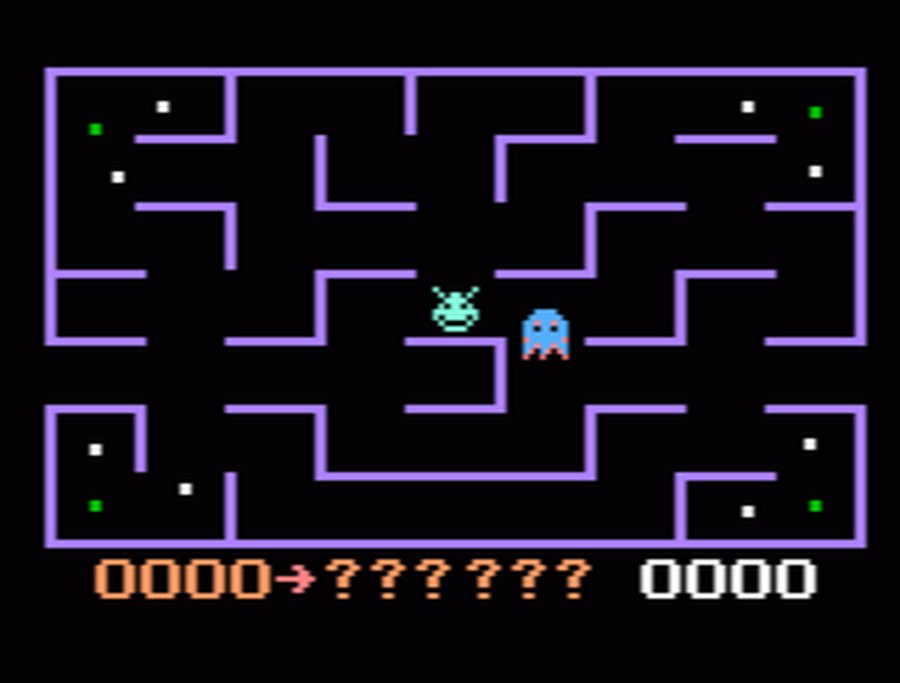
For the American Odyssey 2 owner, the practical news is good with footnotes: most Videopac cartridges will run on an Odyssey 2, and most Odyssey 2 cartridges on a G7000, but a documented minority misbehave across the NTSC and PAL divide — some Parker Brothers titles and several of the numbered releases among them — and the hardware modules respect no borders at all, being host-specific. Buy the European exclusives, check the compatibility lists, and keep a G7000 in mind: the console’s second homeland is not a footnote. It is half the story.
The Plus frontier
The G7400 deserves a final word of its own, because it is the road the whole platform travels in Europe’s telling. Released in 1983 as the Videopac+, it kept the G7000’s soul — the same processor family, the same keyboard idea, full compatibility with the standard library — and added the enhanced background graphics that Plus-marked cartridges could exploit, with a small run of Plus-only releases at the end of the line. America’s version of this machine, the Odyssey 3 Command Center, was demonstrated, celebrated in the press, and cancelled; Europe simply bought its counterpart in shops. That asymmetry is the cleanest single measure of the two markets’ different relationships with this console: in one, its future was a prototype in a photograph; in the other, it was a product with a price tag.
For the collector in 2026 the Plus frontier is therefore the natural final expedition — a G7400, the enhanced reissues of Munchkin, Pickaxe Pete and Killer Bees!, the Plus-only titles, and the C7420 BASIC module for the full stop. It is the most expensive shelf in this series and the most historically complete: the Odyssey 2’s story, finished where it was loved longest.
This feature is part of the Odyssey 2 build-up in this series: eighteen cartridge reviews, a hidden gems list and a buying guide sit alongside it, and the flagship history, Odyssey 2 Forever, carries the console’s complete story from its 1978 launch to its 1984 discontinuation. Where this feature names a game that also carries a full review in the set, the review is the place for scores and tactics; this is the place for the machine, the idea and the era that produced both — the context without which no single cartridge on this system quite explains itself.
A note on names, since this system collects them: Odyssey 2 in North America, Videopac in Europe, Odyssey in Brazil — the same silver machine under three badges, with cartridges that mostly cross between them and a minority that misbehave when they do. This series uses the American titles as its default and gives the European Videopac names and numbers wherever they differ, because a collector in 2026 shops both bibliographies at once and deserves to find the same game under whichever name the listing chose.
Two libraries, one machine
The double identity creates the collector’s favourite Odyssey 2 project: the merged library. A full American set is forty-nine official cartridges deep; the numbered European run adds its own sequence, exclusives and Plus-era releases on top, with Brazilian editions beyond that. Few collectors finish either run, and the merged shelf — exclamation marks beside numbers, Munchkin beside K.C. — is the deepest collection the second generation offers at this price level. The hardware tells the same story in plastic: an Odyssey 2, a G7000 and a G7400 on one shelf is a three-volume history of one machine’s two lives.
That, finally, is the answer to the puzzle of the Odyssey 2’s reputation. Judged from America it is the bronze medallist of 1978. Judged from Europe it is a market-defining computer-games machine that outlived its rivals’ first era and earned a successor. Both judgements describe the same silver box with the keyboard. The Videopac story is not the alternative history of the Odyssey 2 — it is the other half of its actual one, and any account of the console that stops at the Atlantic is, precisely, half an account.