
At a glance: Panzer Dragoon Orta · Xbox · Smilebit / Sega, 2003 · Rail shooter · Score: 8.5/10
Panzer Dragoon Orta is the most beautiful game on the original Xbox, and the claim survives every challenger. Smilebit inherited Team Andromeda’s strange, mournful rail-shooter series — a lone rider on an armoured dragon, fighting a bio-engineered empire beneath alien skies — and rebuilt it for hardware that could finally render the vision whole: painterly cloud-seas, ruined colossi, forests of living machines, all flowing past at speed while you paint targets with a lock-on reticle. Orta is short, demanding and utterly singular. It is also, quietly, one of the great arguments that the rail shooter — gaming’s oldest genre — could be art.
The system deepens the series’ signature lock-on shooting with a morph mechanic that changes everything. Your dragon shifts between three forms in flight: the balanced Base Wing, the heavy Glide Wing with its devastating lock-on volleys and no defensive berserk, and the manoeuvrable Heavy Wing with a rapid-fire gun for close work. Each form levels up separately as you collect gene base from fallen enemies, and high-level play is a constant, musical shifting between forms — heavy for the boss’s exposed core, agile for the missile swarm, base for everything between. Add the berserk attacks, form-specific and screen-clearing, and Orta becomes a shooter of genuine strategic texture inside a genre usually content with reflexes alone.
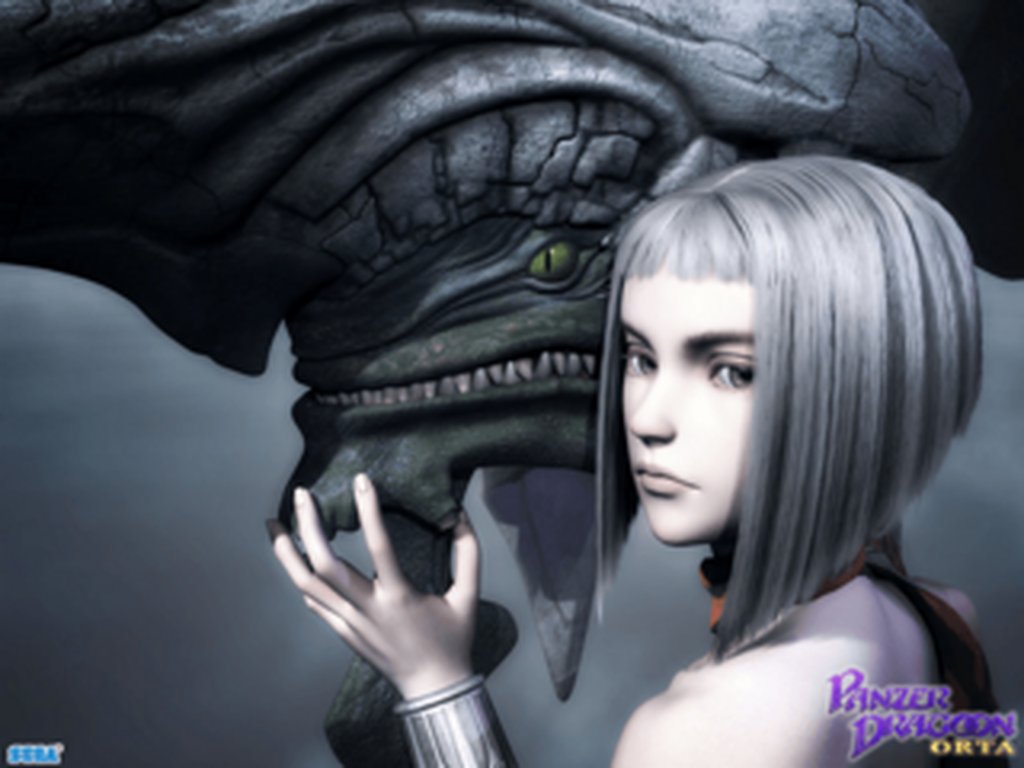
The campaign’s ten episodes tour a world that feels excavated rather than designed: the doomed capital under dragon-fire, a canyon of waterfalls, an ancestral ruin where the series’ past literally rises to fight you, and a finale among the Cradle’s orbital machinery that pays off three games of lore. Orta herself — a girl imprisoned her whole life, freed by the dragon in the opening minutes — gives the series its first real protagonist, and the story, told in the invented Panzerese language with subtitles, treats its mysteries with rare restraint. Between episodes, an extensive encyclopedia rewards the curious. This is Sega’s world-building at its most literary, wearing a shooter’s clothes.
Difficulty, length, and the Pandora’s Box
Honesty about the shape of the thing: a skilled player finishes Orta’s campaign in an afternoon, and an unskilled one may not finish it at all — the difficulty, even on Normal, is authentically Sega-hard, with boss encounters (the twin airships, the final form gauntlet) that demand pattern mastery. The game’s answer to both charges is its extraordinary depth of replay: branching routes through episodes, score attack with letter ranks, and Pandora’s Box, an unlockable vault of bonus content earned by performance — sub-scenarios, a playable Imperial side-story, concept galleries, and, famously, an emulated port of the original Saturn Panzer Dragoon in full, hidden inside as the ultimate unlockable. Few games have ever respected their own history this completely.
Orta flies like a dream of the Saturn era drawn by a machine that could finally keep up with the dreamers.
The Xbox hardware is used with unusual intelligence: progressive-scan output that makes the game glow on modern displays through component, textures with a hand-painted grain, draw distances that sell the sky-ocean scale, and effects — dragon-fire, rain, the living architecture of the final levels — that never cost the frame rate its composure. The soundtrack, by Saori Kobayashi, extends the series’ invented-folk-meets-electronica sound with some of its finest themes. If the visuals date anywhere it is in the human character models during cutscenes, stiff beside the dragon’s magnificence — the right thing to be magnificent is, fortunately, the dragon.

Small debits beyond length and spikes: the lock-on reticle occasionally fights the camera’s chosen framing in the busiest turns, the story assumes a familiarity with the Saturn games that the encyclopedia only partly supplies, and the very last unlocks demand ranks that will keep all but the devoted from Pandora’s Box’s deepest drawer — including, cruelly, that Saturn port. These are the flaws of a game made for its faithful. The faithful were right about it, and time has joined them.

A series honoured, a genre crowned
Context sharpens the achievement. The Panzer Dragoon series began as a Saturn curiosity — a shooter whose art director, Manabu Kusunoki, built an entire visual civilisation from art-nouveau curves, invented languages and melancholy ecology — and its RPG chapter, Saga, became one of the most treasured games ever made. Orta carries that inheritance on a shooter budget and honours it: the dragon designs evolve the originals rather than rebooting them, the Empire’s bio-mechanical horror deepens, and the unlockable Imperial side-story closes narrative loops a decade old. Newcomers get a superb shooter; the faithful get a homecoming. Few franchise revivals manage both audiences at once, and fewer still do it while looking like a moving painting.
For today’s player the disc is one of the Xbox’s essential imports-that-never-were — a Japanese art game shipped worldwide at launch-window prices, now mid-priced and steadily climbing as its reputation compounds. It demands a light touch with difficulty expectations: start on Easy without shame, learn the morph rhythm, then climb. The reward structure is honest — every rank earned opens something real in Pandora’s Box — and the campaign’s brevity makes it the perfect palate cleanser between hundred-hour epics. What stays with you is not the afternoon it takes. It is the sky it showed you, which no other game has ever quite reproduced.
Sound, sky and the details between
Two more crafts deserve naming before the verdict. The first is sound: Orta’s effects design gives every lock-on a musical chime that rises with your combo, so expert play literally composes the soundtrack’s top line, while the score moves between mournful strings, invented folk instruments and martial electronics without ever sounding like another game’s fantasy. The second is the bestiary. Smilebit’s creature design — Imperial bio-weapons grown rather than built, ancient guardians that look like temples that learned to fly, the dragon itself passing through life-cycle forms as it upgrades — gives every episode a silhouette you remember. Screenshot any thirty seconds of Orta at random and the frame is recognisably, unmistakably its own. In a genre built on borrowed science fiction, that visual authorship is the rarest achievement of all.
Set expectations for the first hour honestly: Orta will humble you on Normal until the morph rhythm clicks, and that click — when your hands start shifting forms before your eyes have finished reading the threat — is one of the great sensations in shooter history. Persist through it. Behind the difficulty stands a campaign that wastes no minute of its length, a dragon that feels genuinely alive under your hands, and an ending that closes the series’ long story with grace. Some games are events. Orta is a heirloom.
Verdict
Panzer Dragoon Orta is a short, stern, ravishing masterpiece: the rail shooter’s high-water mark, the Xbox’s most beautiful disc, and Sega’s love letter to its own strangest world. It asks an afternoon and offers a legacy — three forms to master, ranks to chase, a vault of series history to unlock. Collectors prize it; players should play it. On a shelf of shooters that chased realism, Orta remains the one that chased wonder, and caught it.