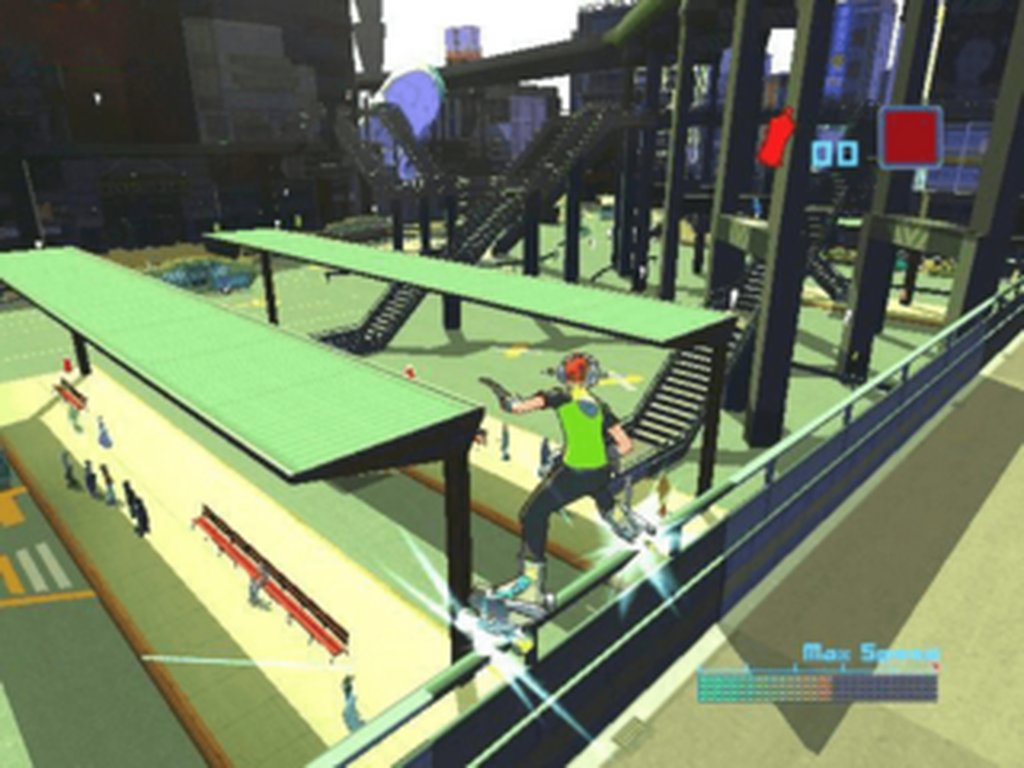
At a glance: Jet Set Radio Future · Xbox · Smilebit / Sega, 2002 · Action skating game · Score: 9.0/10
Jet Set Radio Future is the coolest game on the original Xbox, and the argument is not close. Smilebit’s sequel takes the Dreamcast original’s cel-shaded Tokyo, inline skates and graffiti warfare, then rebuilds everything bigger, faster and smoother for Microsoft’s new machine: huge open districts instead of small stages, thirty frames of pure style, police who escalate like a cartoon arms race, and a soundtrack — Hideki Naganuma’s sample-collage funk above all — that remains one of the greatest ever assembled for a game. It launched in the console’s first months, often bundled in the same box as the machine, and it told everyone watching what the Xbox could be when a developer with a singular vision got real horsepower. Twenty years on, nothing else looks or sounds like it. Nothing ever did.
The structure change defines the sequel. Where the Dreamcast game chopped Tokyo-to into timed stages, Future opens the city into sprawling connected districts — Shibuya-cho’s shopping canyons, Chuo Street’s neon, the industrial sprawl of the Rokkaku Expo site, a sewer system you could lose an afternoon in — and lets you roam them as the GG’s gang war unfolds. Story missions, graffiti turf battles and tag races flow without the original’s loading-screen rhythm. Grinding is the locomotion and the joy: rails chain entire districts together, momentum is generous, and the trick system rewards flow over fussiness. Future is simply a more pleasurable game to move through than its predecessor, and movement is the whole game.
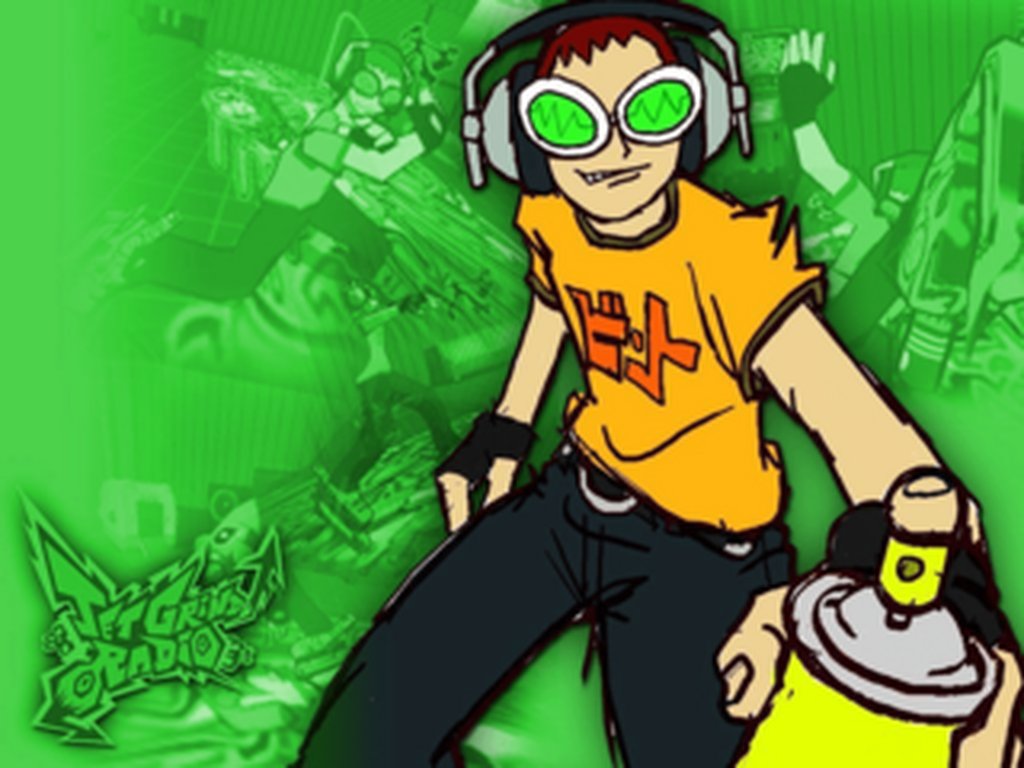
Graffiti, the series’ signature verb, is streamlined: large tags now trigger a smooth spray animation rather than the Dreamcast’s analogue-stick gestures. Purists missed the ritual; the trade bought speed, and Future is about speed in everything — the police arrive faster too. Captain Onishima’s forces escalate from baton cops to riot squads, helicopters, tanks and worse, and fleeing a full escalation through a district you know by its rails is one of the era’s great action set-pieces, generated fresh every time by the systems colliding. Rival gangs — the techno-shaman Noise Tanks, the horror-clown Love Shockers, the undead Poison Jam — give the turf war faces, races and boss encounters that keep the mid-game buoyant.
The look, the sound, the argument for both
Cel shading was everywhere in 2002 and almost nowhere done this well. Future’s characters are bold ink outlines and flat colour worn like fashion; the city is a manga panel you can skate through, all saturated signage and impossible sky. The Xbox’s power is spent on scale and smoothness rather than realism — districts stream at size, crowds scatter, and the frame rate holds the illusion. Then there is the soundtrack. Naganuma’s tracks — “The Concept of Love,” “Funky Dealer,” the immortal “Birthday Cake” by Cibo Matto crashing in from the licensed roster — fuse funk, hip-hop, J-pop and noise into the game’s bloodstream; DJ Professor K’s pirate-radio narration stitches missions into a broadcast you never want to end. A content warning the game itself jokes about: people have bought the soundtrack and received the game free, emotionally speaking.
Jet Set Radio Future is not a game about graffiti. It is a game about being young, fast and ungovernable in a city that wants you scheduled — and it makes the argument with its wheels, not its words.
Honest debits: the removal of the time limits and spray gestures lowers the skill ceiling the Dreamcast original demanded, and veteran Rudies found Future almost too welcoming. The camera occasionally wrestles you in the tightest interiors. Late-game missions reuse districts with heavier police rather than new geography, and the final act’s escalation tips from thrilling to attritional in two notorious chases. Multiplayer modes — races, tag battles — are charming extras rather than a destination. On the charge sheet of a game this alive, these are misdemeanours.
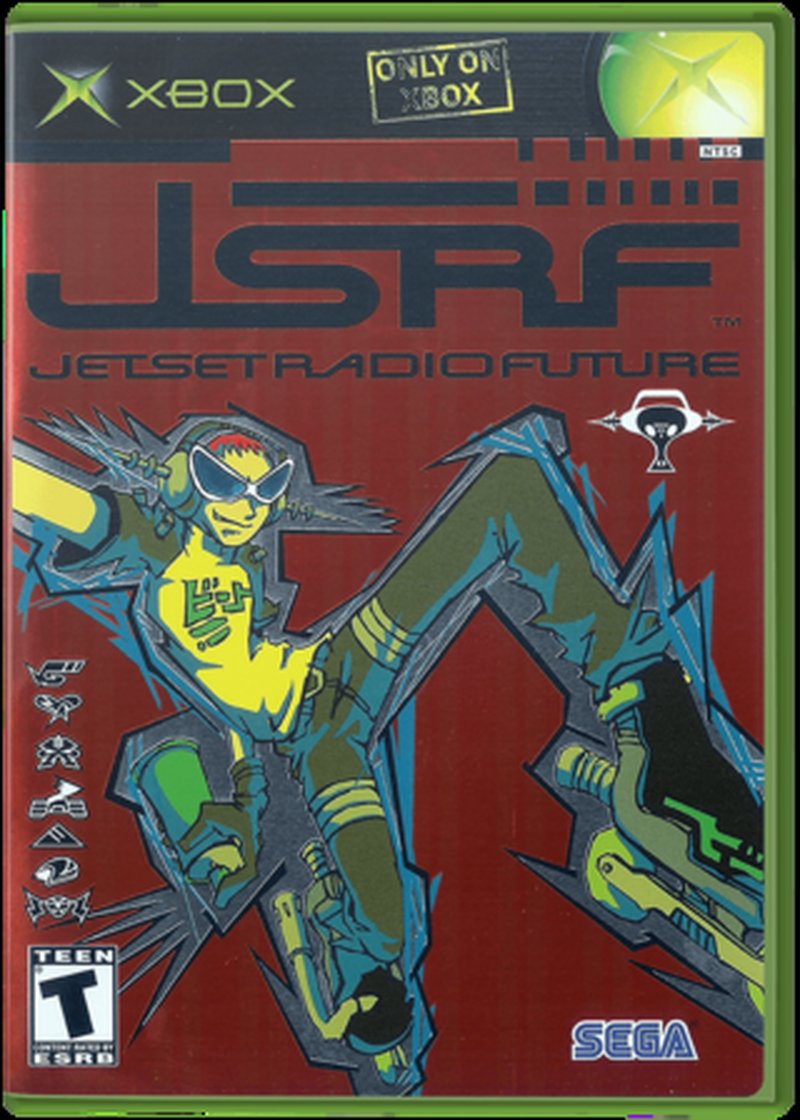
As an Xbox artefact, Future is doubly precious: it was effectively exclusive to the machine (later bundled discs paired it with Sega GT 2002, the two-game pack found in millions of attics), it never received a port for two decades, and its spirit survived mainly in the games it inspired. Playing the original disc today — upscaled by the hardware’s component output, soundtrack intact — is the canonical way to own it. The GG’s story closes with a genuinely strange, sincere finale about freedom and control that lands harder now than it did in 2002.
The gang’s all here
The roster deserves its own applause. Future expands the playable Rudies into a crew worth collecting — each unlocked through races and challenges, each with stats that subtly change how districts feel under your wheels — and the rival gangs are drawn with a fashion-magazine confidence that makes every turf battle feel like a dance-off with stakes. Professor K’s narration, part pirate DJ and part Greek chorus, gives the story a voice American localisations rarely manage: funny, slangy, warm. The plot’s villain, the Rokkaku corporation’s creeping privatisation of Tokyo-to’s streets, reads in 2026 less like cartoon dystopia and more like documentary with better music. And the graffiti editor, letting players design their own tags from stamps and strokes, was player-expression infrastructure years before that phrase existed — your art, on the city’s walls, judged by no algorithm.
Practical notes for the modern skater: the standalone disc and the Sega GT double-pack contain the same game, and the double-pack is among the cheapest worthwhile Xbox discs in existence. Save to the hard drive, play through component for the cleanest cel lines, and do not skip the Jet Grind Radio tutorial echoes in the early districts — Future teaches its flow generously and then trusts you completely. What it never does is waste your momentum. In a library full of games that begin by stopping you, that respect for motion is the whole philosophy, and it has not dated by a single frame.
A final lap of Tokyo-to
Beyond the credits, Future keeps its districts alive with Graffiti Souls to hunt, street challenges to clear and ranks to earn on every story mission — a completionist tail that turns the city from a backdrop into a checklist worth finishing. The Jet Rank demands, in particular, reveal how deep the scoring systems run beneath the game’s welcoming surface: routes you cruised become optimisation problems, and the police you outran become part of the arithmetic. It is the mark of the best arcade design — a floor low enough for anyone, a ceiling high enough for years.
Verdict
Jet Set Radio Future is a masterpiece of style with the substance to carry it: a bigger, faster, friendlier sequel that traded a little difficulty for a lot of flow, wrapped in the defining art direction and soundtrack of its generation. Every Xbox collection should hold it — ideally the standalone release, certainly in some form. Put it on for ten minutes to check the picture and you will come up for air two districts later, humming. Understand, understand, the concept of love.