
At a glance: Pac-Man · Atari 5200 · Atari (Namco licence), 1982 · Maze chase · Score: 8.0/10
To understand the 5200’s Pac-Man you first have to remember the other one. The Atari 2600 conversion of the world’s biggest arcade game arrived in March 1982 to enormous sales and a frosty reception it has never lived down: flickering ghosts, a maze redrawn beyond recognition, dots that were dashes, and a hero who munched in two directions only. It became the standing joke of the industry — proof, supposedly, that home machines simply could not do Pac-Man. Eight months later the 5200 launched, and this cartridge was Atari’s rebuttal. It is not a perfect Pac-Man. But it is unmistakably, defiantly Pac-Man, and in context that felt like a rescue.
The maze is the maze
The first relief is the playfield itself. The maze is the arcade maze — the real layout, in blue neon, filling the screen with the ghost pen where it belongs, the tunnels where they belong, and actual round dots in the corridors. Pac-Man is yellow, round, and munches in all four directions with his mouth opening the way he travels. The four ghosts are four different colours, keep their arcade names and personalities in spirit, turn blue and frightened when you take a power pellet, and flash white as the timer runs out. The fruit under the pen cycles through the arcade’s early rewards — cherry, strawberry, orange — and the scoring follows the coin-op’s table. After the 2600 version, simply listing these facts feels like luxury.
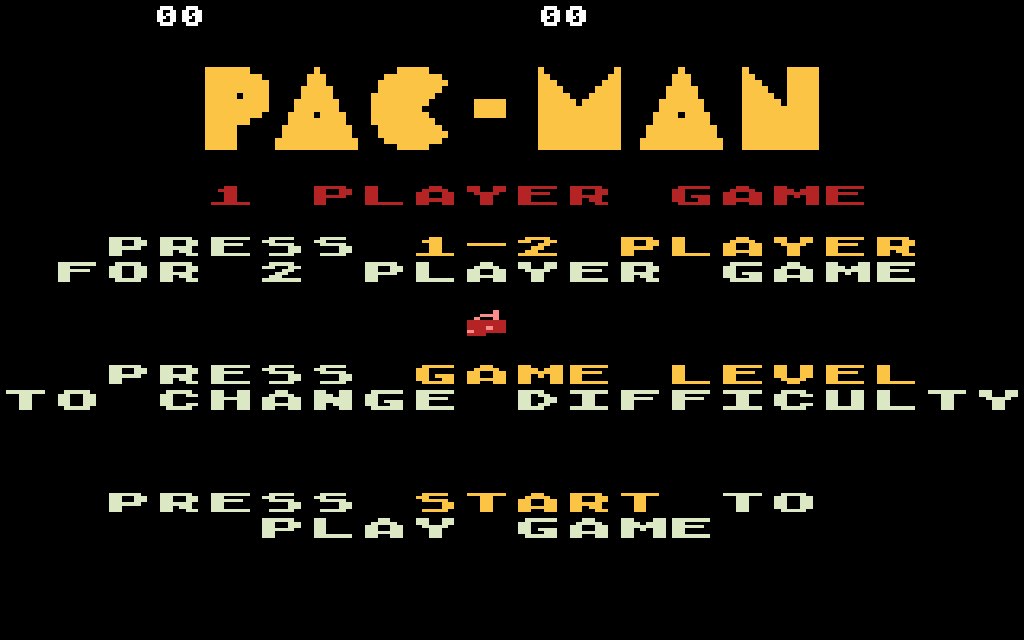
Better still, it plays like Pac-Man. The speed is close to the arcade’s early boards, the ghosts hunt with recognisable intent rather than wandering, and the cornering — shaving turns to gain a half-step on a pursuer — works the way it should. Energiser timing gives you a fair window to turn the tables, and the game obligingly pauses between boards. A player who learned the coin-op will find their instincts transfer, which was precisely the test the 2600 version failed.
Not the arcade — and the stick sees to that
Two things keep this conversion a clear step below the coin-op. The first is pace and polish at the margins: the maze is slightly squashed by the 5200’s display, the waka-waka sound is an approximation rather than the arcade’s gulping chatter, and the intermissions — the little cartoon skits between stages that the arcade used as breathing spaces — are missing entirely. None of these ruin a game, but together they mark the distance between a very good port and a perfect one.

The second is the controller, and it is not a small thing. Pac-Man is a game of committed directions: you hold a course, then snap ninety degrees at the last instant. The 5200’s analogue stick, with its loose centre and rubber-boot resistance, is at its worst exactly there. Turns get missed. Pac-Man slides past a corridor mouth, and Blinky collects the difference. Experienced 5200 hands develop a deliberate, almost exaggerated style — push early, push firmly — and the keypad overlay era produced more than one work-around, but the pad is fighting the game in a way it never fights a shooter. Atari’s programmers did what they could; the hardware vote went the other way.
Why it mattered — and still does
Context is this cartridge’s co-star. Pac-Man became the 5200’s pack-in game in 1983, replacing Super Breakout, and for the rest of the system’s short commercial life this was the disc — well, cart — that defined it in most living rooms. It is the rare pack-in that is also one of the console’s best games, and it holds up as the version that restored a reputation: magazine reviewers of the day treated it as the redemption the 2600 game never got, and they were right. Against its true contemporaries it also compares well: the Atari 8-bit computer Pac-Man is a close cousin, the ColecoVision never got one at all, and only later home versions — Ms. Pac-Man’s own sequel cartridge included — would raise the bar again.
For collectors, it is common, cheap and essential — the first cartridge most 5200 owners reach for and the one visitors ask to see. Played today, ideally with a rebuilt or replacement controller, it delivers the real game’s rhythm with only period-authentic compromises. The stick will still cost you a life now and then. The maze, the ghosts and the chase are all present and correct, and for a machine whose story is usually told as a failure, that counts as a win.
Difficulty, cherries and the long game
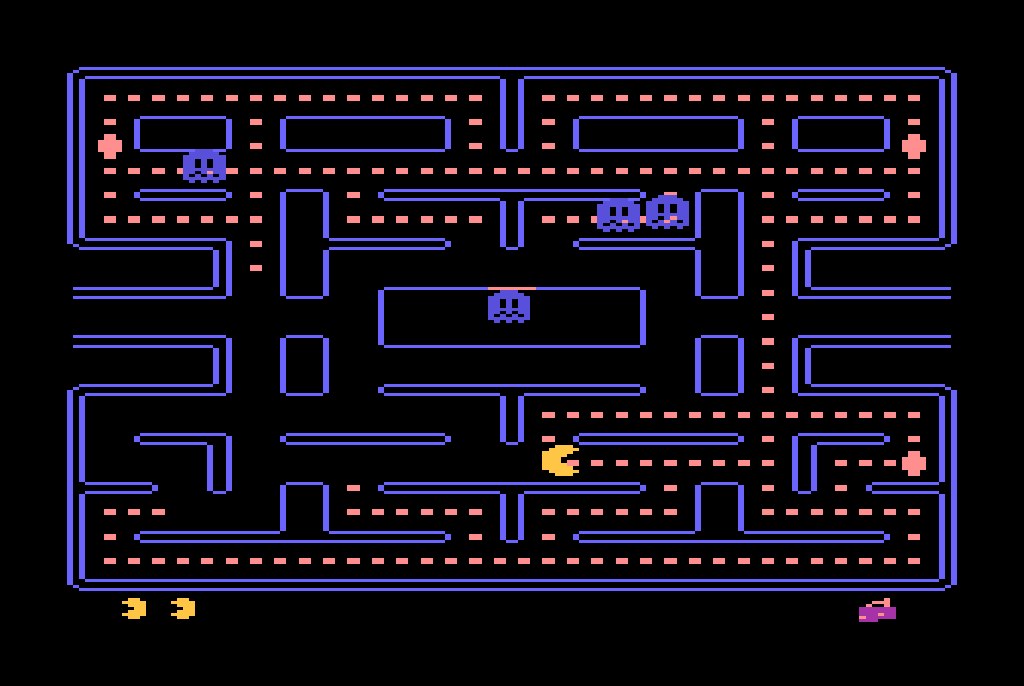
The conversion’s options deserve a mention, because they extend the cartridge’s life considerably. The difficulty selection — framed on the options screen as game levels — changes the terms in the arcade’s own spirit: ghosts get faster and smarter, the frightened time after a power pellet shrinks, and the fruit ladder climbs. On the easiest setting this is a welcoming game that a novice can genuinely clear boards on, which mattered in 1982 and matters now when the cartridge is handed to a visitor. On the hardest, it is a serious examination that will humble anyone whose Pac-Man is purely recreational. An extra life at a sensible score, two-player alternating play, and the high-score table complete a package that Atari plainly intended to be lived with, not sampled.
There is also pleasure in the small print. The ghosts’ eyes travel back to the pen when eaten. The bonus fruit sits under the pen exactly where it should. The little jingle that opens each board is the right jingle, or near enough that your memory fills the difference. Compare that checklist with the 2600 version’s — ghosts of one colour flickering in turns, a hero who faced two ways, pellets like dashes — and you understand why 5200 owners were insufferable about this cartridge in 1983, and why the machine’s owners still reach for it first. It was proof of concept for the whole SuperSystem idea: that the gap between arcade and home was a choice manufacturers had been making, not a law of nature.
One caution for today’s players: go in with period expectations of the audiovisuals. The maze’s blue is the right blue and the sprites are the right shapes, but this is a 1982 rendering — no attract-mode demos, no digitised anything, sound built from POKEY’s square waves. What you are buying is fidelity of play, and on that measure the cartridge has few equals on its system.
The ghosts, properly introduced
A final measure of the port’s seriousness is the ghost behaviour. The arcade’s four ghosts are not interchangeable: Blinky hunts your position directly, Pinky aims ahead of you, Inky’s targeting is a vector trick involving both you and Blinky, and Clyde wanders off when he gets close. No home port of the era reproduced that mathematics exactly, and this one is no exception — but it preserves the practical consequence, which is that the four ghosts feel different to play against, spreading, cornering and hesitating in recognisably individual ways rather than homing as a pack. Patterns exist, as they should; the early boards can be learned, and a practiced player will run up the score the arcade way, by routing. The deeper boards, though, belong to improvisation, and the cartridge’s escalating speed makes sure of it. That balance — learnable but not solvable — is the soul of Pac-Man, and it is present here in a way it simply was not on the machine this console replaced.
Verdict: The redemption cartridge: a faithful, colourful, properly-playing Pac-Man that finally brought the arcade home, held back from the top tier only by its own console’s controller. 8.0/10