At a glance: Galaxian · Atari 5200 · Atari (Namco licence), 1982 · Fixed shooter · Score: 7.0/10
Galaxian was the game that taught the arcade to use colour properly. Namco’s 1979 original put a formation of alien insects on a starfield, gave them the nerve to peel off and dive at you, and made every home system of the following half-decade prove it could keep up. The Atari 2600 version, for all its charm, plainly could not — its aliens were blocky, its formation stuttered, and the whole thing felt like a souvenir of the arcade game rather than the game itself. The 5200 conversion, arriving as an early showcase for the SuperSystem in 1982, exists to make the opposite point: this hardware could do the formation, the dives and the starfield all at once, and make it look easy.
The formation, faithfully
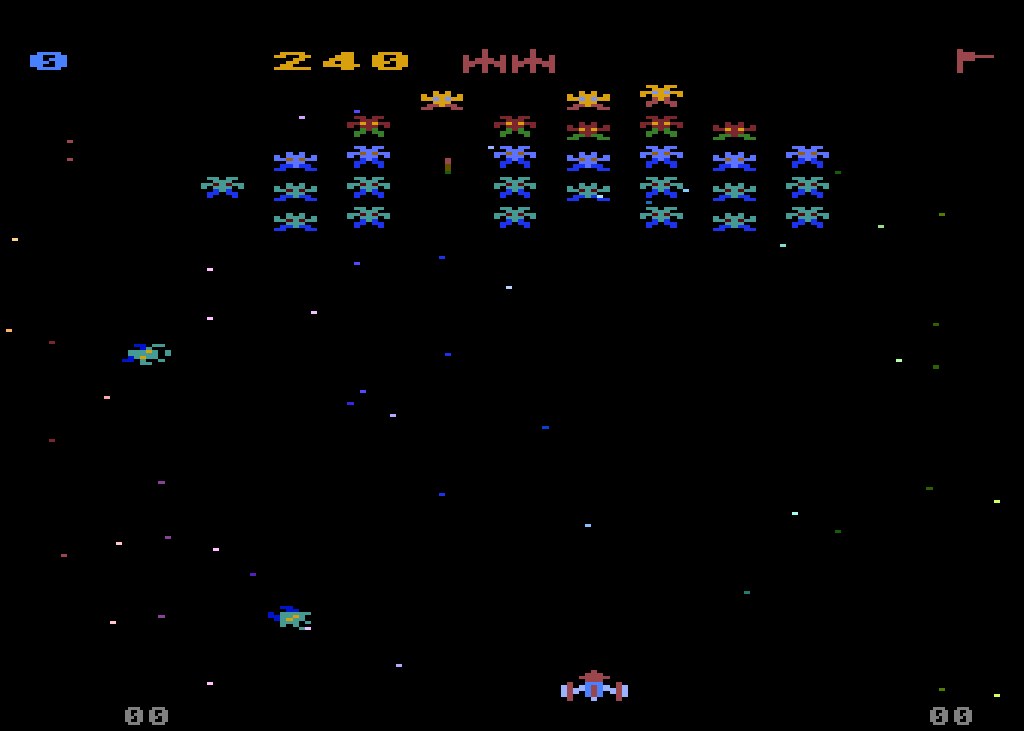
Fire it up and the first thing you notice is how complete the picture is. The full convoy is there — the red flagships with their escorts, the rows of blue and purple drones beneath — drawn in multiple colours, holding formation against a scrolling starfield, while your ship sits at the bottom with a proper reserve display. When the aliens dive, they dive in the arcade’s swooping curves rather than the straight-line drops lesser conversions settled for, and they shoot on the way down. Your own firepower follows the arcade rule of one shot on screen at a time, which modern players may read as stinginess but which is actually the game’s whole tactical engine: every shot is a commitment, and a miss while a diver is bearing down on you is a small emergency.

Compared side by side with the 2600 cartridge, this is not an incremental improvement but a different class of conversion. Compared with the Atari 8-bit computer version, with which it shares a great deal of DNA, it is essentially the same strong game wearing console clothes. The 5200’s version keeps a good pace, the difficulty curve is honest, and the flagship’s 800-point dive — if you can take out its escorts first and then the flagship itself — remains one of the great risk-reward shots of the fixed-shooter era.
Where the shine comes off
The conversion is not flawless. The sound is the thinnest part of the package: the arcade’s warbling background hum is reduced to a sparse approximation, and the explosion effects are functional rather than thrilling. POKEY, the 5200’s capable sound chip, would go on to do far more characterful work in other cartridges. There is also the unavoidable question of the controller. Galaxian only needs left, right and fire, so the 5200 stick’s analogue wandering matters less here than in most of the library — but its long throw still makes fine positioning at the screen’s edge feel swimmy, and the side fire buttons are small targets in a panic. A decent gamepad-era player will adapt within minutes; a purist will grumble for longer.
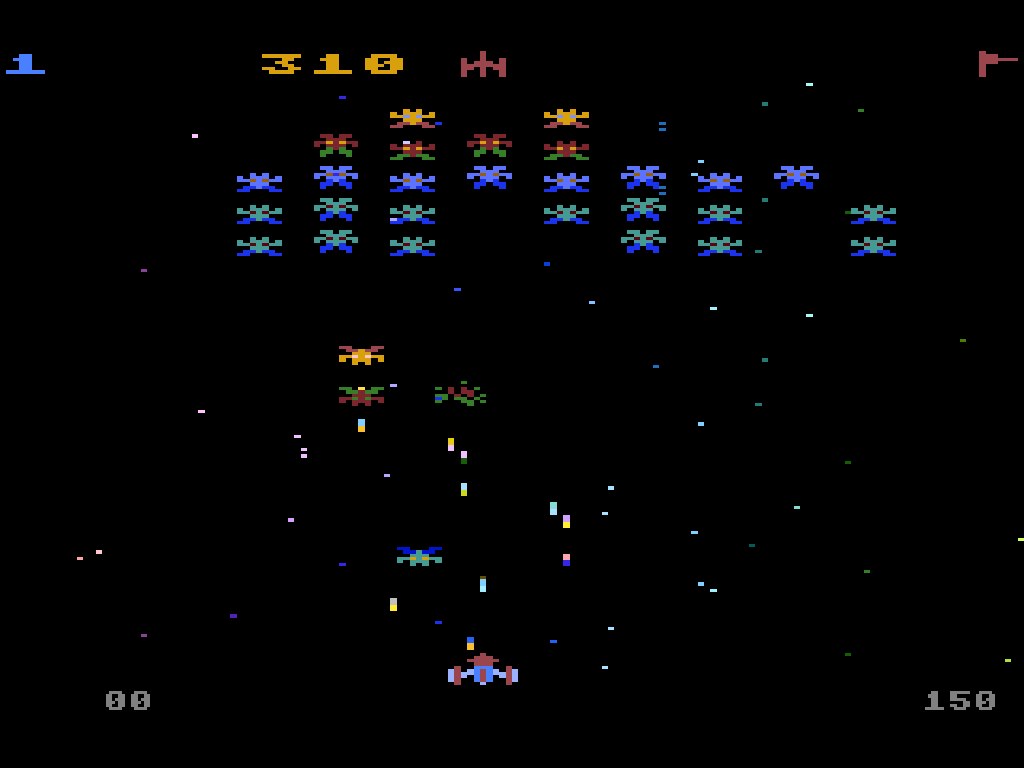
Options are respectable for 1982: you can select your starting level of aggression within limits and play alternating two-player games, and the scoring table is the arcade’s own. What you do not get is much in the way of extras — no bonus modes, no remixed formations. This is a port, proudly and plainly, of a three-year-old arcade game, and by the time the 5200 launched, Space Invaders-style fixed shooters were already being displaced in players’ affections by scrolling games and maze chases. Galaxian on the 5200 was therefore slightly old-fashioned the day it shipped.
The verdict on the convoy
None of that stops it being a genuinely good cartridge. The fixed shooter lives or dies on the feel of the formation and the dive, and both are right here: colourful, smooth and faithful, with the one-shot discipline intact. If you are assembling a 5200 library, this is the version of Galaxian that finally did the coin-op justice at home in its era, and it plays a cleaner, fairer game than the machine’s reputation suggests. It is not the system’s most exciting shooter — that argument belongs to the twin-stick games — but as an early proof that the SuperSystem hardware could deliver arcade colour and motion, it did its job beautifully.
The tactics the formation teaches
Spend real time with the 5200 Galaxian and its depth declares itself. Because you can only have one shot in flight, the game becomes about choosing targets, not spraying: the diving alien is worth multiples of the one in formation, but shooting at a diver means committing your single bullet to a moving target while the rest of the convoy presses down. The flagships are the connoisseur’s obsession. A flagship diving alone is worth 100 points; diving with both escorts alive, killed last after its guards, it is worth 800 — a bonus the game never explains and the manual only hints at, which makes discovering the order of kills one of the era’s great pieces of arcade folk knowledge, fully preserved in this conversion. Whole evenings can disappear into setting up that one perfect dive.
The difficulty curve deserves credit, too. Each new wave flies lower, dives more often and shoots more freely, but the escalation is graduated rather than spiked, so improvement feels earned: the formation that overwhelmed you last week becomes this week’s warm-up. Extra ships arrive at sensible score intervals, and the two-player alternating mode made it a fixture of the era’s high-score duels — passing the controller on death, groaning at the other player’s lucky flagship, demanding the next go. Galaxian is a game built for that ritual, and the cartridge supports it completely.
There is a final point of context that flatters it. When this cartridge shipped, the fixed shooter was supposedly finished — the market had moved on to mazes and ladders. The 5200’s Galaxian arrived anyway and sold on the strength of being definitive: the home version you bought when you wanted the matter settled. In a library that would go on to include faster and more modern shooters, it remains the one that plays most like 1979 felt, and there is real value in a machine keeping one perfect time capsule of the genre that started everything.
A word about its famous sequel-shaped shadow
Every Galaxian review eventually has to answer for Galaga, the 1981 sequel that swallowed its parent’s fame whole — the dual fighters, the capture-and-rescue, the challenge stages. The 5200 never received Galaga, which makes this cartridge the system’s whole statement on the series, and it is a statement worth hearing on its own terms. Galaxian is the sterner, purer game: no power-ups, no second ship, no spectacle beyond the formation and the dive, and a scoring system that rewards study rather than spectacle. Players raised on Galaga sometimes find it austere. Players who meet it here, in this faithful form, tend to find it hypnotic — a game reduced to three questions. When do I fire? Who do I fire at? And how long do I dare hold my position while the diver decides whether I was right? The cartridge asks those questions at the arcade’s tempo, in the arcade’s colours, and forty years of sequels have not improved the asking.
One more practical word: because it was a launch-window title, Galaxian is an easy cartridge to find and a cheap one, and the two-player mode makes it a natural first purchase alongside the pack-in games. Every 5200 library needs a fixed shooter to call its own; this is the definitive one for the machine’s first era.
Verdict: The arcade formation, in colour, at home, at last — thin sound and a swimmy stick keep it from greatness, but this is the Galaxian conversion its decade deserved. 7.0/10