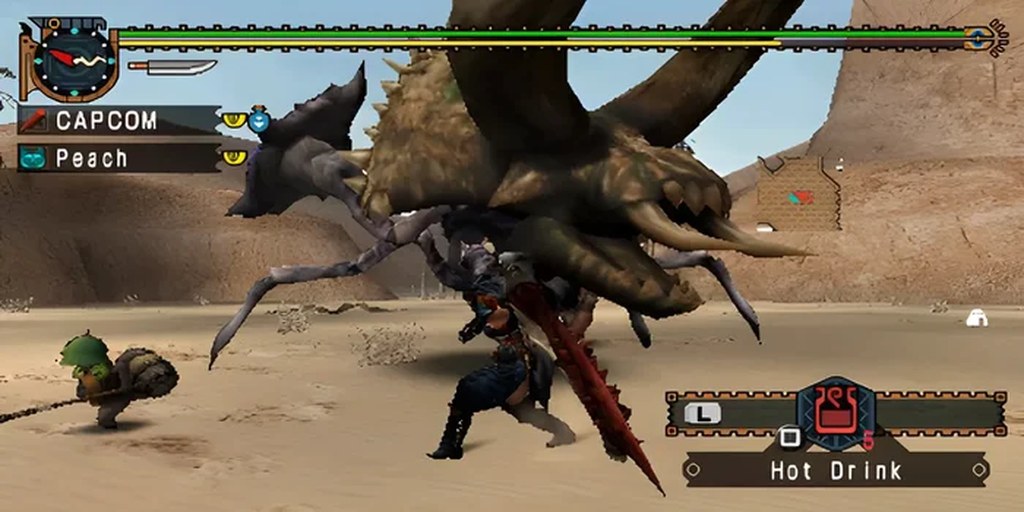
At a glance: Monster Hunter Freedom Unite · PSP · Capcom, 2008 (JP) / 2009 (West) · Action RPG · Score: 9.5/10
Some games you finish. Monster Hunter Freedom Unite you move into. Capcom’s expanded version of Monster Hunter Freedom 2 is the largest game the PSP ever held: several hundred quests, over sixty large monsters, a guild hall, a farm, a kitchen staffed by cats, and a playtime ceiling so high that Japanese players measured it in school terms and job tenures. It sold in the millions, turned PSP ad-hoc multiplayer into a national social ritual, and remains the fullest expression of what Monster Hunter was before World brought it to the world.
The premise never changes and never needs to: you are a hunter in the village of Pokke, and there are monsters. You take a quest, track the beast through a segmented wilderness of snowfields, swamps and volcanoes, fight it with a weapon the size of a door, carve its body for parts, and forge those parts into better armour so you can hunt a bigger monster. The loop is ancient, transparent and completely absorbing, because every verb in it is earned.
Eleven weapons, eleven different games
Freedom Unite offers eleven weapon classes, and the word class undersells it — the Great Sword’s charged, positional chess shares almost nothing with the Hunting Horn’s buff-singing support play or the Bowgunner’s ammunition economy. Mastering one is a hobby; the game assumes you will eventually dabble in three. Combat is deliberate to a degree modern players may find shocking: animations commit, there is no lock-on worth the name, and every swing is a small contract you sign with your positioning. When a Tigrex turns, you learn. When it turns again, you are already somewhere else.

The bestiary is the series’ golden-age roster at full stretch: the flagship Tigrex, the bladed Nargacuga new to this entry, elder dragons like Teostra and Chameleos, and the series’ ultimate examinations — White Fatalis, and the G-Rank gauntlet that Unite adds above the old high rank. G-Rank is not a difficulty slider; it is a second game stacked on the first, with new monster behaviours, new materials and armour sets that make the previous hundred hours look like a tutorial with better catering.
Better with hunters — by design
Solo players are catered for and then some: the Felyne Comrade system gives you an AI cat partner whose personality, skills and enthusiasm you cultivate, and the entire quest ladder can, with skill and stubbornness, be climbed alone. But Unite was built for four hunters in a room, PSPs linked by ad-hoc Wi-Fi, and in Japan that is exactly how a generation played it — in fast-food booths and train carriages, strangers teaming up over a Rajang. The West got the same game without the same culture, which makes its Western cult following all the more deserved.
Technically it is a marvel of compression and compromise. Load screens separate the hunting zones — the era’s signature — yet each zone is dense, vertical and distinct, and the monsters animate with a weight and readability that handheld hardware should have fumbled. The camera, wrestled with the claw grip veterans still joke about, is the game’s one true villain; every other frustration — a hip-check’s generous hitbox, a Rathalos who will not land — is at least the game’s own honest cruelty.

The time question
Freedom Unite’s real review score is measured in hours, and it demands them without apology: drop rates that treat a rare plate as a rumour, gathering quests padded into the early ranks, and a learning curve like a cliff face with a gift shop at the top. Newcomers in 2026 have friendlier Monster Hunters available. What they do not have, anywhere else on a handheld of this vintage, is this density — this much game, this well made, asking this much and giving more.
Pokke village and the slow life
Between hunts, Unite’s village is a game in itself: a farm to upgrade for honey, mushrooms and ore; a training school that teaches each weapon against fixed monsters; a kitchen where Felyne chefs cook meals whose skill buffs — health, stamina, the occasional miraculous defence boost — become part of your pre-hunt ritual. The Pokke farm’s quiet economy matters more than it first appears, because Unite’s true currency is preparation. The hunter who grows, combines and plans in the village is the hunter who carts less in the field, and the game makes that lesson feel like husbandry rather than homework.
Reading the monsters
What separates Monster Hunter from the action RPGs it inspired is that its monsters are animals, not puzzles. A Rathalos has tells, habits, a limp when it is dying and a habit of retreating to its nest to sleep — during which a prepared hunter lays barrel bombs beside its head. Unite’s roster teaches this literacy monster by monster: the Khezu teaches spacing, the Plesioth teaches humility about hitboxes, the Tigrex teaches that sometimes the correct input is running away beautifully. There are no health bars. You learn to read wounds, rage states and exhaustion the way the game’s own hunters would.
The G-Rank wall — and the door in it
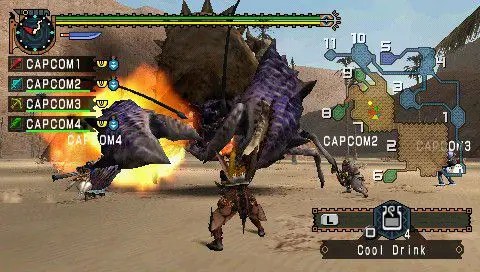
Veterans measure Unite by its top end: G-Rank quests where a Nargacuga’s tail-slam arrives a half-beat faster than muscle memory expects, and event quests that pair two apex monsters in one arena as a joke you are invited to survive. The sensible response is company — four hunters with planned roles trivialise what solo players spend evenings on — but Unite never locks its best content behind the multiplayer gate. Every wall in this game has the same door: better armour, a sharper weapon, a hunter who has stopped panicking. It is demanding in the way mountains are demanding, and for the same reason people keep climbing it.
A portable institution
Context is part of the review: in Japan, Freedom Unite — sold as Monster Hunter Portable 2nd G — was not merely a hit but a social platform, credited with driving PSP hardware sales years into the machine’s life and training the audience that made Monster Hunter 3 Ultimate and World phenomena. Playing it now, on the hardware it conquered, is the closest games offer to visiting a famous café where a movement started. The coffee is strong, the chairs are hard, and the regulars have been here for a thousand hours. Pull up a seat.
Downloads, crossovers and the long support
Capcom supported Unite the way modern live games are supported, years early: downloadable event quests, crossover armour, joke weapons with real statistics, and challenges that assumed a community trading strategies in schoolyards and forums. The event calendar gave the game a social rhythm beyond its hunts. Much of that content required the era’s infrastructure and community archives to survive — a preservation story in itself — but the philosophy it proved, that a handheld game could be a service and a place, shaped everything Capcom and its rivals did next.
A practical closing note, hunter to hunter: start with the Sword and Shield or the Great Sword, finish the village elder’s quests before living in the guild hall, cook every meal, and never — ever — hunt a G-Rank anything in armour you forged in the game’s first week. Freedom Unite rewards patience with the most generous interest rate in portable gaming. Your first hundred hours are the tutorial. The monsters are waiting, the cats have lit the kitchen, and Pokke village in the snow is still, after all these years, one of gaming’s great home towns.
Verdict
The PSP’s bottomless game and the classic Monster Hunter formula at its peak. If your handheld library can hold only one hundred-hour monster, Unite is the one wearing the crown.