Developer: Konami · Publisher: Konami · Released: October 31, 1991 (Japan, Super Famicom) · December 1991 (North America, SNES) · Platform: Super Nintendo · Genre: Action platformer
Thirty-five years ago today, Konami handed Simon Belmont a whip that could finally go anywhere — and quietly built the finest traditional Castlevania ever made. Super Castlevania IV was the Super Nintendo showing off, the series growing up, and Halloween arriving early, all in one cartridge.
A Launch-Window Showpiece
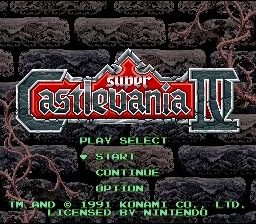
The Super Nintendo needed proof. Through its first year, Sega’s Genesis had the attitude, the arcade ports and a two-year head start, and Nintendo’s beautiful new machine needed a game that made 16-bit feel like a generational leap rather than a fresh coat of paint. Konami — already the NES’s most reliable hit factory — delivered it on Halloween 1991 in Japan, weeks before the console’s first Western Christmas. Super Castlevania IV wasn’t just a sequel. It was a demonstration reel.
Story-wise, it is a retelling of the original 1986 Castlevania: the year is 1691, Dracula has risen again after a century of rest, and Simon Belmont takes up the Vampire Killer whip his family has carried for generations. Konami would later tidy this into the timeline as a remake, but in 1991 nobody cared about canon. What mattered was the scale of the thing — eleven stages instead of six, a Simon sprite nearly twice the size of his NES self, and a castle that felt less like a stack of levels and more like a place.
The team, directed by Masahiro Ueno, understood the assignment precisely. This was not the moment for a difficult experiment or a reinvention; it was the moment to take the most beloved action series on the NES and remove every technical excuse it had ever hidden behind. Contemporary reviews responded like a coronation — the magazines of the day reached for words like “masterpiece” with unusual unanimity — and the game anchored Konami’s SNES catalogue for the life of the console, the cartridge you bought alongside the machine to show relatives what the machine was for.
The Whip Learns New Tricks
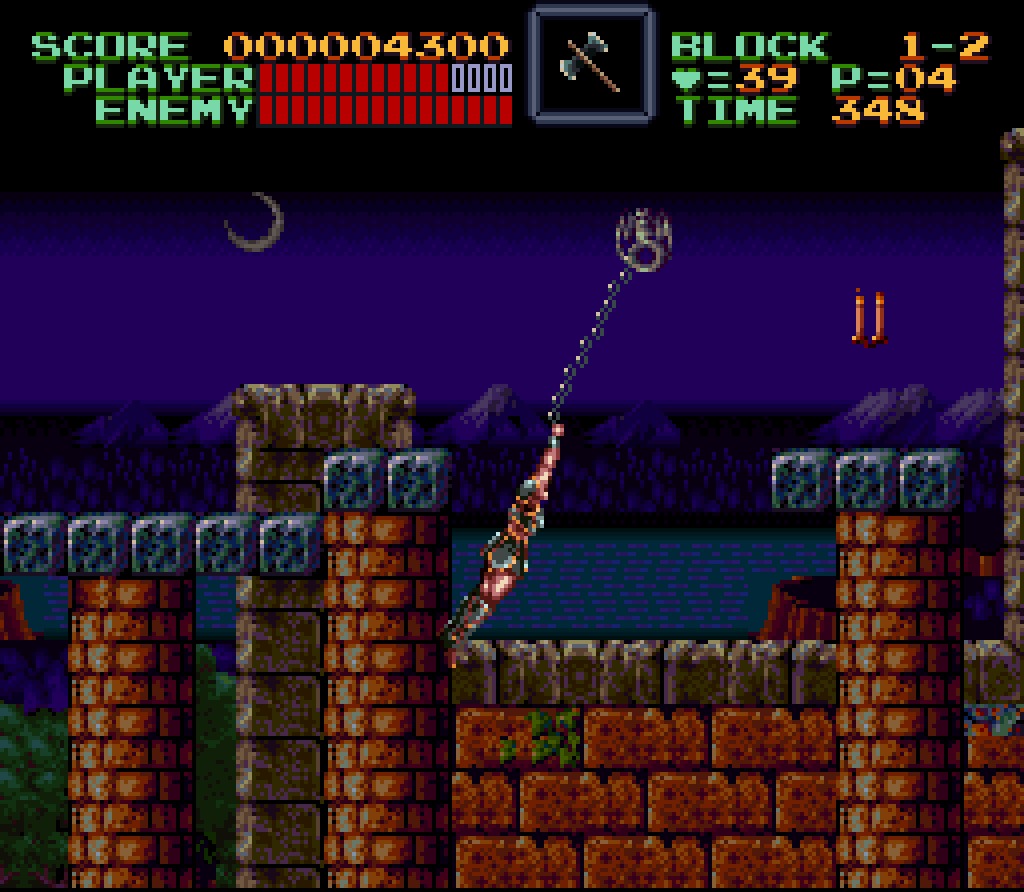
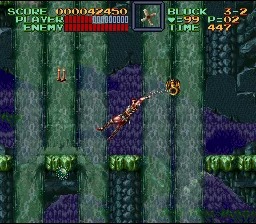
Every Castlevania before this one treated the whip as a metronome: press the button, it cracks straight ahead, on the beat. IV set it free. Simon can whip in eight directions — up, down, diagonally, mid-jump — and can hold the button to let the whip dangle and spin, a floppy little shield that shreds weak enemies and, more importantly, makes you feel like a man conducting an orchestra of violence. He can grab onto rings and swing across gaps. He can even moonwalk up the staircases backwards, a piece of pure showmanship the developers left in because it looked wonderful.
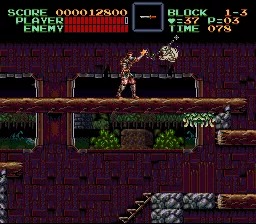
It sounds like a small thing. It rewired the whole series. The stiff, committed jumps of the NES trilogy were a design language built around a whip that only fired forward; give Simon full directional control and the same castle becomes a playground instead of an exam. Purists have argued for 35 years about whether this made the game too easy, and they have a point — IV is the most forgiving of the traditional Castlevanias. But forgiveness, here, is flow. The game trades white-knuckle punishment for momentum, and momentum is why people still replay it every October. (Its staircases, mind you, kept their menace — we have written about exactly why.)
Honesty requires the counterweight. The password system is generous to a fault, the middle stages coast a little on atmosphere, and a player raised on the NES trilogy’s cruelty may finish IV wondering where the wall was supposed to be. The wall is there — it is just in the castle’s final third rather than everywhere at once — but the criticism has followed the game for three and a half decades and it is not baseless. What the decades have settled is the reply: difficulty was never the series’ soul. Atmosphere was, and control was, and on those two counts nothing in the 16-bit era touches this.
Eleven Stages of Escalating Theatre
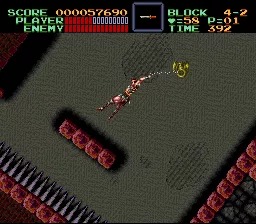
The journey to Dracula is structured as a slow tightening of the noose. You begin outside the castle walls entirely — stables, a haunted forest, a sunken city — and the game spends its first half simply arriving, teaching you its tricks while the castle grows on the horizon. Then the doors close behind you, and IV becomes a tour of everything the SNES could do: a library with floating platforms, a treasury glittering with gold, a clock tower of gears and pendulums, and the stage everyone still talks about — the room in Block 4 that rotates a full 360 degrees around Simon, the entire world turning while he clings to a bar, Mode 7 flexing like a peacock.
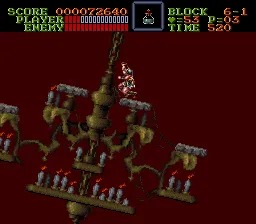
What elevates it beyond a tech demo is restraint. Each gimmick appears once, does its work, and leaves. The chandeliers swing in one room. The waterfalls of the sunken city scroll at their own dreamy pace. Nothing is repeated until it becomes a chore, which is more than can be said for most of the 16-bit era’s showpiece games. IV understood that spectacle is a seasoning, not a meal.
“Super Castlevania IV didn’t just port a series to new hardware — it asked what the whip would feel like if it were free, and built a masterpiece around the answer.”
The Sound of the SNES Growing Up
Composers Masanori Adachi and Taro Kudo had the SNES’s Sony sound chip barely a year old, and they wrote like men who had been waiting for it. The score opens with funereal organ and doesn’t let up: “Theme of Simon Belmont” is all swaggering brass, while the arrangements of the NES classics — “Vampire Killer,” “Bloody Tears,” “Beginning” — are treated like standards being reinterpreted by a jazz band that suddenly had a full orchestra. There’s genuine melancholy in the caverns theme, genuine dread in the cellar. In 1991, game music mostly aspired to be catchy. This aspired to be scored. It is still, track for track, one of the three or four finest soundtracks on the console.
The Gauntlet, and the Sunrise
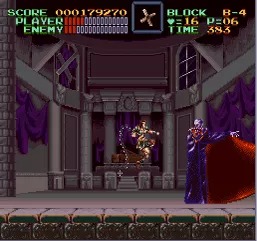
The endgame is a procession of old friends executed perfectly: Slogra and Gaibon, tag-teaming like a double-act; Death, patient and cheap in the grand tradition; and finally Dracula himself, teleporting around his throne room as the music turns to a funeral march. He is, honestly, not the hardest thing in the game — the clock tower kills more players than the Count ever will. But the ending earns its place in history anyway: as Dracula dies, sunlight streams through the castle window and burns him away, one of the first genuinely cinematic finishes the series ever attempted. No text crawl of destiny. Just dawn, doing the work.
The Argument It Started
Every great Castlevania since has been measured against this one, and the measuring has never really stopped. Two years later, Rondo of Blood on the PC Engine CD offered branching stages, a second playable character and an anime sheen, and its partisans will tell you — at length, and not wrongly — that it is the richer game. In 1997, Symphony of the Night dissolved the formula entirely into exploration and RPG systems, and the series never went home again. Which leaves IV standing as something its successors made precious by accident: the purest, fullest expression of the original idea. No map. No levels-ups. No backtracking. Just a man, a whip that finally does everything a whip should, and a castle arranged like an argument — eleven stages long, each one making its point and moving on. The debate about the best Castlevania is really a debate about what Castlevania is, and IV is the traditionalists’ Exhibit A, the one they slide across the table when the talking gets serious.
Playing It in 2026
Konami has kept this one in print with unusual diligence. It sits on the SNES Classic Edition mini console, headlines the Castlevania Anniversary Collection on every modern platform, and the original cartridge — while no longer cheap — remains common enough that nobody is priced out of the real thing. However you reach it, it holds up with an ease that games five years younger can’t manage. The whip still feels modern. The music still sounds expensive. And every October, when the nights draw in, it remains the single best reason to believe that the traditional, stage-by-stage Castlevania — before the maps, before the RPG numbers — reached its peak on a Halloween night in 1991 and never quite needed to go further.
Score: 9.5/10. The finest traditional Castlevania and one of the SNES’s defining games — a whip set free, a castle built like theatre, and a soundtrack that still sounds expensive. Docked half a mark only because its generous heart makes the Count himself the easiest thing in his own castle.