
The Philips CD-i is the most famous failure in games history – a billion-dollar multimedia platform that sold around a million players, lost its maker a fortune, and is remembered by the entire internet for three Zelda games it never wanted to be famous for. But the jokes have eaten the history. The CD-i was a serious attempt by the company that co-invented the compact disc to define what interactive media would be, it midwifed the technology that became Video CD and helped shape DVD, and its afterlife – memes, remakes, homebrew, HDMI mods – is more vibrant than most successful consoles enjoy. This is the complete story of the punchline that pioneered: how it was conceived, how it consumed a fortune, and how it became, against every intention of its maker, immortal.
The Green Book Dream: Philips Invents a Medium
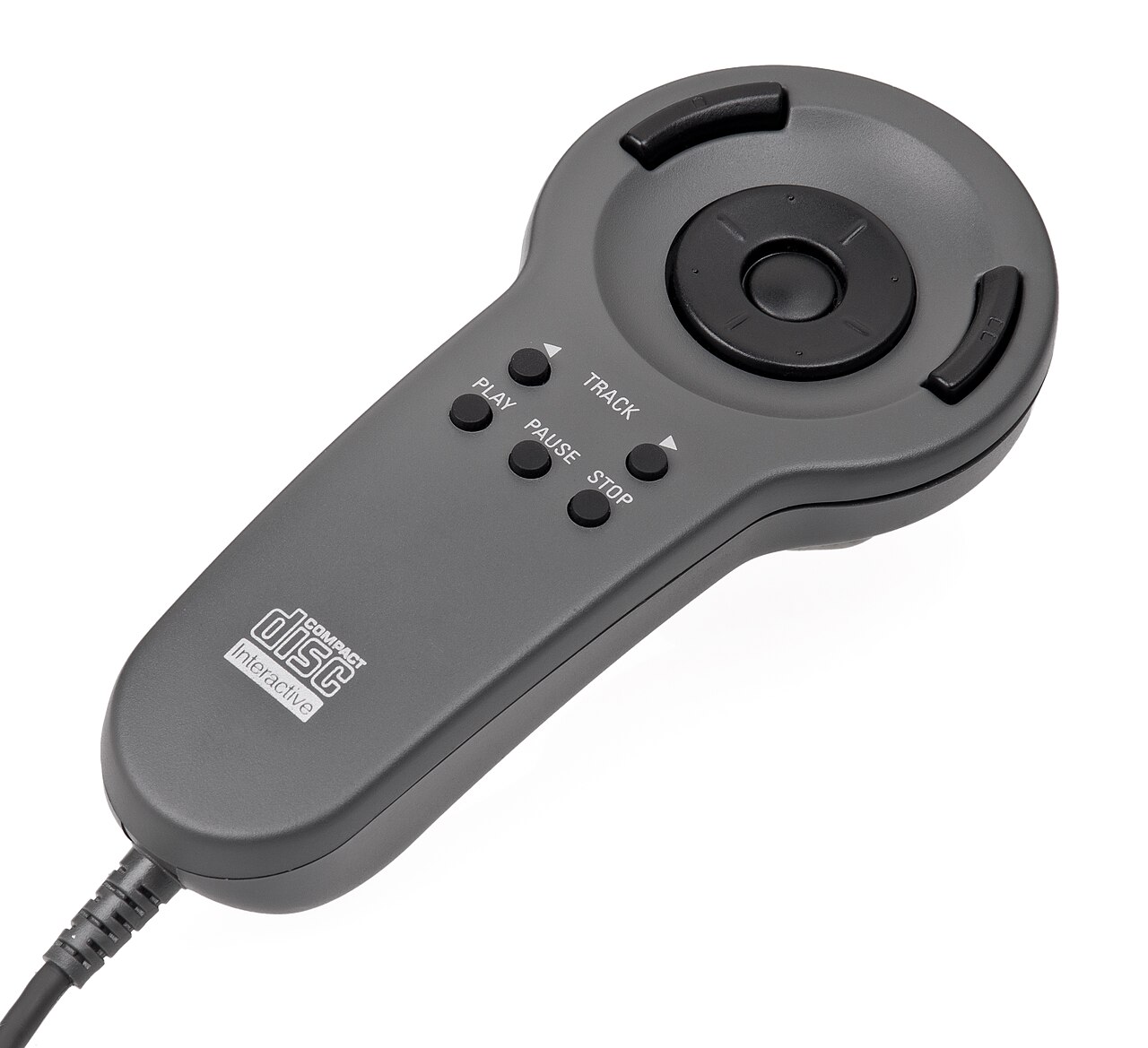
CD-i – Compact Disc Interactive – began not as a console but as a publishing standard: the “Green Book,” issued by Philips and Sony in 1986, specifying how audio, video, text, data and software could interleave on a CD for interactive playback. Philips, which had co-created the compact disc itself, regarded the format as the natural successor to its empire: one disc for the encyclopedia, the language course, the film and the game, played on a television-attached appliance by people who would never buy a computer. The gestation was stately to a fault. Announced in the mid-eighties, CD-i players reached the market only in 1991, led by the CD-i 910 at a formidable launch price, running a Motorola 68000-family processor under Microware’s OS-9, with full-motion video arriving via a plug-in Digital Video cartridge built on the new MPEG-1 standard – the work that fed directly into the Video CD format and, downstream, the whole optical-video era. The positioning was deliberate and fatal: Philips insisted CD-i was not a games console. It was a multimedia system for families, schools and businesses, sold in electronics departments, its catalogue weighted toward reference works, training and “edutainment,” its primary controller – a one-handed paddle with a thumbstick nugget, part remote control, part wand – designed for pointing at menus from a sofa. Everything about the proposition was coherent, except the market: in 1991 a $700-1,000 appliance for interactive encyclopedias was competing for the same household money as $150 consoles with Mario on them. It was competing, too, against the suspicion that the whole idea of interactive television was a solution in search of a problem that most households did not yet know they had.
The Nintendo Deal and the Zelda Catastrophe
The CD-i’s path to immortality runs through the industry’s most famous betrayal. In June 1991 Nintendo, publicly humiliated by Sony’s unveiling of their joint “Play Station” project, escaped into Philips’s arms: by October the companies had announced their own SNES CD partnership. The add-on never shipped – but the contract’s licensing clause did its quiet work. Philips held rights to use Nintendo characters in CD-i games, and it exercised them: Link: The Faces of Evil and Zelda: The Wand of Gamelon (1993), produced by Animation Magic – an American-Russian studio working at speed and on a shoestring, whose hand-drawn cutscenes became the most parodied animation in the medium – followed by Zelda’s Adventure (1994) and the puzzle game Hotel Mario (1994). Contemporary reviews were kinder than legend allows (the side-scrolling pair drew respectable marks in places for scope and music), but the internet decade re-judged them absolutely: from the mid-2000s the cutscenes – “Mah boi,” the shopkeeper’s rubies, dinner – became foundational raw material for YouTube Poop and remix culture, and the CD-i Zelda games were crowned the worst ever made by an audience that had never played them. Nintendo has never acknowledged the titles since. The irony is structural: Philips’s billion-dollar platform is remembered, globally and permanently, for licensed games made in months by a subcontractor – and that infamy, as the afterlife below shows, is precisely what keeps the machine alive.
The Zelda Games, Forensically
Because the four Nintendo titles are the CD-i’s public meaning, they deserve the forensic paragraph their memes never give them. Faces of Evil and Wand of Gamelon were produced simultaneously by Animation Magic, a studio whose animation workforce sat in post-Soviet St. Petersburg – the cutscenes’ distinctive look is partly an artefact of a young Russian animation industry working fast in a style its directors didn’t supervise closely. The games beneath the films are more substantial than their reputation: side-scrolling action adventures in the Zelda II mould, with large interconnected maps, dozens of voiced characters and a scope contemporary reviewers noticed even while flinching at the controls and the cinema. Zelda’s Adventure, from Viridis, took the opposite approach – a top-down structure recognisably modelled on the original Zelda, wrapped in live-action filmed sequences – and is by most sober accounts the most playable of the three, and the least meme’d, because competence doesn’t remix. Hotel Mario is a perfectly serviceable single-screen arcade puzzler executed by its own cutscenes. The forensic era has been kind to all four: fan remasters of the Animation Magic pair (four years of unpaid labour, released in 2020) let the games be played with modern controls and widescreen, speedrunners and irony-players built genuine communities, and the design community’s verdict settled somewhere honest – flawed, cheap, fascinating artefacts of a licensing accident, made by people working harder than the jokes allow. Nintendo’s official position remains a silence so complete it functions as erasure; the internet’s position is total recall. The internet is winning.
Beyond the Memes: The Actual Library
Strip the jokes away and the CD-i catalogue – roughly two hundred titles – is a genuine pioneer corpus. Its spine was the multimedia Philips had promised: interactive encyclopedias, music and art explorations, language and training courses, reference discs that genuinely prototyped the web-era idea of the living-room information appliance. Its games, the minority pursuit, included work of real merit: Burn:Cycle, a cyberpunk FMV adventure of legitimate ambition and atmosphere; strong ports of The 7th Guest and Myst, titles whose CD-native design suited the platform better than any cartridge machine; the Don Bluth laserdisc conversions (Dragon’s Lair, Space Ace) finding their natural disc-based home; Inca and its sequel, Coktel Vision’s gloriously strange space-Inca adventures; Chaos Control and a tail of European productions, some of them, in the European catalogue, cheerfully adult in a way no console of the day would have countenanced. And there was the Digital Video library proper: feature films sold on CD-i and Video CD in the half-decade before DVD, a real retail category that trained a generation of Philips’s customers to expect movies on five-inch discs. Judged as a games console the catalogue is thin. Judged as the first attempt at a unified home media format, it is the missing link between the laserdisc era and the streaming one.
The Hardware Zoo: A Format, Not a Console
Because CD-i was a standard rather than a product, its hardware is a zoo rather than a line. Philips’s own range ran from the sober consumer decks (the 200-series that most owners knew) through the games-leaning 450 and 550, to portables with built-in LCD screens that were, in 1994, close to science fiction. Third-party makers licensed the badge: Magnavox sold Philips’s designs in America, Goldstar built players for the Korean and US markets, Kyocera and others served professional niches, and – the era’s sweetest irony – Sony, co-author of the Green Book and by 1994 Philips’s nemesis in the Nintendo affair, manufactured its own professional portable CD-i player for the education market. Around the players accreted an ecosystem of pointers, touchpads, mice and keyboards for the edutainment catalogue, and the crucial accessory: the Digital Video cartridge, an MPEG-1 decoder that slotted into most models and unlocked full-screen film playback, making the fully-specified CD-i a two-purchase proposition at precisely the moment the 3DO was making the same mistake at $699. The discs, meanwhile, quietly advanced the state of the art: CD-Bridge formatting let the same pressing serve CD-i players and Kodak’s Photo CD ecosystem, and the bridge work fed directly into the White Book that defined Video CD – the format through which much of Asia watched films for a decade, long after the players that inspired it had left the shops. The CD-i’s standards legacy is entirely real. It is also, historically, the problem: Philips had built infrastructure, and what the market wanted in 1991 was a toy.
The Format War Nobody Won
The CD-i did not lose to the SNES. It lost a category. The early nineties hosted a full multimedia format war that hindsight has compressed into a footnote: Commodore’s CDTV (an Amiga in a hi-fi case, launched months before CD-i players), Tandy’s VIS, the 3DO company’s licensing empire, Pioneer’s LaserActive, and CD-i itself, all preaching the same sermon – the television appliance that would absorb entertainment and information – while the actual congregation quietly bought home PCs. The PC’s CD-ROM drive was the assassin of every appliance in the war: by 1994-95 a family computer played the encyclopedias better, the edutainment deeper, the games incomparably richer, and upgraded for the price of a CD-i Digital Video cartridge. Windows 95 finished the argument. Each appliance’s post-mortem differs in flavour – CDTV died of Commodore, 3DO of price, VIS of indifference – but the CD-i’s is the cleanest case of the category error, because Philips executed its plan competently: the standard was sound, the video technology genuinely led somewhere (VCD, and Philips’s seat at the DVD table), the professional niches were real. The plan simply answered a question the public had decided, by about 1993, to ask its computers instead. What remained for the CD-i, once the sermon was over, was the games it had disdained – which is why the games-leaning 450 reads like a white flag, and why the platform’s real history begins, perversely, only after its strategy ends. The consortium coda matters, though: in 1995 Philips and Sony – the Green Book’s parents, estranged by the Nintendo affair – reconciled to co-sponsor the format that finally achieved the unification CD-i had promised, the DVD. Every DVD menu ever authored, with its chapters, extras and cheerful interactivity, is the CD-i sermon delivered a decade late on a disc the public actually bought; Philips’s billion-dollar tuition bought the industry, if not itself, an education in how home media converges.
The Empire of Kiosks: CD-i’s Institutional Career
The consumer story is a failure; the institutional one is a modest, real success, and it explains the format’s long tail. Philips aimed CD-i squarely at organisations that needed interactive media without computer literacy, and through the mid-nineties the players quietly accumulated in the world’s unglamorous corners: dealer-training programmes for car manufacturers, interactive holiday brochures on travel-agency counters (a British high-street staple of the era), museum and visitor-centre exhibits, language laboratories, corporate induction courses, and the reference-and-edutainment catalogue – Compton’s Interactive Encyclopedia and its kin – that schools bought for the same reason they bought the players: no keyboard, no configuration, no fear. This is the market the Green Book’s authors had, at bottom, designed for, and in it CD-i performed respectably for most of a decade, outliving its consumer obituaries by years. The history books record the format war’s appliances as a row of tombstones; the facilities managers of 1996 would have recognised at least one of them as office equipment. When production finally ended in 1998, the CD-i had been manufactured for seven years – a lifespan most “successful” consoles of the CD era would have taken gladly – it had simply spent most of it where the games press never looks.
The Long Fade: A Billion-Dollar Identity Crisis
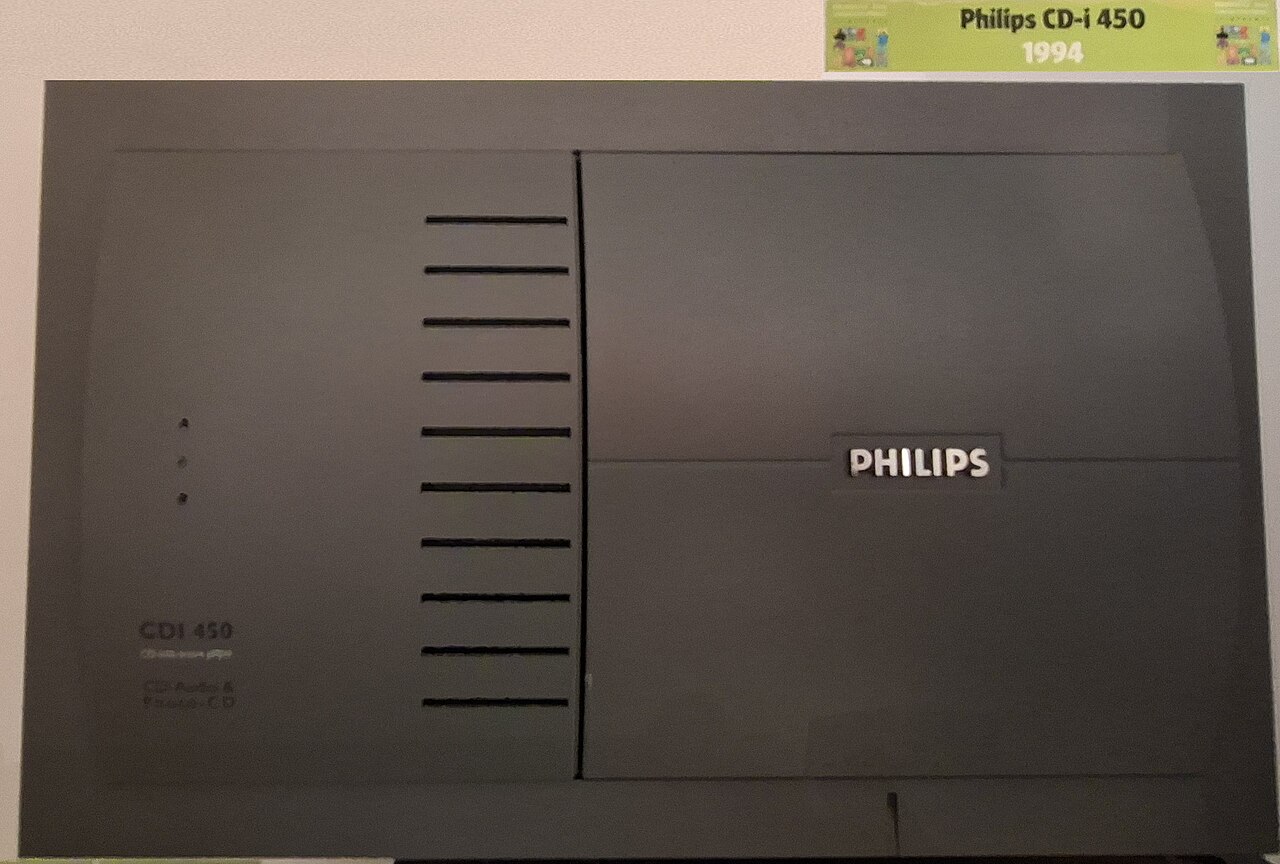
The CD-i’s failure mechanics were the 3DO’s, squared: too expensive, in the wrong shops, with the wrong controller, marketed for purposes its buyers couldn’t picture – while being shown, quarterly, what a real games phenomenon looked like. Philips iterated gamely: prices fell, the catalogue’s games share rose, and in 1994 the CD-i 450 – a smaller, cheaper, explicitly games-positioned model – tacitly confessed that the multimedia sermon had failed and the console pitch was the only one left, three years and several Mario generations too late. Total player sales settled around a million worldwide against development and marketing costs reported in the region of a billion dollars, one of the most expensive format bets in consumer-electronics history – a bet placed, moreover, by a company that understood optical media better than any rival alive, which is precisely what makes the outcome instructive rather than merely comic. Yet the obituary needs its footnote: CD-i did not vanish in 1994. Philips sustained the platform in its professional niches – training systems, kiosks, point-of-information installations, the unglamorous industrial career for which the standard had arguably always been best suited – and players remained in production until 1998, seven years after launch: a longer commercial life, quietly, than the Dreamcast managed in the open. The consumer failure is total and the institutional afterlife real, and both facts belong in the record.
Afterlife: Canonisation by Meme
No failed platform has a stranger, warmer resurrection. The pipeline ran: ridicule → remix → nostalgia → scholarship → creation. The Zelda cutscenes’ meme immortality made the CD-i the one nineties format a generation of non-owners could recognise on sight; preservation followed the attention (the CD-i’s disc library is now archived with a completeness luckier failures envy, and emulation through MAME has matured the platform from curiosity to playable record); the hardware scene treats the players as patients worth saving, with modern video modifications – the HDMI conversion chronicled elsewhere on this hub – dragging the punchline into the digital present; and the homebrew developers, the surest sign of a platform’s second life, are producing new software, including the Super Quartet project covered on this shelf. The canonisation was sealed in 2023 when Arzette: The Jewel of Faramore – a loving, openly-declared spiritual successor to the CD-i Zelda games, with original voice talent returning – was received not as a joke but as a tribute, and reviewed like one. Philips built the CD-i to be the future of media and lost a billion dollars proving the timing wrong. What it got instead was permanence of a kind money rarely buys: there are teenagers today who can quote its worst games line by line. The collector market underwrites the verdict in cash – complete copies of the mocked Zelda titles change hands for serious three-figure money, working players are hunted despite (partly because of) their famous maintenance curse, the soldered timekeeper battery whose death takes the machine’s memory with it and which the mod scene now routinely replaces along the way to HDMI. The complete story of the CD-i is that it failed at everything it attempted, and at the one thing it never attempted – being unforgettable – it has no rival.