At a glance: Planet Smashers · Atari 7800 · Atari Corporation, 1989 · Vertical scrolling shooter · Score: 6.0/10
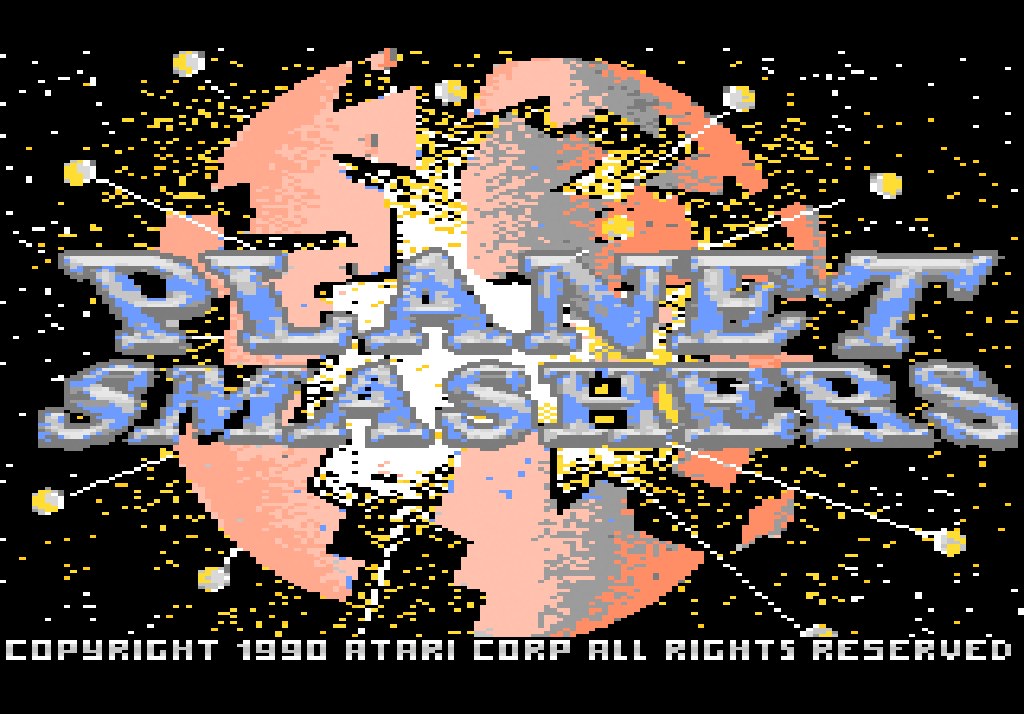
Planet Smashers has the best title screen in the 7800 library and one of its most argued-about games behind it. The art hits first — a shattered planet wrapped in chrome lettering, “COPYRIGHT 1990 ATARI CORP” in the corner — and then the game begins: a vertical shooter in the Xevious lineage, defending Earth itself, whose shield is a literal meter at the bottom of the screen that falls as enemies get past you. It is colourful, fast, ambitious and flawed in ways that start arguments. Forty years of shooter design have taught us to ask a game three questions — is it fair, is it readable, does it escalate — and Planet Smashers answers yes, mostly, and oh yes, in an order that produces its very particular reputation.
The structure will be familiar to Xevious veterans: your ship rises through scrolling space, waves of alien craft descend in formation and in ambush, and ground — well, orbital — installations complicate the lower half of the screen. The distinctive systems ride in the status bar: WARP, RANGE, SHIELD, CLOAK, and the all-important EARTH SHIELD. Power-ups cycle and can be collected to extend your weapon range, cloak your ship briefly, or restore shield; warp points skip you forward through the assault. And underneath everything, the Earth’s shield ticks away whenever the invasion leaks past you, giving the whole game a planetary stakes-clock: this is not just your survival being measured, it’s the home world’s.
Colour everywhere, mercy nowhere
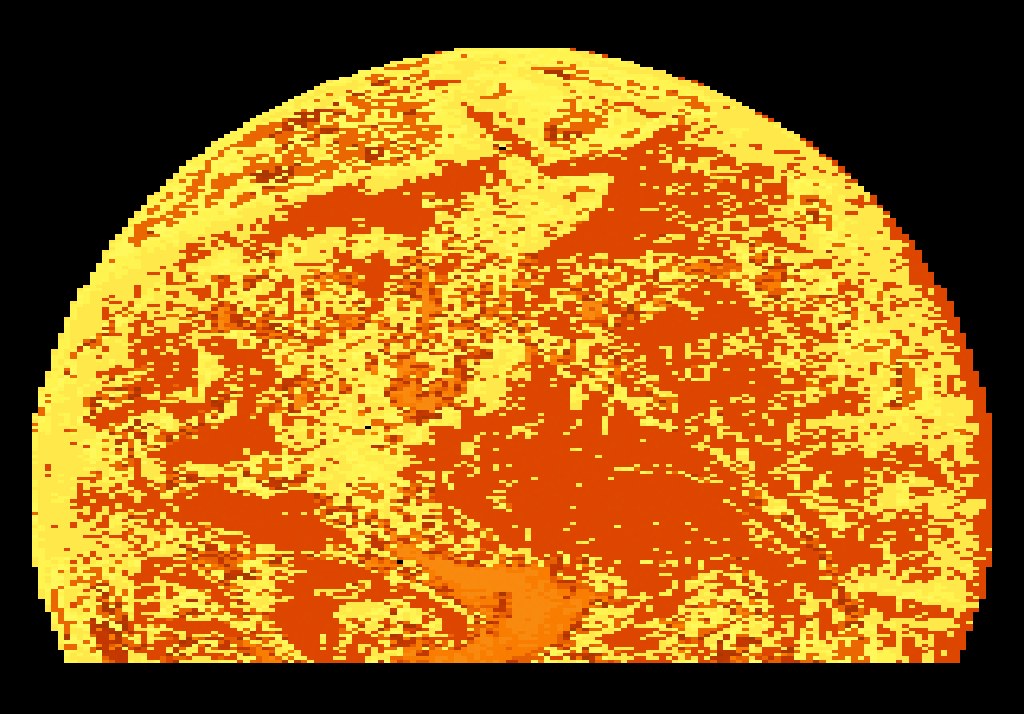
Visually, this is the late 7800 showing off without restraint. Enemy designs are big and strange — crystalline fighters, bulbous carriers, geometric horrors — drawn in saturated colours against the black, and the set pieces include the famous moment when the Earth itself fills the screen, a huge burning disc of a backdrop. There is genuine spectacle here, of a kind the launch library never attempted. The status bar, busy as it looks, keeps the game’s several economies legible, and a good run develops a satisfying rhythm of aggression and collection: push up-screen to harvest warps and range boosts, fall back to defend the shield line, cloak through the impossible wave.

And then the difficulty arrives, and the argument begins. Planet Smashers is hard in a way that feels less tuned than unleashed: enemy speed and numbers climb steeply, some waves seem to demand the cloak you may not have, and the margin between a heroic defence and a collapsed Earth Shield can be two leaked enemies. The game’s defenders call this purity — a shooter from the era when shooters were sieges. Its detractors call it a wall. Both are describing the same wall; the review’s job is to report that it is load-bearing. New players will bounce off early and often, and the game’s sparse continues policy ensures they bounce at full velocity.
A system too far?
The other honest criticism is that the game’s ambition occasionally outruns its clarity. With cloaks, warps, range states and two shield meters in play, the mental overhead is real, and the screen at full flood — enemies, shots, power-ups, your own ship — can tip from “exhilarating density” into “which of these killed me?” The 7800 renders it all without slowdown, which is precisely the problem: nothing ever relents. Xevious, the obvious comparison, paces its pressure with geography. Planet Smashers paces its pressure with more pressure.
The best title screen on the system, a shield meter for the whole planet, and difficulty like a cliff face. Planet Smashers does not want to be liked by everyone — and isn’t.
And yet the game has its loyalists, and they are not wrong about what they love. There is a real thrill in a run coming together — range maxed, cloak timed through the worst wave, warp taken with the Earth Shield at a sliver — and the game’s sheer colour and scale give it a personality no other 7800 shooter has. It is also a genuinely scarce and interesting artefact of the console’s final commercial push: Atari, in 1989, still funding original shooters with this much art in them. The cartridge looks like a flagship. It plays like a dare.

There is a defence to be filed before the scoring is finalised, and it runs like this: Planet Smashers is the only 7800 shooter that feels like it belongs to the 1990s rather than the 1980s. Its ambitions — persistent ship upgrades, a planetary fail-state, warp routing, screen-filling set pieces — are the ambitions of the coming decade’s shooters, arrived early on hardware from the decade before. Ambitious games that overshoot are often more interesting than careful games that land, and Planet Smashers overshoots in colour, at speed, with the Earth burning picturesquely behind it. If the system’s library is a story about a console that kept being asked to do more than its era allowed, this cartridge is one of the chapters where it actually tried. That trying counts, even in a review that must also count the bruises.
For the siege-minded
Advice, for those who enlist anyway: the game’s economy rewards the early investment. Bank range and shield restorations greedily in the opening waves, when the sky is survivable, because the middle game’s flood will spend whatever you saved and invoice you for more. Treat the cloak as a fire extinguisher, not a strategy — it exists to get you through the one wave per stage that the designers clearly built around it. And learn the warp discipline: skipping forward is not cowardice, it is the game’s intended pressure valve, trading score potential for a shield that still exists. Played this way — as a resource siege rather than a reflex test — Planet Smashers reveals the game inside the wall: a genuinely distinctive shooter whose ideas deserved a gentler sequel tuning pass they never got. It remains, even in defeat, one of the most interesting cartridges in the late library — the one that makes players argue, and arguments, in a library this old, are a form of life.
Say this for it, finally: nobody who has played Planet Smashers forgets it. In a library where a dozen worthy games blur into ‘solid arcade port,’ the flawed, gaudy, impossible shooter with the burning Earth on its title screen stands out like a distress flare. There are worse legacies. There are few louder ones.
Enlist, then — but enlist informed. Bring patience, hoard your cloak, and accept that the Earth will burn a few times while you learn. The view, at least, is spectacular.
Its title screen alone has sold more copies of this game than its difficulty ever will — a shattered planet in chrome, promising a blockbuster. The game behind it is a siege simulator in blockbuster clothing, and both halves of that sentence are the review.
The verdict
Planet Smashers is the 7800’s most divisive shooter: spectacular to look at, system-rich, and tuned hard enough to exclude the casual player it seems designed to attract. Shooter devotees who enjoy a siege will find a distinctive, colourful campaign here. Everyone else should know what they’re enlisting for. Six out of ten, with respect — and with a warning label.
Score: 6.0/10 — Colourful chaos, caveats attached. The Earth’s shield is in your hands, briefly.