
At a glance: Scrapyard Dog · Atari 7800 · Atari Corporation, 1990 · Platformer · Score: 6.5/10
Scrapyard Dog is a hostage negotiation conducted as a platform game. Lou, a junkyard owner in the classic mould, comes home to a ransom operation: Mr Big has the dog — Scraps, his partner, a cheerful mutt with a face built for comic panels — and the instructions are delivered in the game’s opening letter: “I’VE GOT THE DOG. GO TO THE PHONE AT THE EAST END OF THE JUNKYARD FOR FURTHER INSTRUCTIONS ON TIME. — MR BIG.” (The grammar is Mr Big’s; the urgency is Lou’s.) What follows is a side-scrolling trek across the city — junkyard, streets, sewers, warehouses — collecting money, recycling cans for cash, buying help at pawn shops, and platforming past the city’s rats, thugs and hazards to save the dog. It is the 7800’s most sustained attempt at the Mario-shaped platformer, and its most charming failure to quite become one.
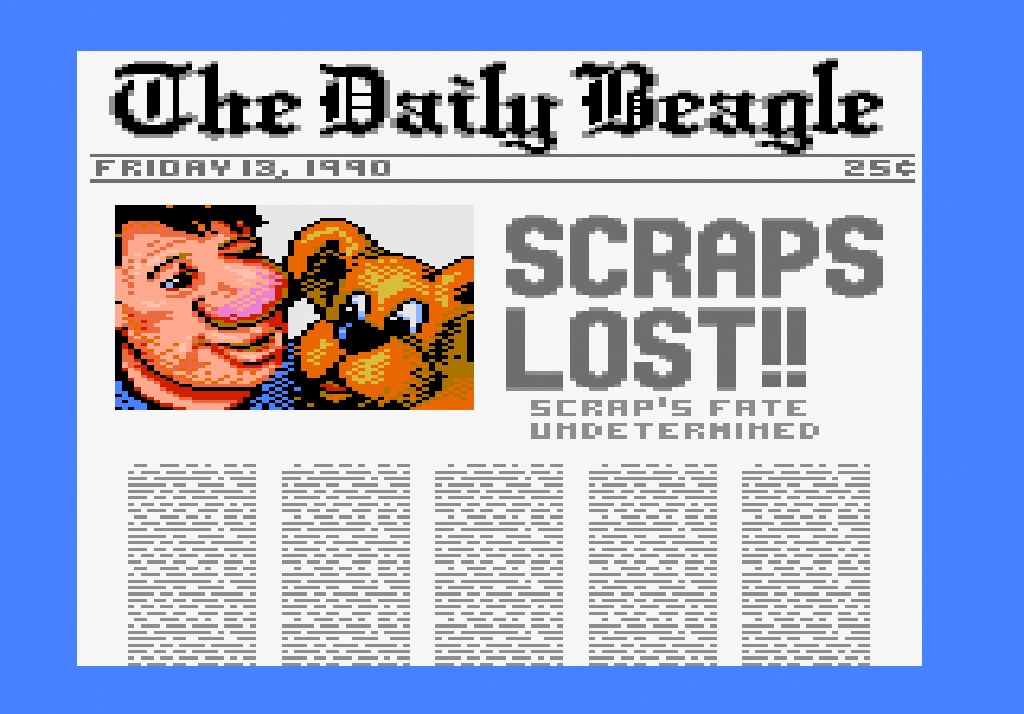
Start with the charm, because there’s plenty. The title screen is a cartoon: Lou and Scraps, big-nosed and beaming, over a bright blue sky. The newspaper that opens the adventure — The Daily Beagle (“SCRAPS LOST!!”) — sets the tone perfectly. In the game, Lou scampers through a bright, chunky city with real personality: wooden fences and phone booths, brick walls on Eisenhower Lane, the infamous 1st Street Sewer below. Money litters the route; cans can be carried to the recycling man for cash; shops let Lou convert his scavenging into extra lives and equipment. The economy gives the platforming a scavenger’s purpose that pure level-running lacks — you are not just crossing the city, you are financing a rescue.
Lou versus the city
The platforming itself is honest mid-tier work. Lou runs, jumps and ducks with adequate responsiveness; the levels scroll in fair-sized stages stitched into districts; enemies — rats, birds, street toughs — patrol in learnable patterns. There are secrets in the walls and the warp-ish shortcuts of the era, and the difficulty is pitched friendlier than most of the 1990 library: this is a game that expects you to finish it eventually, and mostly helps. The famous furniture includes a piano-playing mini-game — find the piano, play the tune correctly from memory, collect the bonus — a bizarre, delightful set piece that tells you everything about the team’s spirit.

Technically, the 7800 is comfortable here. The city scrolls smoothly, the sprites are big and characterful, the colour is daytime-bright — a useful contrast to the system’s many black-sky shooters — and the story screens give the whole trek a Saturday-morning frame. This is the same hardware that ran Food Fight’s arena; applied to a scrolling city, it produces a game that looks, at a glance, like it belongs in the NES conversation. At a glance is doing some work in that sentence, and the next section is where the bill arrives.
Where the leash slips
The problems are the problems of a hundred modest platformers. Lou’s jump is serviceable rather than joyful — the arc is a little floaty, the landing a little vague — and in a genre where the jump is the whole instrument, “serviceable” is a ceiling. Enemy contact damage is generous to the enemy. The levels, district by district, reuse their ideas with a thrift that becomes visible by the sewer, and the game’s length leans on repetition rather than invention. The Lynx version, it must be noted, is a different and lesser game wearing the same name; the 7800 original is the one to have, which is faint praise in two directions at once.

A ransom note, a recycling economy and a piano exam, wrapped around a rescue mission for a very good dog. Scrapyard Dog’s heart is bigger than its jump — and its heart wins.
Set against its moment, though, the game earns its affection. In 1990, Atari’s console had almost no platformers with this scope — a multi-district city, shops, secrets, a story — and the ones it had rarely smiled this much. Scrapyard Dog is the 7800’s comfort-food cartridge: unpretentious, likeable, and built around the most sympathetic stakes in the library. Scraps, for the record, is worth every can Lou recycles. That is not nothing. In a library of invasions and apocalypses, a man crossing a city for his dog is a plot you can feel.
One more pleasure deserves its paragraph: the scavenging. Most platformers treat coins as decoration with a jingle; Scrapyard Dog treats money as the plot. Cans become cash, cash becomes lives and tools, and the route through each district becomes a small business plan — which alleys to sweep, which risks pay, when to bank the recycling and press on. It gives Lou’s walk a texture that purer platformers lack, and it suits the character perfectly: a junkyard man crosses a city the way he crosses his own yard, seeing value everywhere. Games are often praised for respecting the player’s intelligence. This one respects its hero’s profession, which is rarer and funnier.
The city, district by district
The tour itself deserves credit for variety within its means. The junkyard opening is a tutorial wearing a fence and a phone booth — the ransom mechanics, the first cans, the first shop economy all introduced at walking pace. The streets open the game up: longer runs, traffic-adjacent hazards, the brick canyons of Eisenhower Lane. The sewer is the tonal dip every good platformer needs — greyer, tighter, with the city’s least employable wildlife. And the later warehouse districts push the platforming as hard as the engine allows, with the rescue finally in reach. None of it reinvents anything. All of it is arranged with a care that suggests the team liked Lou, liked Scraps, and wanted the walk between them to feel like a place. For a budget-era cartridge on a dying console, that affection is the difference between a product and a game.
It helps, too, that the game is kind about its own limits. Checkpoints are fair, lives can be bought back with honest scavenging, and the whole enterprise moves at a pace that forgives the occasional vague landing. Scrapyard Dog wants you to reach the dog. In 1990, when so many games wanted you to reach for more quarters, that generosity of intent is worth a point all by itself — call it the Scraps bonus.
And when the piano appears, sit down and play. Every rescue mission deserves a recital, and every recital deserves an audience of one very patient dog.
One more endorsement, from an unexpected direction: children get this game instantly. A man, a stolen dog, a city to cross, cans that turn into money — the whole design explains itself to a seven-year-old in one screen, which is more than most of the system’s library can claim, and which explains the cartridge’s quiet second life as a family favourite.
The verdict
A mid-tier platformer with top-tier likability. The jump keeps it from greatness; the world, the economy and the dog keep it in the collection. If you want to know what the 7800’s late, scrappy, inventive period felt like at its friendliest, Lou and Scraps are waiting by the phone booth.
Score: 6.5/10 — Lou’s long walk home: an amiable platformer with a ransom note for a heart.