
There will never be another one like it. The PlayStation 2 sold more than 160 million units – a number Sony let slip for years as “over 155 million” before confirming the full figure in 2024 – which makes it not merely the best-selling games console in history but the best-selling by a margin of tens of millions over everything since. It played host to more than 4,000 games. It was manufactured for thirteen years, launched officially in Brazil in 2009 (six years after its successor was announced anywhere else), received new releases in 2013, and for a meaningful stretch of the 2000s it was simply what television-connected entertainment was: the DVD player in the living room, the arcade in the bedroom, the default setting of a generation’s leisure. It killed the Dreamcast, outlasted the GameCube and Xbox combined twice over, then refused to die when its own successor launched – for two years, the PS2 outsold the PlayStation 3. This is the complete story of the black monolith: the Emotion Engine’s impossible promises, the DVD Trojan horse, the library that swallowed an industry, and the longest victory lap in consumer electronics.
The Emotion Engine: Kutaragi’s Impossible Machine
The PS2 begins with Ken Kutaragi – the engineer who had talked Sony into gaming with the SPC700 sound chip and then built the original PlayStation into a 100-million-selling empire – deciding that the sequel would be designed like a supercomputer and marketed like a moonshot. When Sony unveiled the machine in March 1999, the specifications read as provocation: a 294.912 MHz “Emotion Engine” CPU co-designed with Toshiba, with twin vector units for geometry; a “Graphics Synthesizer” GPU pushing 75 million polygons a second in the marketing maths; and rhetoric to match – real-time Toy Story, the Matrix jacked into your television, a chip so powerful that Japanese export regulators briefly had to classify it, and breathless reporting claimed Saddam Hussein was stockpiling consoles for missile guidance. The reality, as developers discovered, was more interesting and more difficult: the Emotion Engine was genuinely formidable at the floating-point geometry that 3D worlds run on, but its architecture – tiny caches, parallel vector units programmed almost in assembly, a graphics chip with fast embedded memory and no patience for conventional texturing tricks – was a bespoke instrument that punished porting-house habits. Early PS2 games looked jagged next to the Dreamcast’s clean anti-aliased output, and the press briefly wondered if the emperor had no polygons. What the sceptics missed was the rest of the specification, the part that wasn’t about games at all: a DVD-ROM drive, in the year 2000, when a standalone DVD player still cost more than the $299 Sony intended to charge for the whole console. The Emotion Engine got the headlines. The DVD drive got the market.
Launch: The Night the Monolith Took the World
Japan first, on March 4, 2000: queues around city blocks, roughly a million machines gone across the opening days, and a launch line-up (Ridge Racer V at its head) that mattered less than the drive inside – the PS2 was the cheapest DVD player in Japan, and it arrived as the format’s catalogue ignited; for thousands of buyers the first PS2 “game” they owned was a movie. North America followed on October 26, 2000, at $299, with a half-million units against demand several times that, a 29-game launch wave (SSX, Tekken Tag Tournament, Madden NFL 2001, Midnight Club, Smuggler’s Run) that established the machine’s range in a single day, and a secondary market in which consoles traded at double retail into Christmas. Europe, as Europe then was, waited until November 24 and paid more. The shortages were partly genuine constraint – the Emotion Engine’s yields were a manufacturing education – and partly the oldest trick in the business, but their effect is beyond argument: the PS2 entered the culture as an event, an object of desire reported on the evening news, while the Dreamcast – a wonderful machine, a year older, half the price, with a better launch library behind it – watched its future evaporate in the glare. Sega announced its exit from the hardware business on January 31, 2001, ten months after the PS2’s Japanese launch. The console war of the generation was effectively over before the GameCube and Xbox even arrived; the rest of the decade was the occupation.
The DVD Trojan Horse and the Living Room
It is impossible to overstate what the DVD drive did, because it operated on people who never bought games. Through 2000 and 2001 the DVD format was crossing from enthusiast gadget to default medium; the PS2 was, in market after market, the best-selling DVD player of the year, purchased by film fans who then discovered the games were good, and by gamers whose parents could justify the box as a family appliance. The economics compounded: DVD manufacturing made games cheaper to produce than cartridges had ever been, the format’s capacity ended the storage arguments of the CD era, and Sony’s control of the whole stack – chips, discs, players, and a film studio’s catalogue – made the PS2 the hinge of the company’s entire living-room strategy. The rivals’ answers underlined the point. The GameCube, a lovely games machine, played proprietary mini-discs and no movies at all. The Xbox played DVDs only with a paid remote kit, an act of licensing parsimony that read as an insult. Meanwhile the PS2’s black slab sat under millions of televisions doing double duty every evening, normalising Sony’s presence in the room for a decade – and its software library was about to give those accidental owners four thousand reasons to stay.
One more specification did quiet, decisive work: the PlayStation 2 played the original PlayStation’s entire library. Sony had embedded the PS1’s CPU in the machine as an I/O processor – the older console literally lived inside the new one – so launch-day buyers kept their games, their controllers and their memory cards, and the PS2’s effective day-one catalogue was not 29 titles but over a thousand. Backward compatibility sounds like a courtesy; commercially it was a moat, converting the PS1’s hundred-million-owner base from an audience to be re-won into an inheritance to be collected, and it set the expectation – honoured patchily by every manufacturer since – that a library is something a platform owes its owners across generations. Between the DVD drive for the film fans, the inheritance for the gamers, and the Emotion Engine for the headlines, the PS2’s launch was not one product launch but three, aimed at three different publics, all of them landing in the same quarter.
The Rivals, Autopsied
The generation’s other three consoles read, in the PS2’s light, as controlled experiments in how to lose. The Dreamcast (1999) did almost everything first and right – built-in modem, online play, a superb library – and died of everything except quality: Sega’s finances, EA’s refusal to publish for it, and a year of PS2 anticipation in which Kutaragi’s Toy Story rhetoric persuaded the market to wait. Nintendo’s GameCube (2001) was the better-engineered games machine at a keener price ($199), and handicapped itself with the two decisions the PS2 had already refuted: no DVD playback, and a proprietary mini-disc that capped capacity and read as control for control’s sake; it sold 21.7 million, a beloved failure. Microsoft’s Xbox (2001) bought its way in with brute force – a hard drive, Ethernet, Halo, and losses estimated in the billions – and its 24 million sales purchased exactly what they were meant to: a seat at the next generation’s table, not this one’s. Combined, the three rivals moved about 55 million consoles. The PS2, by itself, tripled them, and its dominance compounded in the way platform monopolies do: developers led on PS2 because everyone owned one, everyone bought one because developers led on it, and the exclusives that resulted (the GTA trilogy’s timed exclusivity was bought with the proceeds of that logic) locked the flywheel. The generation wasn’t close, and its not-closeness is the PS2 story in one paragraph.
The Library That Swallowed an Industry
Every platform holder promises “something for everyone”; the PS2 is the one that delivered it, at industrial scale, for a decade. The pillar franchises stacked up year after year: Gran Turismo 3 and 4 (the latter still the series’ popular peak); Metal Gear Solid 2’s postmodern sleight-of-hand and MGS3’s jungle masterpiece; Final Fantasy X’s voiced, weeping epic and XII’s programmable gambits; Devil May Cry, Onimusha, and Capcom’s whole renaissance; God of War I and II turning the machine’s twilight into a second golden age; Team Ico’s two meditations, Ico and Shadow of the Colossus; Katamari Damacy’s joyful absurdity; Okami’s sumi-e swan song. And towering over the economics, Grand Theft Auto: GTA III (2001) redrew the map of what a mainstream game was – the open-world city as genre – Vice City made the eighties a theme park, and San Andreas (2004) became the console’s best-selling game at some 17 million copies, a cultural event that pulled congressional attention, a hidden-content scandal, and a generation of imitators. The mid-tier flourished as it never has since: Sly Cooper, Ratchet & Clank, Jak and Daxter, Dark Cloud, Rogue Galaxy, Persona 3 and 4 arriving as late-era masterpieces in 2006-08, when most consoles are already embalmed. Then the expansion fronts: EyeToy cameras and SingStar microphones colonising European living rooms years before the Wii made casual gaming a headline; Guitar Hero (2005) launching the plastic-instrument era from a PS2 exclusive. The flip side of 4,000 games is a shovelware stratum kilometres deep – the budget bins of the late 2000s are a geology of licensed haste – but that, too, is what total market victory looks like: when a platform is the market, everything is published on it, the sublime and the cynical alike.
Online, Slimmer, Cheaper: The Middle Years
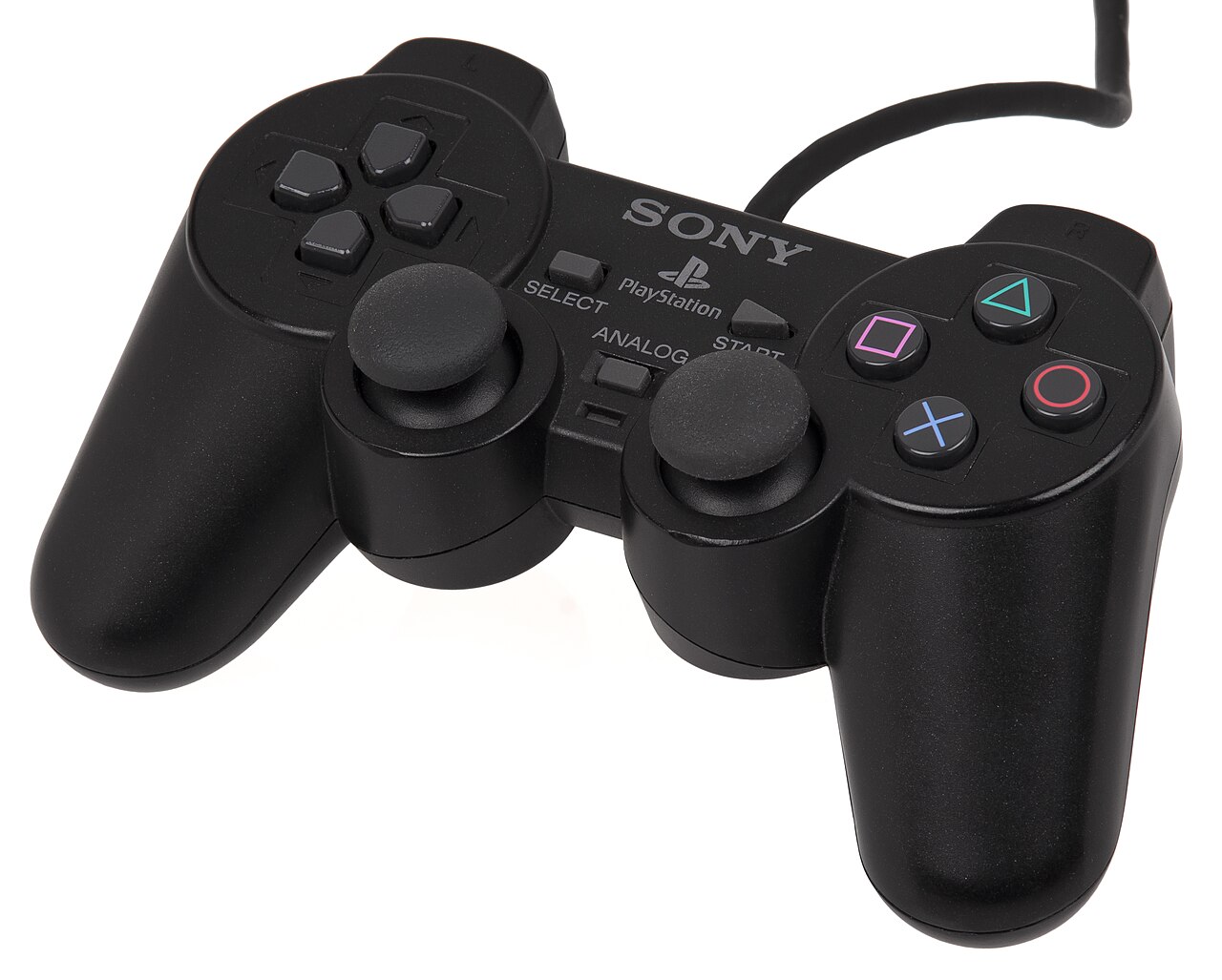
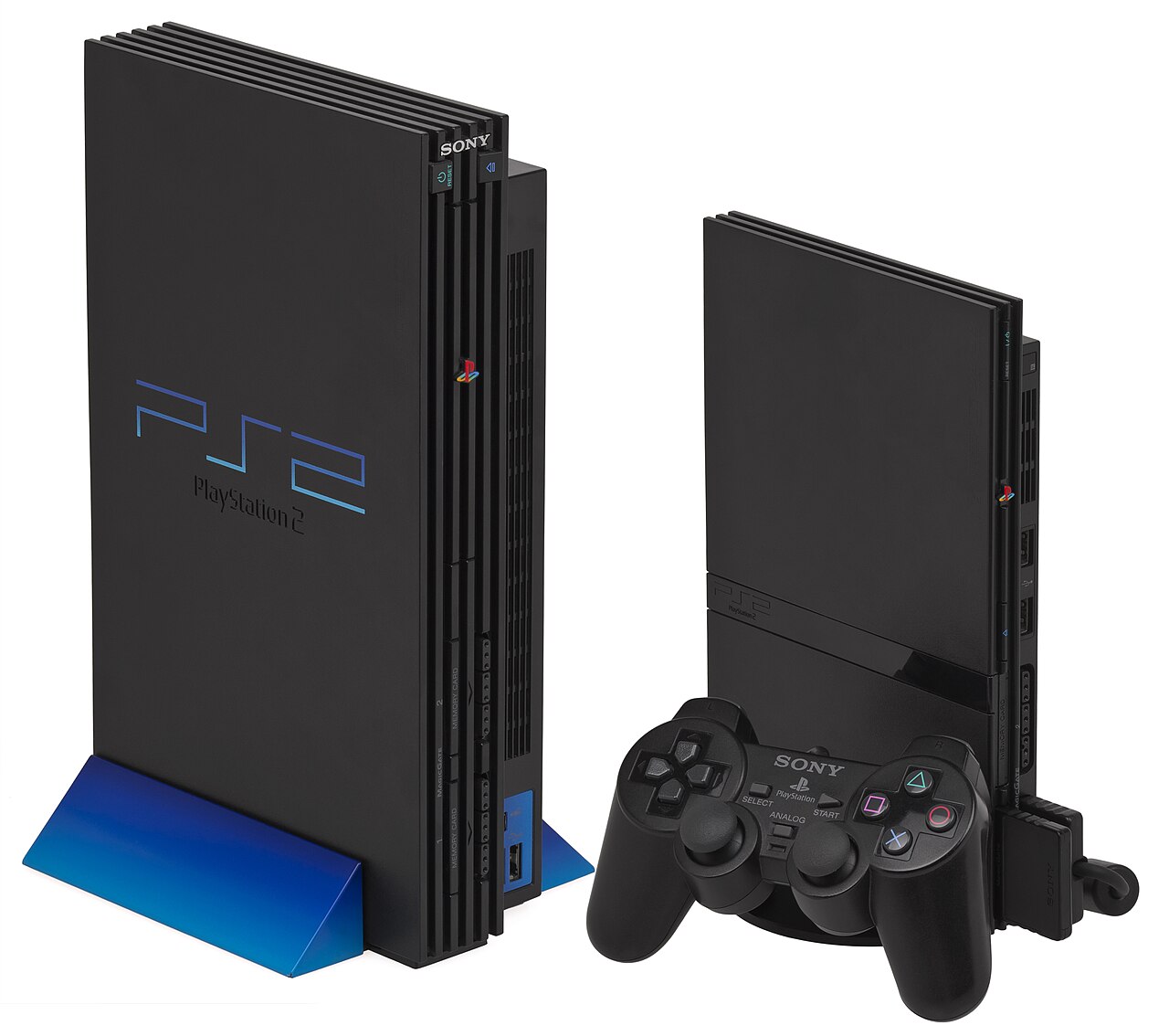
The PS2’s hardware biography is a study in managed longevity. The original “fat” model – all ridges and expansion bays, designed to stand vertically like a tiny tower block, a silhouette the whole world promptly compared to 2001’s monolith – accumulated options the way PCs do: a Network Adapter (2002) that brought online play via SOCOM and, with the hard drive, Final Fantasy XI, the first console MMO to thrive; a Linux kit that turned the console into a hobbyist workstation (and a tax classification argument in Europe); the PSX, a Japan-only PS2-with-DVR that flopped as a product and read, in retrospect, as a rough draft of the PS3’s ambitions. The masterstroke was the Slimline of late 2004: the console shrunk to roughly a quarter of its volume, the network port built in (and, in the final 90000-series revision, the power supply internalised too), the price gliding down through $149 to $129 and, in 2009, $99 – each cut opening a new market of late adopters, second rooms and developing economies. Sony even sold a Bravia television with a PS2 built into its base (2010), which is what complete domestic saturation looks like when rendered as furniture. Through all of it the DualShock 2 – pressure-sensitive in every button, a refinement so right that its shape survived into the PS3 – remained the controller, unchanged, because nothing about it needed to change.
The Long Tail: Outliving Its Own Successor
The strangest chapter is the last one. The PlayStation 3 launched in November 2006 at $499-$599, haemorrhaging money and goodwill – and for its first two years it was outsold, month after month, by its own predecessor. The PS2 in 2007 received God of War II as a deliberate statement, in 2008 received Persona 4, and in market after market – India, the Middle East, Southeast Asia, Latin America – it was not a legacy console but the current one, officially launched in Brazil only in 2009. Final major releases dribbled into the 2010s (FIFA 14, improbably, in 2013), production in Japan ended in December 2012, and worldwide manufacture ceased in January 2013 – thirteen years after the Tokyo launch queues, with the tally at the time reported as 155 million-plus and confirmed in 2024, when Sony updated the number with a precision that suggested pride: more than 160 million. No console before or since has combined that scale with that duration, and the structure of the modern market – digital storefronts, subscriptions, platform convergence – almost certainly forbids a repeat. The PS2 was the last machine that could be the whole industry for a whole decade, and it was.

The Cultural Monolith
Somewhere in the middle of the decade the PS2 stopped being a product and became a period. Sony marketed it like one: the launch-era advertising, directed by the likes of David Lynch (the “Third Place” campaign’s surreal vignettes) and Chris Cunningham, sold not games but a parallel world with better production design, and the console’s own industrial design – those ridges, that verticality – entered the permanent vocabulary, exhibited in design contexts that had never previously made room for a games machine. It was also, in a way that became clear only afterwards, the last console of the offline era: broadband was an adapter, not an assumption; the social layer was a memory card carried to a friend’s house; a game was a finished object on a disc, patched never, owned completely. The generation of developers now running the industry’s studios was formed inside those constraints, and the PS2’s fingerprints are on their design instincts – the confidence that a single-player game could be an event, that a console library could hold Ico and SingStar and San Andreas without any of them apologising. When the culture gets nostalgic for “the PS2 era,” it is usually this totality it means: the machine, the library, the living room it organised, and a decade in which the centre of the medium’s gravity sat, unchallenged, in one black box.
Afterlife and Legacy: The Standard Everything Is Measured Against
The PS2’s afterlife is an industry of its own. PCSX2’s two-decade maturation turned emulation from a slideshow into the definitive way to run the library at resolutions the Graphics Synthesizer never imagined; Sony’s own PS2 Classics lines on PS4 and PS5 keep the canon in print; the collectors’ market has anointed its holy grails (Kuon, Rule of Rose, a shelf of late Atlus); an entire indie-horror movement renders itself deliberately in PS2 polygons and fog, treating the aesthetic as a genre. When Sony confirmed the 160-million figure in November 2024 – moving the PS2’s lead over the Nintendo DS and Switch back out of reach for another news cycle – the announcement landed as what it was: a champion acknowledging a record it does not expect to break. What the machine actually bequeathed is the template of the modern console generation: the multimedia Trojan horse, the year-five slimline, the decade-long tail, the library-as-ecosystem, the launch as a global media event. The Dreamcast pioneered much of it and the PlayStation drafted it, but the PS2 is where the template ran at full scale, at full length, without serious opposition. Every console since has been reviewed, implicitly, against a black monolith standing vertically beside the television – and found, in some dimension, to be a footnote to it.