
In October 2014, Sony released the strangest PlayStation ever made: a console the size of a pack of cards, with no screen, no battery and no disc drive, that played Vita games on your television — badly, some of them, gloriously, others — for $99. The PlayStation TV (the Vita TV in Japan, where it arrived a year earlier) was pitched as a little bit of everything: a Vita for the TV, a PS4 extender for a second room, a PlayStation Now streamer, a PS1 classics box. It failed at being a product line and succeeded, across a decade, at becoming something better: the Vita library’s second life, and one of retro gaming’s most useful little machines. This is its story — a $99 microconsole that outlived its pitch.
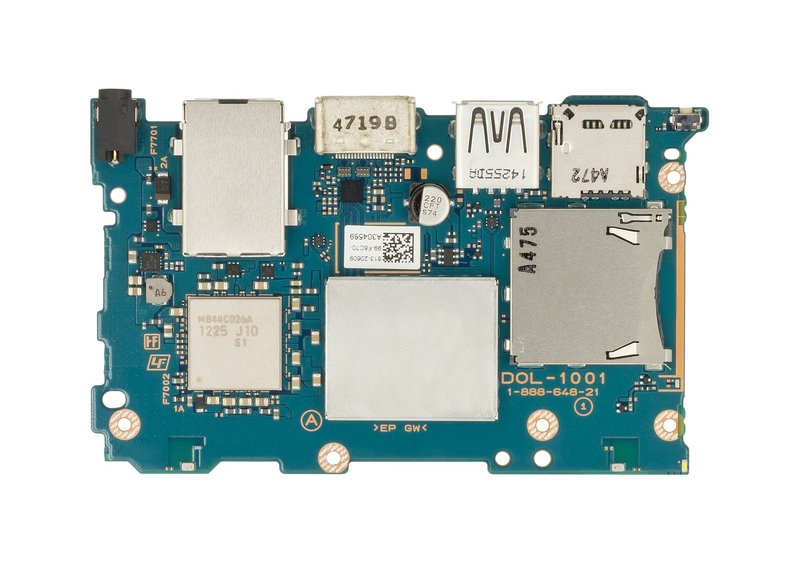
The hardware is a Vita in a sardine tin: the same quad-core ARM and PowerVR heart, 1GB of storage, a Vita cartridge slot, a Vita memory-card slot, one USB port, HDMI out at up to 1080i, and an Ethernet socket the handheld never had. Pair a DualShock 3 or 4 and the illusion is nearly complete: the Vita’s entire interface, its bubbles and its brilliance, on the big screen. Nearly — because the Vita had a touchscreen, a rear touch pad and cameras, and the PSTV had a compatibility list instead. Games that needed the Vita’s exotic inputs were whitelisted out: Uncharted: Golden Abyss, Tearaway, WipEout 2048 in the West at first, a roll-call of the platform’s defining titles, unplayable on the platform’s own TV box. The DualShock 4’s touch pad papers over some of it. The rest is the PSTV’s permanent asterisk, and any honest account starts there.
The pitch vs. the machine
Sony’s marketing never decided what the PSTV was for, and the market punished the indecision: launched at $99 bare and $139 with a controller and memory card, it was discounted within a year, and clearanced — in one of retail history’s great fire sales — down to prices that made it cheaper than a Vita memory card. Players who bought it at clearance discovered what the pitch had buried. As a PS1 and PSP machine, fed by the PlayStation Store’s classics catalogue, it was superb: crisp HDMI output, proper controllers, save states of a sort via the Vita OS, hundreds of games. As a PS4 Remote Play extender — its most advertised trick — it was genuinely useful in the wired-Ethernet, same-house conditions it demanded. And as a Vita, within the whitelist, it played the library’s twin-stick and traditional games beautifully: Persona 4 Golden on a television is a revelation this little box delivered years before the game escaped to modern platforms, and Killzone: Mercenary, the racers, the fighters and the RPGs all took to the big screen like they had been waiting for it.
The homebrew chapter completed the redemption. The PSTV was swept along in the Vita scene’s golden age — the same exploits, the same plugins — and the community promptly removed the whitelist’s sting with patches that let the box attempt everything, touch games mapped to sticks with variable grace. More importantly, the scene turned the PSTV into a connoisseur’s retro station: near-perfect PS1, excellent PSP and Vita, strong emulation of everything older, all from a silent, invisible box behind the television. Sony had sold a locked garden. The owners planted what they liked.

What it is worth now
The market, as usual, re-priced the story: the fire-sale box now sells for multiples of its clearance price, complete boxed units especially, and the PSTV has settled into the collector’s canon as the Vita family’s eccentric sibling — the third model, the home model. Its virtues in 2026 are concrete. It is the easiest legal way to play a Vita cartridge collection on a television. It is a superb classics box. It sips power, makes no noise, and its DualShock 4 pairing remains the most comfortable way to play the Vita’s traditional games for long sessions. Its limits are equally concrete: the whitelist (unmodded), the 1GB storage that makes the memory-card tax mandatory, output that tops out below the sharpness modern retro scalers spoil us with, and a storefront living on borrowed time in a phased closure Sony has now dated to 2027 for most regions.

The compatibility list, examined closely, is also a map of the Vita’s soul. What the PSTV plays natively is the Vita of buttons: the RPGs, the fighters, the racers, the twin-stick shooters, the entire PS1 and PSP inheritance — which is to say, most of the library by hours, including nearly all of its longest games. What it refuses is the Vita of surfaces: the touch-and-camera experiments that made the handheld unique. A PSTV-only owner therefore gets a superb, slightly hypothetical Vita — the platform as a pure games machine, minus its weirdness — and the honest recommendation follows: the PSTV is a companion to a handheld, not a replacement for one. Together, the pair cover the whole library and both rooms of the house. Apart, each is a brilliant fraction. Sony sold them as rivals for the same wallet. History refiled them as a set.
There is one more role the little box has grown into, and it may prove the longest-lived: the preservation station. As the store’s closure approaches — phased by region, complete by July 2027 on Sony’s current schedule, with re-downloads promised for the foreseeable future after — the PSTV’s owners have been quietly downloading their libraries onto memory cards while downloading is simple, building local archives of a digital catalogue whose days are numbered. A silent box, a big card, a decade of purchases, safe on a shelf: the microconsole as lifeboat. Sony never pitched that. It may be the best pitch the PSTV ever had.
Buying one in 2026 takes the usual care, plus one PSTV-specific check: confirm the firmware and the box’s region story before you pay a premium, because the homebrew-friendly units and the still-sealed collector units are different purchases wearing the same plastic. Bundles with the DualShock 3 and the 8GB card — the original $139 set — are the honest middle path: everything working, nothing precious. However you arrive, arrive before the store’s final curtain makes the classics catalogue a memory: the little box’s best trick needs its library, and the library, for the first time in the PSTV’s life, has a deadline.
It also remains, quietly, the easiest way to introduce a sceptic to the Vita library: no handheld quirks to explain, a proper controller in their hands, and Persona 4 Golden on a television doing the rest of the talking.
The verdict of history
The PlayStation TV failed the way the Vita failed: a good idea, pitched at everyone, priced against its own family, abandoned early. But objects outlive strategies. A decade on, the little sardine tin sits under thousands of televisions doing quiet, excellent work — Persona at midnight, PS1 weekends, a Vita library liberated from a five-inch screen — and it has earned the affection its launch never got. The $99 microconsole that couldn’t say what it was turned out to be the most PlayStation thing Sony made that decade: over-engineered, under-explained, and better than its obituary. If your Vita collection deserves a television, it still does the job. Outliving your pitch is the best ending hardware gets.