
At a glance: Puyo Pop · Neo Geo Pocket Color · Compile / Sega, 1999 · Puzzle · Score: 8.5/10
Before there was a Puyo Puyo industry, there was this deceptively soft-looking game about blobs. Compile’s Puyo Puyo had already colonised Japanese arcades and consoles through the nineties, reaching Western players mostly in disguise — as Dr Robotnik’s Mean Bean Machine and Kirby’s Avalanche — before Puyo Pop brought the series to the Neo Geo Pocket Color in 1999 under its own name, with its heroine Arle Nadja front and centre where she belonged.
The rules are the genre’s foundation stones. Pairs of coloured Puyo fall; rotate and place them so four of a colour touch, and they pop. The genius is in the chains: arrange your board so one pop topples Puyo into the next match, and the next, building the towering multi-chain combos that send garbage — clear, unmatchable nuisance Puyo — cascading onto a versus opponent’s board. Solo, you race set challenges; against an opponent, Puyo is a fighting game in puzzle clothing, all setups, feints and sudden executions.
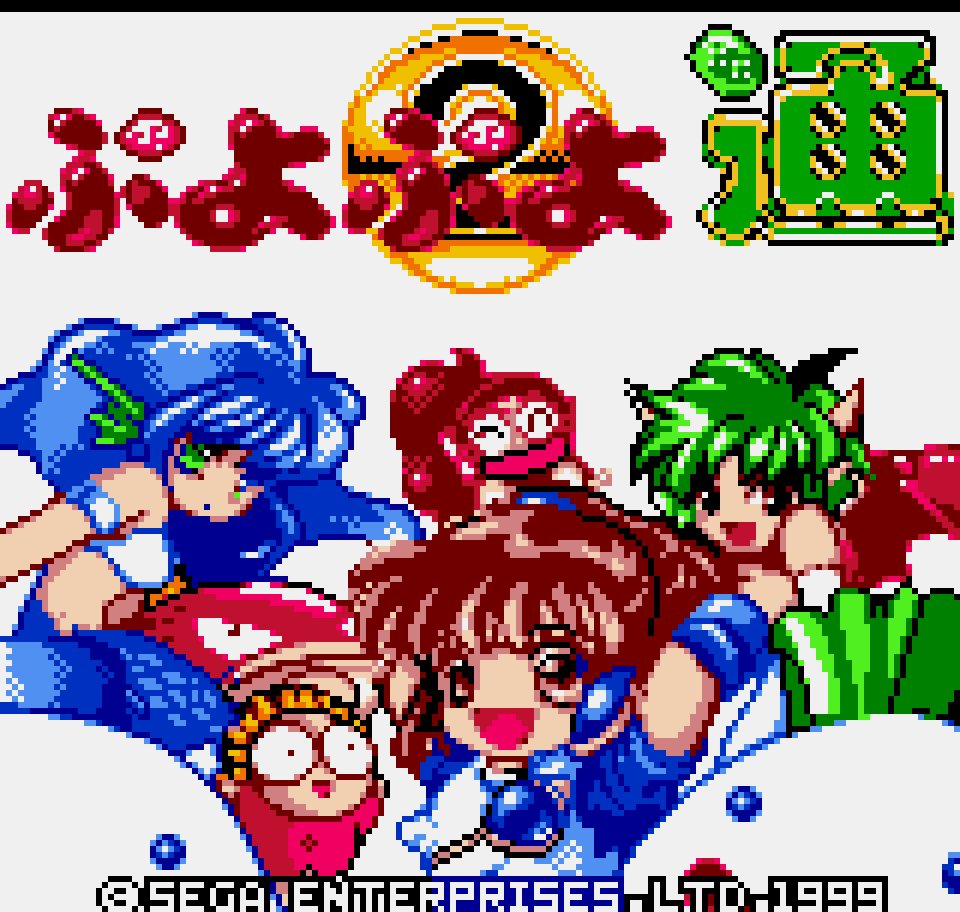
Arle’s pocket campaign
Puyo Pop wraps the mechanics in a proper presentation. A story mode walks Arle through a ladder of rivals from Compile’s Madou Monogatari world — the fish-man Suketoudara, the harpy, the skeletal braggart, series villain Satan himself — with dialogue exchanges that keep their comedy in translation. Versus CPU duels, an endless mode for score and survival, and link-cable head-to-head cover the competitive bases. For a 1999 handheld puzzler, the package is complete.
More importantly, the feel is right. Puyo is a game of fine margins — the soft drop speed, the rotation behaviour at the wall, the split-second decision to break a chain early — and the pocket version reproduces the home games’ handling faithfully. The board is fully legible on the small screen, the Puyo wear their expressions (you will learn to read a board’s health in their faces), and the chain counter’s escalating cries translate into satisfying chiptune punctuation. This is the genuine science of Puyo, chain-building intact, in a cartridge.
Puyo is a fighting game in puzzle clothing — all setups, feints and sudden executions — and the pocket version keeps the whole science intact.
Where it wobbles
The caveats are the series’ own. Puyo’s learning curve is a wall disguised as a hill: until you can build a reliable three-chain, the CPU’s mid-tier will bury you in garbage, and the story mode does not grade its lessons gently. Single-player longevity leans on your appetite for score attack once Satan falls. And Sega’s Western handling of the series was so confused in this era that Puyo Pop’s very existence — unrenamed, unhidden — feels like a small administrative miracle; plenty of NGPC owners simply never saw it on a shelf.

Time has been kind to its reputation. With Puyo Puyo now a global fixture — esports in Japan, Tetris-crossed hits in the West — Puyo Pop reads as a precious early English-language edition of Compile-era Puyo, made with the original studio’s craft before the series passed fully to Sega. The NGPC Selection era has not (yet) restored it to sale, which makes the cartridge a genuine collector’s puzzle in both senses.
Compile’s farewell tour
There is historical weight in this cartridge that its cute surface hides. Compile — the studio that created Puyo Puyo and nursed it into a phenomenon — was in its final years when Puyo Pop shipped; the series’ stewardship would pass to Sega, and Compile itself would wind down within a few years. Puyo Pop is therefore among the last Puyo games made by its creators, and it carries their house style intact: Arle’s world, the Madou Monogatari cast, the particular comedy of the dialogue, the feel of the drop. Later Puyo is excellent, but it is interpretation. This is the original hand.
It is also, quietly, a small landmark in the series’ Western history: an unrenamed, unmasked Puyo Puyo, sold under its own name in English, years before Puyo Puyo Tetris finally made the blobs mainstream in the West. The NGPC’s tiny installed base meant few Western players noticed at the time. Collectors have noticed since — which is why this friendly little puzzler now sits on the pricier half of the system’s puzzle shelf, and why playing it feels like finding a first edition of a book everyone now reads in paperback.
A practical note for the chain-curious: Puyo Pop is the right teacher. Its endless and practice-friendly modes let you rehearse the classic staircase and sandwich builds without a clock’s cruelty, and the CPU ladder’s early rungs are honest sparring partners for a learner’s first real chains. The moment your first planned three-chain fires — set up over twenty seconds, executed in one — is one of puzzle gaming’s great initiations, and this cartridge has been delivering it, in English, since 1999.
The presentation’s last charm is restraint. Boards are clean, the Puyo themselves carry the expressiveness, and the soundtrack keeps its bounce at exactly the volume a long session can bear. Compile understood that a puzzle game is furniture in your life — it has to fit the room. Puyo Pop fits every room the NGPC ever entered, which is to say trains, classrooms and sofas across three continents, and it fits them still.
For the versus-minded, the link mode closes the case: Puyo’s chain warfare against a human, on the train, in 1999, with garbage falling like weather — this was a competitive scene in a cartridge, years before the series’ esports era made the same spectacle famous in arenas. The pocket players were there first, as usual.
Arle’s adventure ends, as all good Puyo does, with the board reset and the next pair falling. Some games you finish. Puyo you simply stop playing, eventually, and carry the patterns in your head forever. This cartridge installs them beautifully.
Compile’s craft shows in the small mercies, too: the next-pair preview that makes planning possible, the offset window that keeps a rally honest, the way a doomed board gives you one last split-second to spend your chain early and live. Puyo is a hard game that never feels rigged, and that fairness — engineered here by the people who invented the form — is why its students become its evangelists. Pop one chain in this cartridge and the evangelism becomes yours to carry.
Blobs away. May your third chain always land.
Final word: every library needs a game you can lose at for thirty years and call it practice. On the NGPC, this is that game — Arle’s blobs, Compile’s craft, and a skill ceiling with no top floor yet found. Pop responsibly; you will not.
Verdict
Puyo Pop is the deepest puzzle game on the Neo Geo Pocket Color: a foundational design, faithfully handled, wrapped in Arle’s charm. It asks more of you than the bubble-shooters and the orb-grabbers — and it pays you back in one of gaming’s great skill ceilings. Chain responsibly.