
At a glance: Biomotor Unitron · Neo Geo Pocket Color · Yumekobo / SNK, 1999 · RPG · Score: 8.5/10
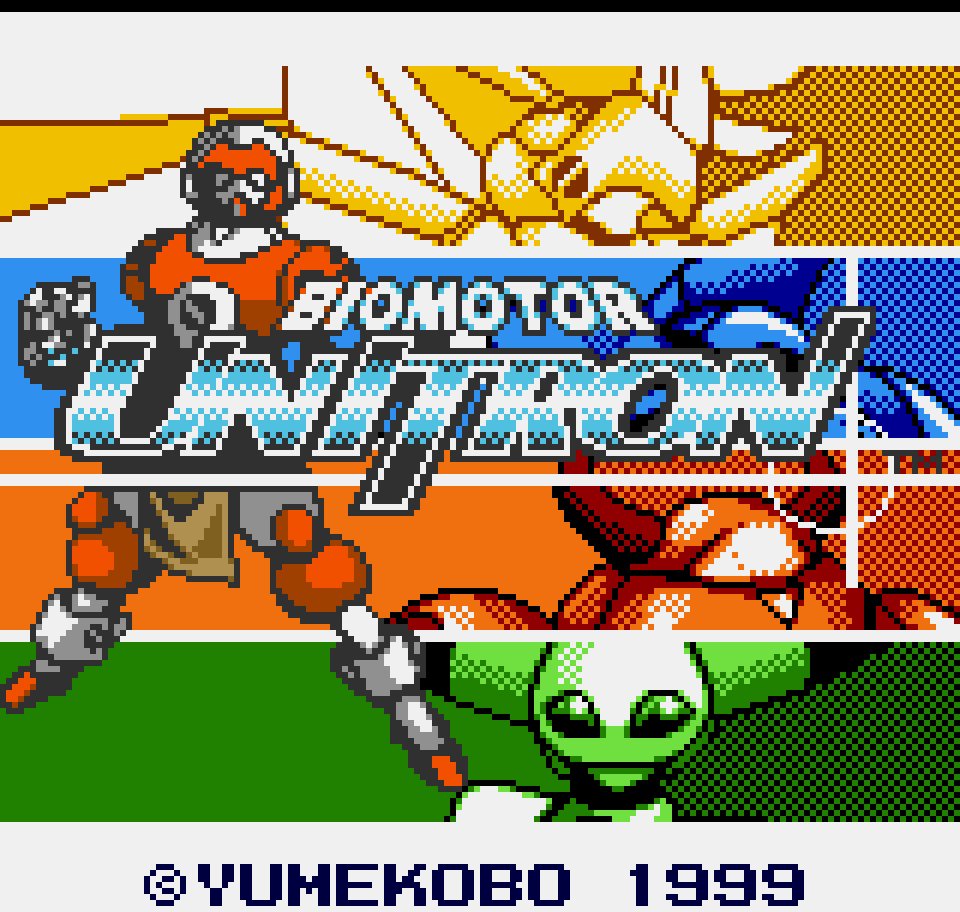
Every handheld generation gets one RPG that tries to bottle Pokémon’s lightning with its own flavour. The NGPC’s entry is stranger and more interesting than most: Biomotor Unitron, developed by Yumekobo and released in 1999, asks not for monsters but for a machine. You are a young engineer — a ‘Master’ — in a world where builders compete with Unitrons, custom robots assembled from parts, materials and hard-won technique. Your Unitron begins as a humble frame with a sword arm. What it becomes is your design.
The loop is a beautifully pocket-shaped one. In town, you take on work, buy materials and develop new parts by combining what you have — arms, legs, backpacks, weapons — each combination altering your Unitron’s stats, elemental affinities and available techniques. In the dungeons — a handful of multi-floor ruins and forests rendered in first-person-ish exploration with random encounters — you gather rare materials and experience. In the arena, ranked tournaments test your build against rival Masters. Build, venture, compete: three gears meshing perfectly for short handheld sessions that somehow eat whole evenings.
Engineering as gameplay
The parts system is the game’s heart and its claim to originality. Rather than levelling a fixed character, you are iteratively designing one: a fire-element arm with high attack but poor accuracy, legs that trade defence for speed, a backpack that unlocks a healing technique. Enemy Unitrons in the arena are design puzzles — the champion’s build is a thesis you must answer with your own. Long before ‘builds’ became gaming’s common vocabulary, Biomotor Unitron built an entire RPG around the concept, and around the tactile pleasure of the workshop: try this arm, test it, scrap it, dream bigger.
Battles are turn-based and readable, with elemental strengths doing much of the tactical work; your Unitron’s AI options let you set its temperament while you direct key decisions. Dungeons are honest old-school crawls — grid floors, random encounters, a boss at the bottom — and the game’s difficulty respects your engineering: a well-built Unitron walks dungeons that flatten a careless one.
Long before ‘builds’ became gaming’s common vocabulary, Biomotor Unitron built an entire RPG around the workshop bench.
Charm and limits
Presentation is warm: the town and its characters — including your fairy-like assistant, who keeps the story’s heart beating — are drawn with the NGPC palette’s best manners, and the Unitron designs themselves, assembled from chunky parts, have a toybox appeal that suits the machine. The plot is light — a tournament ladder, a rival, a mystery about your Unitron’s origins that deepens late — but the characters carry it.

The limits are real. Dungeon variety runs thin by the late game, the material economy can turn grindy when a dream part is three rare drops away, and the sequel that refined all of this never left Japan — Western Masters got one game where the design begged for two. Random encounter rates belong to 1999, with everything that implies. None of it breaks the loop; all of it dates the loop.

The sequel-shaped hole
Japan received a sequel, Kikou Senki Unitron, which refined the formula — more parts, more dungeons, a bigger tournament — and its absence from Western shelves is one of the NGPC’s purest what-ifs, a ready-made hit that simply arrived on the wrong side of SNK’s collapse. Playing the original with that knowledge gives its systems a pleasant ache: you can feel where the design wanted to grow. The modern compilations have at least secured the first game’s legacy, and the fan community’s documentation of the sequel means the curious can now cross the language barrier the market never did.
Biomotor Unitron also deserves its place in the wider monster-raising conversation. Where Pokémon asked you to collect creatures and Digimon asked you to raise them, Unitron asked you to build — to express yourself in torque and elemental affinities — and that engineering fantasy, closer to a model kit than a pet, remains the road not taken by the genre. Every modern game about designing your own fighter, racer or mech is walking ground this cartridge surveyed in 1999.
The workshop itself deserves a closer description, because its tactile logic is the game’s soul. Materials have families and grades; parts inherit the character of what you feed the process; and the development interface makes experimentation cheap enough to encourage and consequential enough to matter. Failed experiments are tuition, not punishment — the materials economy is tuned so that a curious player is always one dungeon run from their next idea. Modern crafting systems with their wiki-mandatory recipes could learn from its transparency: in Biomotor Unitron, you can hold the whole possibility space in your head, and the game is better for it.
One more virtue, easily missed: the game respects the hardware’s social side. Your Unitron’s data could be shown off and compared via the link features of the era’s ecosystem, and the arena ladder’s rival Masters feel designed as answers to the builds players were actually making — a conversation between designer and community conducted in robot parts. It is, in the end, a game about making something and being proud of it. Those do not date.
The quiet radicalism of the game, in hindsight, is its respect for the player’s taste. There is no single correct Unitron; the arena’s champions are arguments, not answers, and the workshop lets you reply in your own dialect of parts and elements. Games that let you express yourself mechanically — rather than merely decorate a fixed hero — were rare in 1999 and are treasured now. This is one of the ancestors, wearing a pocket cartridge’s modest clothes.
Raise one well and the ending feels earned in a way scripted heroes cannot match: the machine that wins the final tournament is the machine you imagined, part by part, failure by failure. That is the review, really. The rest is specifications.
What the game understands, and what its imitators sometimes miss, is that a build is a story. Your Unitron’s lopsided first tournament, the arm that carried the mid-game, the dream configuration that finally answers the champion — the parts list is a memoir, and the cartridge keeps it for you across every session. That is why owners speak of their Unitrons the way other players speak of their first Pokémon team: not as equipment, but as biography. Engineering, it turns out, was a heart mechanic all along.
Build boldly. The workshop believes in you, and so does the arena — eventually.
Verdict
Biomotor Unitron is the NGPC RPG with the strongest identity: not a shrunken console epic but a design native to its machine, built on engineering, iteration and pride in a robot you made yourself. Its place in the NGPC Selection compilations has finally given it the audience it always deserved. Raise your Unitron well — it remembers what you taught it.