
At a glance: Rayman · Atari Jaguar · Ubisoft, 1995 · Platformer · Score: 9.0/10
Here is a piece of gaming history that still surprises people: Rayman did not debut on the PlayStation. Michel Ancel’s limbless hero first appeared on the Atari Jaguar, in September 1995, weeks before the PlayStation version reached shelves — a cartridge built for Atari’s struggling machine by a French studio that had originally aimed the game at the Super Nintendo CD add-on that never happened. The Jaguar was nobody’s idea of a safe bet in 1995. Rayman was the best argument it ever produced that 2D, done with enough artistry, could outshine every polygon in the shop window.
A painting you can play
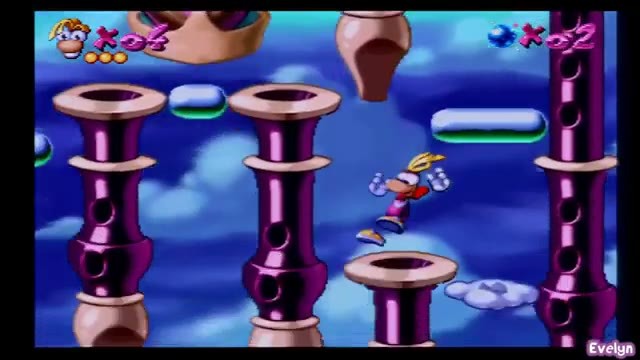
Start with the obvious: this is one of the most beautiful 2D games ever made, on any system, in any year. The Jaguar’s huge colour palette is pushed to storybook extremes — the Dream Forest drips with layered parallax greens, Band Land turns musical instruments into architecture, and the Picture City levels play out across ink bottles and eraser plains. Rayman himself, all floating hands and feet, animates with a squash-and-stretch elasticity that feels hand-drawn rather than rendered, because in spirit it was: Ancel’s team worked from painted art, and the Jaguar version holds that art at a richness the later ports trimmed around the edges.

The Jaguar build has its own identity, and collectors care about the differences. It lacks the PlayStation version’s CD soundtrack and some of its transitional sequences, running instead with a jaunty chip-driven score that suits the cartridge format honestly well. In exchange it keeps levels and layouts in forms that differ subtly from the PlayStation and Saturn builds — some cages sit in different places, some sequences were reworked for the ports — which makes this the connoisseur’s version of a game most people only know second-hand. What matters for a player rather than a cataloguer is simpler: it controls beautifully on the Jaguar pad, the helicopter hair, the telescopic fist and the running power arrive at a fair pace, and the difficulty curve is the same beloved, betraying curve in every version.
Beautiful, and absolutely ruthless
Because we have to talk about the difficulty. Rayman has a reputation problem: it looks like a game for children and plays, from its second world onwards, like it was designed by a smiling sadist. The first world teaches you to jump, punch and admire the scenery. Then come the plum rides over instant-death water, the spiked fruit, the hunters whose bullets track your smugness, and Mr Stone, Mr Skops and the rest of a boss roster that demands pattern-perfect play from a hero with a short health bar and a shorter temper — yours. Lives and continues are finite in a way modern platformers would never dare, and freeing all the Electoon cages to reach the true final sequence is a challenge that has ended friendships.
And yet it rarely feels unfair in the cheap sense. The checkpoints are placed by people who understood frustration arithmetic; the deaths are almost always legible — you see the spike, the gap, the mistimed swing, and you know the fault was yours. This is the contract the great 16-bit platformers made, kept here in a 64-bit frame: mastery is the content. Players raised on infinite retries will bounce off Rayman, and that is a genuine caveat. Players who finished Donkey Kong Country with grit in their teeth will feel immediately at home.
The Jaguar’s finest hour in 2D
Context matters to the score. In 1995 the industry was stampeding towards polygons, and the Jaguar’s own library was filling with texture-mapped experiments that aged in dog years. Rayman ignored the stampede. It used the hardware for what the hardware was quietly superb at — enormous, colourful, multi-layered 2D — and produced the one Jaguar game that can be placed next to the best of the SNES and Mega Drive without a single apology. It is also, not coincidentally, one of the most valuable and sought-after cartridges on the system, a status it earned the slow way: by being the game people kept.

Small caveats survive. The password-and-save structure is of its time. The Jaguar pad’s D-pad is serviceable rather than great for a game this precise, and the Pro Controller is the kinder option if you have one. A handful of the later worlds lean hard on memorisation over reaction. None of it changes the standing of the thing itself.
The worlds, taken slowly
The six worlds deserve their roll-call, because variety is Rayman’s quiet superpower. The Dream Forest is the gentle lie — lush, forgiving, full of plums and vines. Band Land makes music physical, all drum-skin platforms and slippery notation, and is where the difficulty first shows its teeth. The Blue Mountains turn the game into a mountaineer’s trial of ropes, avalanches and the mighty Mr Stone. Picture City — an artist’s desk rendered as a world, ink and erasers and pencil-shaving hazards — is the aesthetic peak, a world that could only have come from a team of illustrators. The Caves of Skops darken everything, literally and mechanically, before Mr Dark’s castle closes the account with a boss gauntlet that remixes every torment the game has taught you. Through all of it run the cages: six Electoons to free per level, hidden with real malice, gating the final confrontation behind a completion standard that separates tourists from lifers. The structure is pure 1995 — worlds, bosses, secrets, a true ending for the thorough — and it is executed with a consistency that most modern platformers, with ten times the staff, would envy.
A word, too, for the sound. The Jaguar cartridge could not hold the PlayStation version’s CD score, so Ubisoft’s team made the machine sing in its own voice: bright, bouncy chip arrangements that sit closer to the game’s cartoon soul than the CD’s more cinematic treatment arguably did. Purists argue the point both ways; what is not arguable is that nothing is missing that the game needs. The Jaguar Rayman is not the demo for a better version elsewhere. It is the first version, complete and confident, of a game that launched a franchise — and it happened to launch on the Atari Jaguar, of all the unlikely cradles in gaming history.
One more distinction for the Jaguar edition, small in print and large in the hand: response. With no disc to spin and no loading to speak of, the cartridge answers instantly — deaths, of which there will be many, restart at the speed of your frustration rather than the speed of a laser assembly. In a game whose difficulty is a conversation between your ambition and its checkpoints, that immediacy is not a luxury. It is the difference between a hard game and an exhausting one, and the Jaguar, for once, is on the right side of it.
Verdict
Rayman on Jaguar is a masterpiece that happens to live on an underdog console: the most beautiful game on the system, one of the hardest great platformers of its decade, and a genuine piece of history as the character’s first home. If the Jaguar had had three more games of this quality, we would tell its story very differently. Score: 9.0/10