
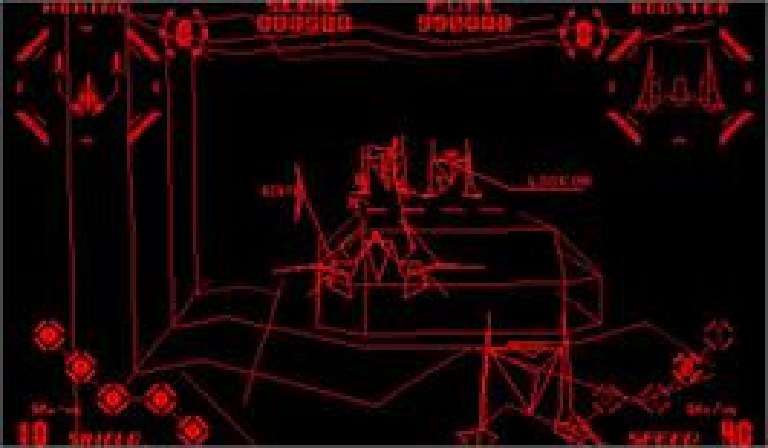
There is a moment early in Red Alarm when the wireframe corridor opens out, enemy formations pour through the breach as constellations of red lines, and you understand exactly what T&E Soft was attempting: Star Fox, rebuilt from pure geometry, inside a machine that could put that geometry at three different distances from your eyes at once. Released as a launch title in Japan and North America in 1995, Red Alarm is the Virtual Boy’s most technically daring game, a free-roaming 3D shooter rendered entirely in vector-style wireframes — because the hardware, asked to fill polygons at speed, politely declined, and T&E Soft turned that refusal into an art style.

You pilot the Tekkou — the ‘Red Alarm’ fighter — through six stages of an invasion by the electronic army KAOS, and the first shock is freedom. This is not an on-rails ride. Your ship can turn, climb, dive, hover, reverse and strafe, controlled by a scheme that uses both of the Virtual Boy controller’s D-pads: one steers, the other manages thrust and lateral movement. It takes a stage to learn and a stage more to stop fighting it, but once it clicks there is a genuine sense of piloting — of occupying a volume of space rather than sliding along a track through it.
Lines in the dark
The wireframe decision defines everything. With no filled surfaces, depth is carried entirely by parallax and scale, and the stereoscopic display earns its keep: a distant turret and a near wall may draw the same red lines, but your eyes never confuse them. Bosses — huge mechanical constructs assembled from hundreds of lines — rotate with a menace that sprite work could not have managed on this hardware, and the Easter eggs hidden in the geometry (a doll’s house, a tiny Virtual Boy itself, tucked into the opening stage’s walls) reward players who explore the space rather than merely survive it.
The cost of all that freedom is legibility. In a crowded dogfight, wireframe enemies, wireframe scenery and wireframe gunfire are all the same colour and the same weight of line, and Red Alarm occasionally dissolves into a red knot you navigate by instinct. The frame rate, too, is a hostage: busy scenes judder, though T&E Soft’s dynamic detail keeps the judder playable rather than fatal. These are 1995 problems on 1995 hardware, and the ambition deserves the larger share of the judgement — but they are real, and they are why Red Alarm is admired slightly more often than it is replayed.
Six stages, no passengers
The campaign is short — six stages, each ending in a set-piece boss — but structured for replay: multiple routes, hidden areas, a scoring system that rewards aggression, and harder difficulties that remix the threat. The soundtrack is propulsive synth work that suits the vector aesthetic perfectly, all urgency and square waves. Sound effects are sparse, which in a wireframe world feels right; space, here, is mostly silent except when something explodes into a brief firework of lines.
Historically, Red Alarm matters beyond its quality. It began life, by T&E Soft’s own account, as the kind of demo that proved 3D was possible on the machine at all, and it remained the library’s benchmark for polygonal action. When people ask whether the Virtual Boy could have supported a ‘real’ 3D library given time, Red Alarm is the exhibit both sides call: proof it could be done, and proof of what it cost.

Born as a demo, built like a manifesto
Red Alarm’s origins explain its shape. T&E Soft — a company whose background was in golf games and PC software as much as arcade action — was among the first third parties Nintendo approached, and by the company’s own telling the project grew from the desire to prove that real-time 3D was possible on the Virtual Boy at all. The wireframe style, so often described as a compromise, was partly a solution and partly a statement: Battlezone and the vector arcade classics had already proven that line-drawn 3D could be beautiful, and on a display with only four shades of one colour, filled polygons would have collapsed into red fog anyway. The lines were the honest way to draw space on this machine.
The control scheme, too, deserves a fairer historical hearing than it usually gets. Dual-analogue flight control did not exist in the home in 1995; the Virtual Boy controller’s twin D-pads were Nintendo’s own strange answer to the problem of six-axis movement, and Red Alarm is the one game that treats them as a flight yoke rather than a redundancy. Modern players meeting the game through emulation with twin sticks will find the translation surprisingly natural — evidence that T&E Soft’s instincts about spatial control were ahead of the input technology of their moment, on a controller nobody else used properly either.
The KAOS campaign, remembered
The six stages repay a closer look than their count suggests. The campaign moves from open interception to interior runs through the machine-spaces of the KAOS army, and the level design understands the wireframe language: arenas are built from frames and gantries that read as architecture in lines, and the celebrated hidden objects — the doll’s house with its stick-figure family, the miniature Virtual Boy and controller, the Ultra Hand, a tribute to Nintendo’s pre-video-game toy era — turn the stages into places rather than corridors. Finding them requires the very freedom the controls give you, which makes Red Alarm a rare early 3D game that rewards looking around for its own sake.
The replay presentation is another forward-looking touch: after each stage, the game can replay your performance from alternate camera angles, including the cockpit view, an idea that treats 3D space as something to be re-examined rather than merely survived. In 1995, on any hardware, that was a connoisseur’s feature. Its presence here, in a launch game for a doomed console, is the surest sign of how seriously T&E Soft took the machine they were given.
A closing note on survival: Red Alarm is the Virtual Boy game most often cited by the homebrew and VR communities as the proof that the machine’s ideas were portable to the future — free spatial movement, depth as a navigational sense, a world built from pure geometry that modern headsets render beautifully. Its wireframes, chosen under duress in 1995, turned out to be the library’s most future-proof aesthetic: they cannot date, because they were never pretending to be anything but light and mathematics. The game T&E Soft built to prove the Virtual Boy could do 3D ended up proving something larger — that the limitation was the style, and the style was the point.
If a single screenshot could summarise the Virtual Boy’s whole argument, it might be a Red Alarm cockpit frame: a world made of nothing but red lines and darkness that your eyes nonetheless read, instantly, as a place you are inside. That transformation — from almost no information to total spatial conviction — is the machine’s magic, and no game performs it more completely.
Verdict
Red Alarm is the Virtual Boy game that most respects your intelligence and most tests your eyes. Its controls demand an apprenticeship, its wireframes occasionally demand guesswork, and what it offers in return — true spatial freedom in glowing red — nothing else on the system quite matches.
Red Alarm — 8.0/10. Ambitious, awkward and utterly singular: the Virtual Boy’s wireframe epic, and still its finest hour of 3D action.