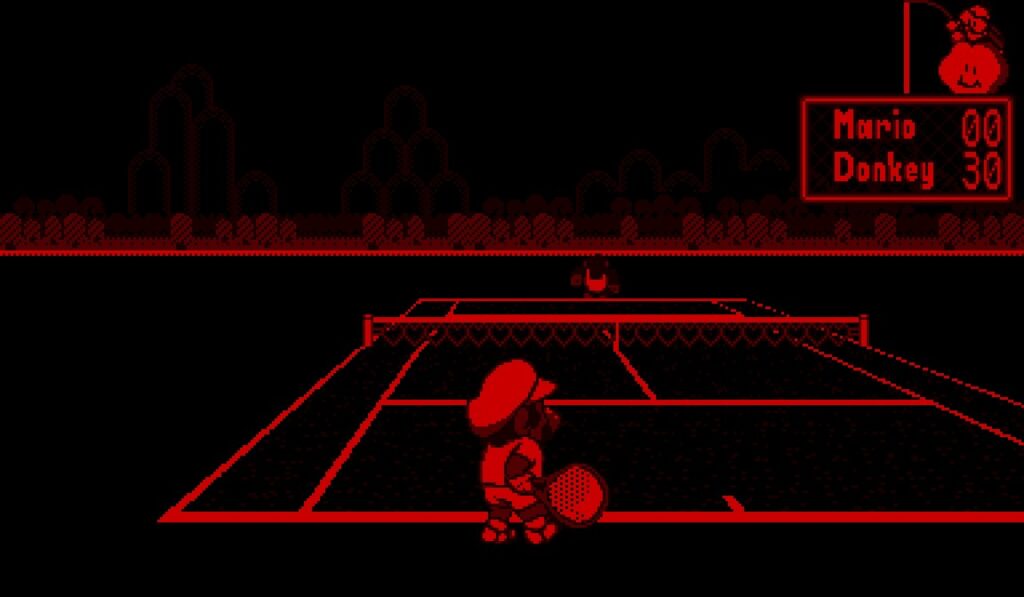
Every console launch has one game carrying more weight than the rest, and for the Virtual Boy that game was Mario’s Tennis. It was the pack-in in North America, which meant it was, for most owners, the first thing the machine ever showed them: a tennis court stretching away into blackness, a ball that genuinely grew larger as it flew toward your face, and Mario — in red, always in red — waiting at the baseline. Nintendo R&D1, the team behind the hardware itself, developed it, and it shows in both the best and worst ways. It is a confident demonstration of depth and a remarkably thin sports game at the same time.

The genius of the choice is obvious in hindsight. Tennis is the perfect stereoscopic sport because the entire game is about judging distance along a single axis. Where a flat tennis game asks you to read the ball’s shadow and scale, Mario’s Tennis lets your two eyes do the work nature intended. Lob a ball high and it hangs in the space in front of the screen, drifting closer; hit a drive and it punches out of the court toward you. The effect is not a gimmick bolted onto the sport — it is information, and it makes even this simple rendition feel oddly physical.
A small court, honestly kept
Strip the depth away and what remains is a modest, likeable tennis game. You can play singles or doubles, in exhibition matches or a short tournament, and the roster is a Mushroom Kingdom roll call — Mario, Luigi, Peach, Yoshi, Donkey Kong Jr., Koopa Troopa and Toad — each with the expected nudge to speed, power or all-round steadiness. Movement is automatic in the generous sense: your player shuffles toward the ball’s neighbourhood, and your job is timing and shot choice. The A and B buttons give you standard and lob shots, and charging a shot while the ball approaches adds sting at the cost of mobility.
That simplicity cuts both ways. Within ten minutes you have seen the game’s whole vocabulary, and the computer opponents, even on the higher difficulties, are more stubborn than clever. Doubles is the better entertainment — the court fills with red sprites and the depth effect works double duty as you track your partner, your opponents and the ball in three genuine layers — but there is no career structure, no unlockable anything, and no link mode to test yourself against another human being and their own Virtual Boy, a missed trick the hardware’s link port kept promising.

The R&D1 house style
Visually this is the Virtual Boy at its cleanest. The sprites are large, the court is drawn with confident perspective, and the little animated touches — characters celebrating, the crowd as a dotted red firmament — sell a completeness the mechanics don’t quite match. The soundtrack, by Kenji Yamamoto’s team in spirit if not in name, is bouncy and unobtrusive, with the satisfying percussive thock of racket on ball doing most of the audio work. Crucially for a launch title on a machine already acquiring a reputation, it is comfortable: the ball’s pace is measured, sessions are short, and nothing here strains the eyes the way faster games could.
What the game really demonstrates is how quickly Nintendo’s own designers understood their odd hardware. The court is not decorated with depth; it is built from it. Net, lines, players and ball each sit on their own plane and the game trusts you to read them. Compare it with the clutter of some third-party efforts and the lesson of the whole Virtual Boy library is right here at the start: restraint looked better in red.

The launch-window burden
It is worth remembering what was being asked of this game in August 1995. The Virtual Boy launched in North America at $179.95 with a concept — true stereoscopic 3D, in red, on a tabletop visor — that no advertisement could adequately explain. It had to be experienced, and for the majority of buyers the pack-in was the experience. Nintendo’s retail strategy leaned on in-store demo units, but the home first impression belonged to Mario’s Tennis. R&D1’s designers knew the assignment: nothing confusing, nothing that strained, the depth effect legible within thirty seconds of switching on. Every simplification in the game — the assisted movement, the small roster, the forgiving timing — reads differently once you understand it was engineered as an introduction to a dimension, not merely as a sports title.
The development pedigree deserves a footnote of its own. Mario’s Tennis was developed by Nintendo R&D1 with support from Tose, the Kyoto workhorse studio behind a quiet mountain of Nintendo software, and it was directed within the division that had designed the hardware — which is why, alone among the launch titles, it never once misjudges what the display does well. The court is wide, bright and uncluttered; the sprites sit at well-separated depths; even the scoreboard is placed where the eyes rest naturally. Later Virtual Boy games would push more polygons and more effects. None of the launch wave is as well-mannered.
How it plays today
Revisited in 2026 — through Nintendo’s own Virtual Boy revival on modern hardware, through emulation in VR, or on an original unit — Mario’s Tennis has aged into the library’s most relaxed pleasure. Its short matches suit the machine’s recommended session lengths perfectly, and its doubles mode, with a second player sharing the visor in turns or simply watching the depth over your shoulder in emulation, remains a small marvel of clarity. What has not aged is the simplicity: a modern player will master the shot selection within an hour and exhaust the tournament soon after. It is a game to visit, not to live in — a first hello from a strange machine, still warm after thirty years.
Its influence is easy to miss because it is mostly negative space: Mario’s Tennis established the house rules every good Virtual Boy game would follow — big sprites, separated planes, nothing important at the edges of vision, sessions measured in minutes. The library’s failures are usually failures to obey them. That the rules were set by a tennis pack-in, rather than by a flagship adventure, tells you something true about the Virtual Boy itself: it was a machine whose genius was in demonstration, in the first thirty seconds of red depth, and Mario’s Tennis is the purest demonstration it ever got.
One more consideration for the modern player: Mario’s Tennis is the Virtual Boy game most likely to be someone’s first, again, because it anchors Nintendo’s own revival programme for the system and headlines every emulation starter set. That is a fitting fate. The game was designed, above everything, to be a first impression — to make a sceptic lean into a visor in a shop in 1995 and say ‘oh’. Thirty years later it performs the same office for the same reason, and the ‘oh’ still arrives on schedule. Few pack-ins in Nintendo’s history have carried their concept so completely in so little software.
Verdict
Mario’s Tennis was never meant to be judged as a full-price sports simulation, and judged as what it is — a pack-in, a demo, a handshake between a strange machine and a sceptical public — it succeeds handsomely. It remains one of the most pleasant ways to spend twenty minutes inside the Virtual Boy, even if twenty minutes is about the length of its attention span.
Mario’s Tennis — 7.5/10. The shallow end of the Virtual Boy pool, but the water is lovely: the purest, friendliest demonstration of what stereoscopic depth could do for a sports game.