
At a glance: Blood Omen: Legacy of Kain (PlayStation, 1996) · Top-down action RPG · Developed by Silicon Knights, published by Crystal Dynamics · Voiced by Simon Templeman as Kain · Score: 8.5/10
Most games about vampires cast you as the hunter. Blood Omen: Legacy of Kain, released for the PlayStation in 1996, had the far better idea: it casts you as the vampire, and not some tortured romantic, either — a murdered nobleman dragged back from death and openly furious about it. Developed by Silicon Knights and published by Crystal Dynamics, Blood Omen is a top-down action RPG steeped in blood, Shakespearean spite and gothic architecture, and it remains one of the most distinctive games on the PlayStation. It also launched the Legacy of Kain saga — Soul Reaver and all that followed — and judged purely on its own terms, the original still deserves its place at the head of the family table.

Vae Victis
The premise is a revenge tragedy with fangs. Kain, a young aristocrat travelling through the land of Nosgoth, is set upon in a village street and murdered. Offered resurrection by the necromancer Mortanius, he claws his way out of the grave as a vampire, interested in the bargain’s fine print not one bit: he wants his killers. What begins as personal vengeance widens into the fate of the world — the Pillars of Nosgoth, nine monuments bound to the health of the land, are crumbling because their guardians, the sorcerers of the Circle of Nine, have been corrupted and slaughtered. Kain’s vendetta and Nosgoth’s rot turn out to be the same story, and the hunt for assassins becomes a hunt for gods.
What elevates all of this beyond genre boilerplate is the voice. Simon Templeman’s Kain is one of the great performances of the 32-bit era — silk, venom and contempt in equal measure — and the script trusts him with long, arch, beautifully poisonous narration. Kain does not merely comment on events; he sneers at them, philosophises over corpses, and delivers the series’ battle-cry, “Vae Victis — suffering to the conquered,” like a man who has waited centuries for an excuse. In 1996, when most game writing was functional at best, Blood Omen played like literature with a health bar.

A bloodthirsty Zelda, then — but darker
Strip away the voice work and the structure is familiar: a large top-down world explored in the Zelda manner, towns and dungeons arranged around a spreading map, new abilities prising open old barriers. The difference is in what those abilities are. Kain does not collect heart containers and hookshots; he collects ways to be a monster. He shifts into a wolf to leap, into a bat to travel, into mist to slip through gates. He disguises himself as a human to walk Nosgoth’s streets unmolested and hear what villagers say when they think no vampire is listening. And he feeds — constantly. Blood is health, health is blood, and the game’s central mechanical loop has you draining peasants, prisoners and enemies alike to stay alive, a resource economy with a body count.
Combat is blunt, heavy hack-and-slash enriched by spells and artefacts, and the world is uncommonly generous in size: this is a long game, with Nosgoth’s regions, strongholds and secrets unfolding over dozens of hours. The balance leans generous to the player once the better weapons arrive, but Blood Omen was never really about challenge. It is about inhabiting Kain — accumulating power, forms and grudges across a map that feels genuinely cursed.
Binding the whole quest together is Ariel, the murdered guardian of the Pillar of Balance, who lingers as a ghost bound to the Pillars themselves and serves as Kain’s spectral guide — part narrator, part conscience, wholly unheeded. It is an elegant frame: the voice of the world’s balance counselling a man whose every solution is atrocity, and their exchanges give the game’s middle hours a dramatic spine that pure dungeon-crawling would lack. Between Ariel’s sorrow, Mortanius’s manipulations and Kain’s magnificent contempt for both of them, Blood Omen builds a triangle of unreliable narrators years before that became a fashionable trick, and it trusts the player to notice that nobody in Nosgoth — least of all its hero — is telling the whole truth.
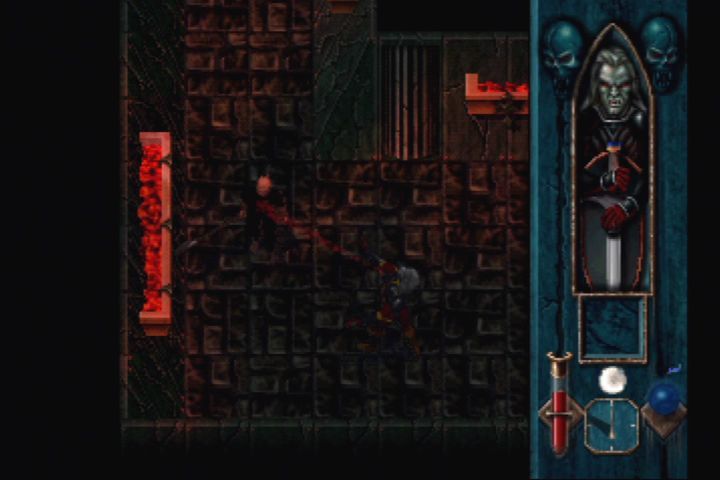
A world that rots beautifully
Nosgoth itself is the second performance of the game, and it deserves equal billing. The map is genuinely vast for its genre and period — a contiguous kingdom of villages, swamps, strongholds and snowfields, threaded together by bat-flight waypoints and secret-bearing back roads. Time passes there: a day-and-night cycle governs the world, werewolf-haunted roads change character after dark, and the moon waxes over a landscape whose decay is written into its geography. The Pillars stand at the centre of everything, visible from the game’s opening hours and revisited throughout, and the pilgrimages between guardians give the revenge plot the shape of a grand tour through a dying world. Silicon Knights were world-builders by temperament, and Blood Omen is the proof — Nosgoth feels less like a level select than like a country with a terminal diagnosis.
And then there is the ending, which the series never stopped arguing with. At the climax, Kain is offered the classic bargain of heroic fantasy: sacrifice himself, restore the Pillars, save the world. Blood Omen, being Blood Omen, lets you refuse — lets you choose damnation and dominion instead, and means it. Either choice closes the game; only one of them could have built a franchise, and when Soul Reaver arrived three years later it confirmed which Kain history had kept: the emperor on the throne of a ruined world. In 1996, endings that let the villain win outright were rare. Endings that let *you* win *as* the villain, then built a saga on the consequences, were close to unheard of. That audacity, as much as any sword or spell, is Blood Omen’s claim on the shelf of classics.
The sound design wraps the whole production in the right kind of dread: tolling, echoing score work beneath the narration, the wet percussion of feeding, weapons ringing off armour in dungeons that sound as hollow as they look. Play it through headphones, as its makers plainly hoped, and Blood Omen’s atmosphere doubles in density. It is another of the game’s quiet firsts — an action RPG that understood, in 1996, that audio was half the gothic.
The PlayStation pays the toll
The costs of all this ambition land squarely on the hardware. Blood Omen is famous — infamous — for its loading: entering buildings, opening menus and shifting areas all involve waits that were conspicuous even by 1996 standards, and the frame rate sags when the screen fills. The sprite work is rich and the pre-rendered gothic scenery still handsome, but the PlayStation is being asked to carry a PC-sized RPG, and it groans audibly. The later PC version eases some of this; on original hardware, patience is part of the difficulty setting, and anyone revisiting today should know that going in.
Verdict
Blood Omen: Legacy of Kain survives its technical creaks because nothing else of its era feels quite like it: a top-down RPG with the soul of a revenge play, fronted by a protagonist who is unambiguously the villain of everyone else’s story and entirely unbothered by the fact. The series would reach greater mechanical heights with Soul Reaver, but its voice, its world and its beautiful, bitter attitude start here, fully formed. An essential PlayStation shelf piece.
Score: 8.5/10