
At a glance: Ristar · Game Gear · Sega, 1995 · Platformer · Score: 8.0/10
Ristar was Sonic Team’s other child — the shooting star with the elastic arms, born from the same design sessions that produced a certain hedgehog, and gifted with one of the great movesets of the platform era. His Mega Drive adventure of 1995 is a cult classic; his Game Gear adventure, released the same year, is something rarer and in some ways more interesting: not a port, but a companion game, sharing the hero, the villain and the premise while redesigning the planets, the layouts and several mechanics for the handheld. If you have finished the 16-bit Ristar, you have not finished Ristar. The little cartridge has its own journey waiting.
The premise is unchanged: the evil Kaiser Greedy has seized the Valdi System, mind-controlled its leaders and kidnapped Ristar’s father, and the young star must swing through seven planets to free them. What changes is almost everything under that premise. Planet Flora, Neer, Onaclove and the rest appear in reimagined forms, with stage layouts built from scratch for the smaller screen and the handheld’s abilities, new gimmicks woven in, and a difficulty curve tuned for shorter, battery-conscious sessions. It plays like a remix by the original artists — familiar melodies, new verses.
Those arms, that swing
The core verb survives gloriously. Ristar grabs: enemies, ledges, walls, the famous star handles that let him build momentum in a circle until he launches like a meteor across the screen. On the Game Gear the grab is as responsive as the hardware allows, the arc of a full-speed launch as satisfying as ever, and the level design leans into it — vertical shafts climbed hand over hand, handle-runs over hazards, secrets tucked behind grabbable scenery. Where the conversion trims is in scale and sprite size: Ristar is smaller on screen, the planets less lush, the spectacular multi-screen set pieces of the Mega Drive replaced by tighter, more intimate challenges. It is a fair trade, honestly made.
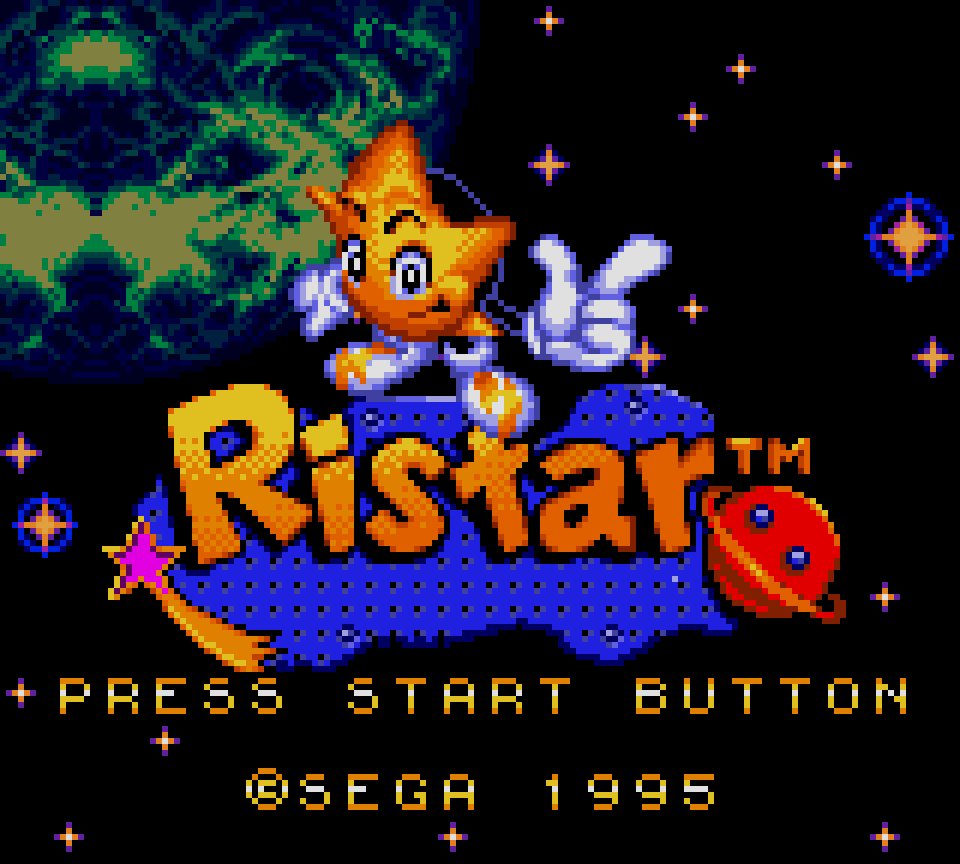
The music deserves special praise, because Ristar’s soundtrack is one of the Mega Drive’s glories and the Game Gear arrangements keep its spirit: Shooting Ristar’s bounce, the dreamy lilt of the water worlds, all re-voiced for the sound chip with real care. Bosses return in adapted form — the snow world’s Itamor, the mechanical menaces of Automaton — each shrunk but characterful, each testing the grab in a different way. Bonus stages and the treasure hunt structure survive, and the password system, period-standard, carries progress between sessions.
Built for the machine
Because this Ristar was designed for the Game Gear rather than cropped onto it, it sidesteps the library’s usual complaint. Sprites are drawn for the display’s resolution, hazards are telegraphed fairly, and the camera keeps Ristar’s next grab in view. The palette work is lovely — this is 1995 Sega, confident in colour — and the starfields and planet skies give the game a bedtime-story glow that suits the hero perfectly. Frame rate holds up well, dipping only in the busiest launch sequences, and the whole package feels like a first-party production that respected its hardware.
Not a port and not a cut-down: a second Ristar adventure, remixed for the small screen by people who loved the first one.
Honest reservations: the campaign is shorter than the Mega Drive’s, the smaller sprites cost some of the original’s squash-and-stretch charm, and a couple of the redesigned planets lean on familiar gimmicks where the 16-bit game would have invented new ones. The final stretch’s difficulty arrives a touch abruptly. And, in a structural sense, the Game Gear Ristar lives in its sibling’s shadow in Western memory — it reviewed well, sold modestly in a fading market, and is still routinely mistaken for a straight port by people who have never played it.

Why it deserves rescue
Play both versions back to back and the Game Gear game’s claim becomes obvious: it is the more replayable of the two in short sessions, its levels are new, its heart is identical. In a library full of conversions that apologise for existing, Ristar simply gets on with being an excellent platformer. For collectors it is also one of the system’s best late releases — a first-party cartridge from the platform’s twilight that shows Sega’s handheld craft at its most assured.

Planets, revisited
The redesigned planets repay a traveller’s attention. Flora keeps its greenery but rearranges its challenges around tighter, more vertical spaces. The water world leans into the grab’s underwater rhythm. The mechanical late planets — always Ristar’s sternest test — are rebalanced for the small screen’s sight lines, which makes this version, in places, the fairer of the two. Treasure chests and bonus stages preserve the original’s generosity, and the boss adaptations hold their personalities: these are not smaller bosses so much as remixed ones, with patterns re-choreographed for Ristar’s handheld reach. Players who know the Mega Drive fights by heart will be caught out, pleasantly, more than once.
It matters, too, that this exists at all. By 1995 the Game Gear’s Western software pipeline was narrowing to a trickle, and a first-party production of this care — a companion game, not a port, for a new mascot — was an act of faith in the platform by the people who built it. The faith was not misplaced. Ristar’s cartridge has aged into one of the system’s most respected late releases, the answer Game Gear owners give when the library’s depth is questioned. Faith, it turns out, is a renewable resource when the games are this good.
Control feel, the platformer’s soul, survives the shrink with remarkable completeness: the grab’s snap, the swing’s build, the launch’s commitment — the whole risk-and-release rhythm that makes Ristar Ristar plays true on the little pad, with the two-button layout mapped sensibly between grab and jump. If a conversion of this moveset had any right to go wrong, it was here, on the smallest canvas and the simplest controller Sonic Team’s design ever faced. It did not go wrong. That, more than any single planet’s design, is the cartridge’s certificate of quality.
The presentation’s final flourish is its colour scripting: each planet owns a palette the way each Mega Drive world owned a musical key, and the handheld’s display — maligned for its hunger, praised for its glow — shows the art exactly as its makers dreamed it. In the dark, on batteries, in 1995, this was the best-looking reason to own the machine that year. It has strong competition for that title now. It held it then without argument.
And the cartridge’s difficulty, given its final fair word, is the friendliest in the hero’s short career — a game that wants to be finished, by the children it was made for, in the sessions its hardware allowed. Finishing it is not the end of it; the treasure hunt and the second run as a connoisseur’s edition of a beloved design give it the afterlife its quality earns.
Verdict
Ristar on Game Gear is the demake done right: a companion adventure that redesigns rather than reduces, keeps the elastic-armed magic intact, and dresses it in some of the prettiest colour work on the system. It is shorter and smaller than its Mega Drive sibling, and it has spent thirty years being mistaken for it. Correct that mistake. This is a first-rate platformer hiding inside a famous name.