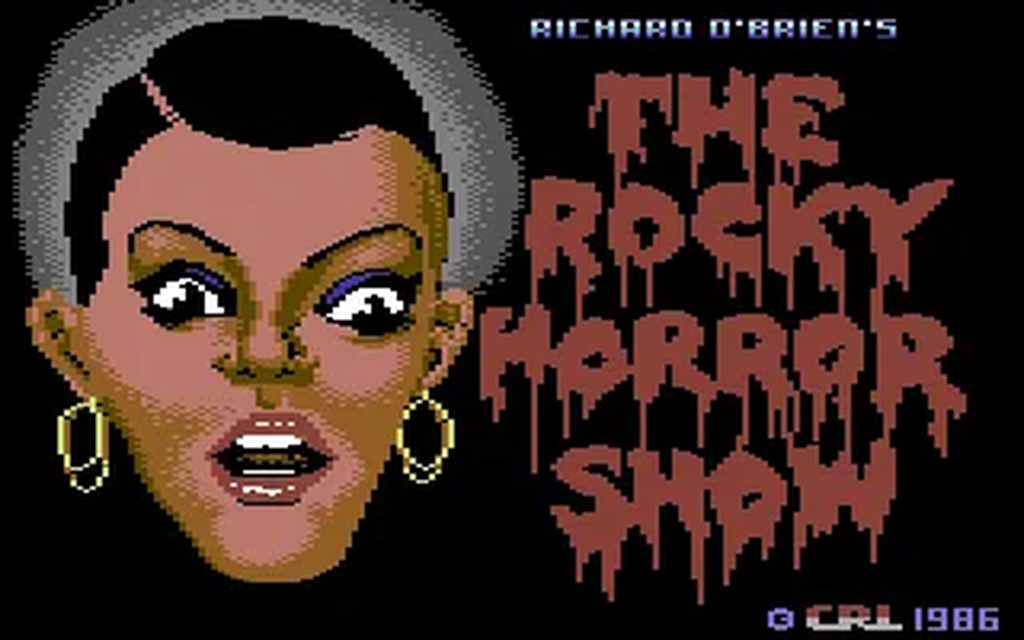
At a glance: The Rocky Horror Show · Commodore 128 · CRL Group, 1985 · Arcade adventure · Score: 6.5/10
Most “Commodore 128 versions” of the 1980s are the C64 game with a sticker on the box. The Rocky Horror Show is the glorious exception, and it is why this review exists. CRL released two genuinely different Commodore builds of Richard O’Brien’s cult musical: the C64 got a straight port of the ZX Spectrum original, while the C128 got a version with completely reworked graphics — more detailed characters, more colourful backgrounds — and a few locations that exist in no other edition. For one brief moment, the 128 was not the machine that also ran the game. It was the machine the best version was made for.
The setup is the film’s, compressed into an arcade adventure. You play Brad Majors or Janet Weiss — your choice at the start — trapped in Dr Frank N. Furter’s castle while your partner sits petrified by the Medusa machine. Somewhere in the castle are the scattered pieces of the De-Medusa device. Find them, carry them — one at a time, naturally — back to the machine, rebuild it, free your other half and escape before the castle blasts off for Transylvania. A countdown ticks away the whole time, because of course it does.
A castle full of thieves
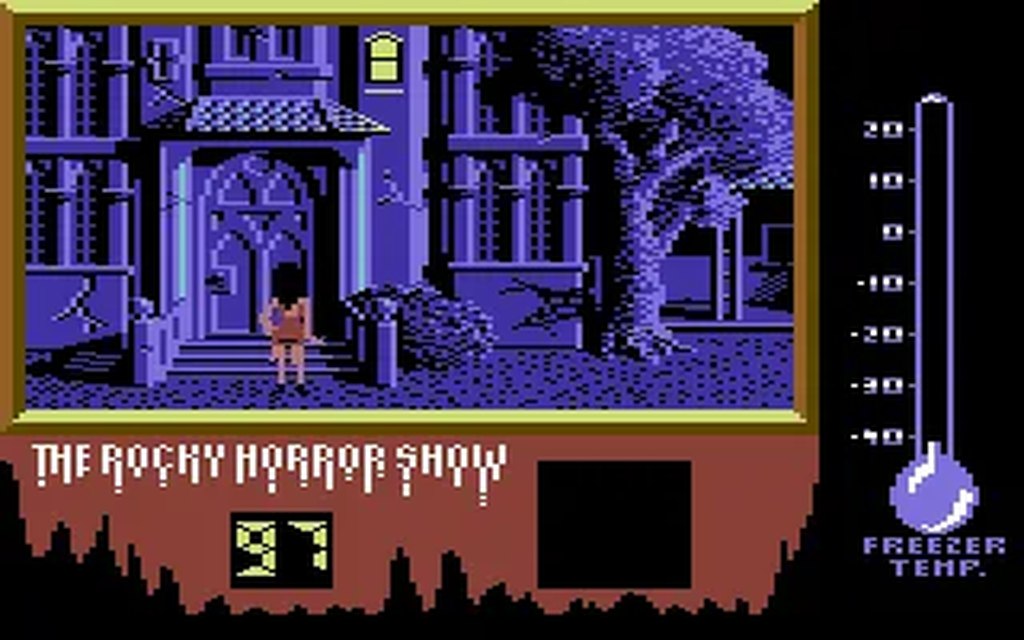
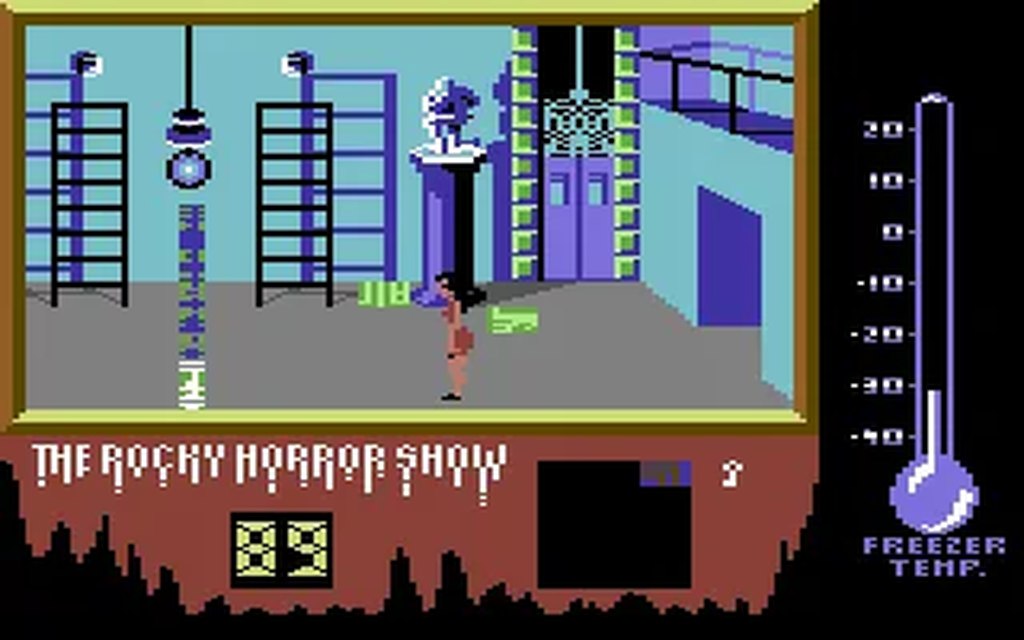
The castle is a flick-screen maze of ballrooms, laboratories, bedrooms and freezers, populated by the show’s cast rendered as wandering sprites: Riff Raff with his laser gun, Magenta, Columbia, Rocky himself, and Eddie, who periodically thaws out of the freezer and comes roaring through the corridors on his motorcycle, which is exactly as dangerous as it sounds. The inhabitants’ signature crime is petty and infuriating: they steal your clothes. Caught undressed, you are slowed and shamed; caught by a laser bolt or a motorbike, you are dead. Keys open locked doors, force fields block passages until disabled, and every trip across the castle with a De-Medusa piece in hand is a small expedition planned around who is likely to mug you on the way back.
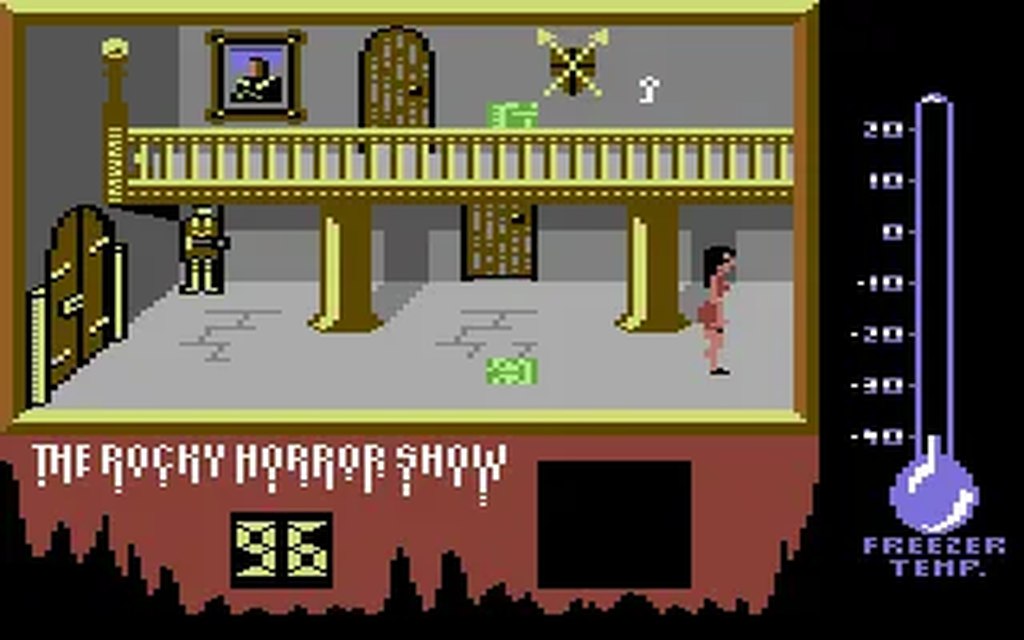
As a game structure it is, frankly, thin: fetch, carry, repeat, against a clock. What carries it is atmosphere and licence. The castle is recognisably Frank’s — the lab, the elevator, the dinner-party grotesquery — and the C128 version’s redrawn graphics do the licence justice in a way the Spectrum-derived C64 build never attempted. Characters have faces and costumes rather than outlines; rooms have colour and furniture. If you grew up with the film’s midnight-movie ritual, there is real pleasure in simply wandering this version of the house.
The 128 difference, honestly assessed
It is worth being precise about what the rework does and does not change. It does not change the design: same castle plan at heart, same fetch-and-carry loop, same enemies, same time pressure, plus those few extra locations folded into the map. It changes how the game feels to inhabit. The C64 version’s Spectrum heritage meant flat, attributed colour and characters who read as tokens; the C128 build uses the machine’s ordinary 40-column graphics properly, with detailed sprites and backgrounds that look drawn for the Commodore rather than translated onto it. In an era when “128 version” usually meant a loader that detected the machine and did nothing, CRL’s effort stands out — this is one of the very few games of 1985 where buying the bigger Commodore visibly bought you a better game.
Two Commodore versions shipped, and they are not the same game wearing two labels: the C128’s Rocky Horror was redrawn from the walls up.
The licence’s music is the obvious missed trick — the Time Warp is present in spirit and in the game’s packaging more than in any memorable SID rendition, and the sound generally is functional rather than theatrical. Controls, too, are of their moment: stiff, digital, with collision that occasionally feels adjudicated by Riff Raff himself. And the underlying design’s repetition cannot be redrawn away. Fifteen-odd round trips through the same corridors is a lot to ask, and the game’s difficulty comes as much from attrition — the stolen clothes, the one-hit deaths, the long walks back — as from anything clever.
Who it is for
For Rocky Horror devotees, this is the home version with the most love in it, on any 8-bit machine — the Spectrum 128K edition has its fans and its enhanced ending, but the C128’s full graphical rework is the most substantial tribute any programmer paid the film in 1985. For the C128 collector, it is one of the handful of titles that justify the machine’s existence as a games platform in its own right. For everyone else, it is a charming, dated fetch-quest whose pleasures are licensed ones.
Playing it straight (well, straighter)
A practical note for modern players: the game’s structure rewards mapping. The castle’s rooms connect in ways that are logical but not signposted, the De-Medusa piece you need is rarely near the room where its absence strands you, and the cast’s kleptomania means your route planning must include what you are wearing. Choose your protagonist with intent — Brad and Janet have identical jobs but the sprite work and the household’s reactions differ enough to make a second run worthwhile — and treat Eddie’s motorcycle appearances as the game’s random lightning: unfair, funny, and absolutely in the spirit of the source. Saves do not exist; the castle is a single-sitting dare, which suits a game about one long night.
The music question deserves a verdict of its own. The Time Warp, the film’s gravitational centre, appears in chip form — recognisable, game, and about as danceable as the SID allows. Purists will call it a synthesised postcard of the song; everyone else will grin, because the audacity of including it at all, on a budget-priced licensed game in 1985, is the whole Rocky Horror ethos in miniature: do it cheap, do it loud, do it anyway.
The licence, honoured
Licensed games of the era usually treated their source as a poster to wrap around an unrelated arcade clone; Rocky Horror is the honourable exception, and the C128 edition doubles down on the fidelity. The plot machinery — the De-Medusa scattered through a castle that wants you naked, lost and late — is the film’s plot machinery; the jokes are the film’s jokes, retold in parser-friendly form; even the Medusa ray itself, the show’s great stone-turning MacGuffin, is used the way the film uses it, as the deadline everything races against. A fan in 1985 could reasonably feel the game respected the show. A fan in 2026 will feel the same, with the added pleasure that the C128 version’s prettier castle makes the respect visible. CRL’s later years were undistinguished; this odd, warm, thoroughly British production is the thing they will be remembered for, and it deserves to be.
The verdict
The Rocky Horror Show on Commodore 128 is a modest game made fascinating by its circumstances: a film licence, a budget British house, and a brand-new computer that almost nobody else was bothering to program for. CRL bothered. The reworked graphics and extra rooms cannot disguise a repetitive core, but they make this the version to play, to keep, and to point at whenever someone claims the C128 never got a native game worth the name. Don’t dream it — this time, the 128 owners really could play the better one.
Score: 6.5/10 — A simple fetch-quest elevated by a genuine graphical rework: the rarest thing in 1985, a C128 version that deserved to exist.