
At a glance: Ultima V: Warriors of Destiny · Commodore 128 · Origin Systems, 1988 · Role-playing game · Score: 9.0/10
There is a sentence buried in the Commodore folklore of Ultima V that every C128 owner knows by heart: the music is only there if you have the 128. Boot Warriors of Destiny on a Commodore 64 and Britannia is silent — Kenneth Arnold’s score simply does not exist. Boot the same disks on a Commodore 128, in 128 mode, and the game detects the bigger machine, spreads itself into the extra memory, and plays music throughout your quest. It is the most famous C128 enhancement in all of gaming, and it turns an already great RPG into the definitive 8-bit version of itself.
The story is Ultima growing up and turning dark. Lord British is lost in the Underworld; his steward Lord Blackthorn has seized the throne and twisted the Eight Virtues into oppressive law — compassion enforced by fines, honesty by torture. Three Shadowlords, embodiments of Falsehood, Hatred and Cowardice, stalk the land. You, the Avatar, return through a moonstone to a Britannia that greets you not with gratitude but with suspicion. It is a sequel about what happens to ideals when they are imposed, and in 1988 almost nothing else in games was attempting moral argument at this scale.

What the 128 actually buys you
Precision matters here, because the C128 version of Ultima V is a mode, not a separate port: the same disks run on both machines. On the 128, three things change. First, the music — a full Arnold soundtrack of town, travel and combat themes, woven through play in a way that transforms the mood of long journeys. Second, memory: the game keeps far more of itself resident in the extra RAM, which means noticeably less disk activity in a game notorious for swapping across its eight disk sides. Third, convenience: the game can autoboot on a 128 with a 1571 drive, and the 1571’s burst mode sidesteps the fast-loader timing problems that plagued PAL C64 owners. None of this alters a single tile of graphics — the visuals are the shared Commodore build — but as an experience, the difference between the silent, swapping C64 run and the musical, smoother 128 run is the difference between a port and a homecoming.
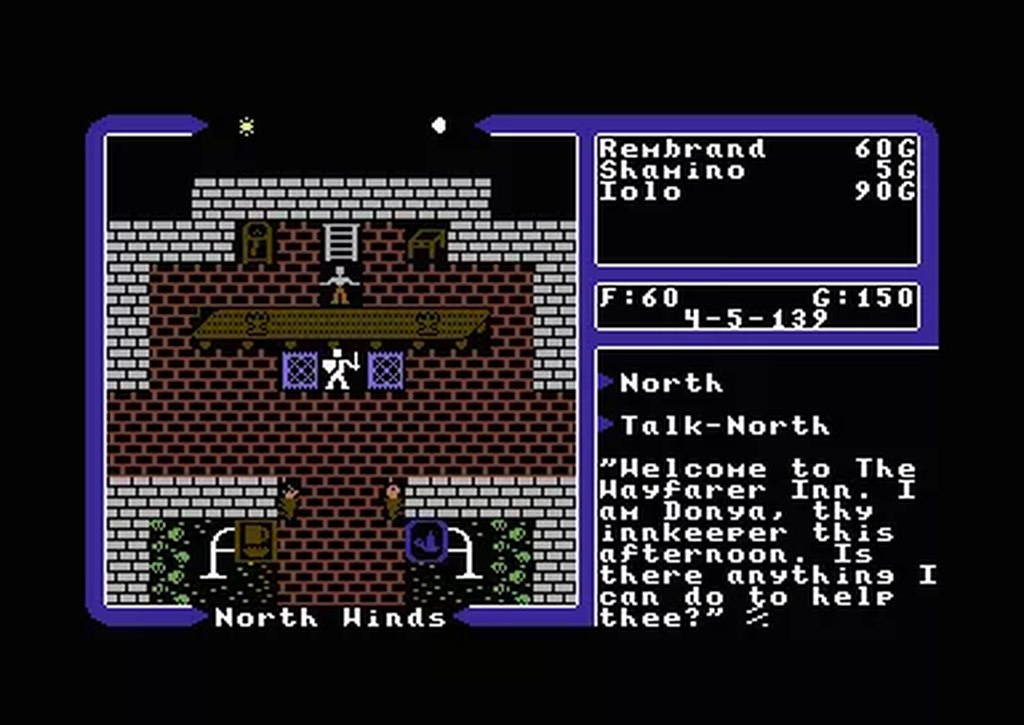
The game underneath is the high-water mark of the Apple II-era Ultima engine. Britannia now runs on a clock: the sun rises and sets, and every towns-person follows a daily schedule — working, eating, sleeping, locking up at night. Miss the blacksmith’s hours and you wait until morning. The world is doubled by the Underworld, a lightless second map beneath the first, reached through the dungeons and essential to the endgame. Combat plays out on tactical battle screens; magic is mixed from reagents; conversation is keyword-driven and deep, with NPCs who remember, lie, and can be permanently killed — by you, if you choose, with consequences the game does not undo.
Britannia as a place, not a backdrop
What Ultima V understood, earlier than almost anyone, is that a world persuades through routine. The day-night cycle and NPC schedules are usually listed as features; in play they are the substance. You plan journeys around darkness — at night, or underground, your view shrinks to a few tiles around a torch. You learn towns the way you learn real towns, by their inhabitants’ habits. Blackthorn’s regime is not a cutscene but a system: his sheriffs patrol, his laws are posted, and the resistance hides in plain sight among people whose schedules you have learned for innocent reasons. The Shadowlords themselves can appear in towns, warping the behaviour and honesty of everyone near — a mechanic that makes the political story playable.
On the C128, Ultima V does not look one pixel better. It sounds like a different, richer game — and in an RPG built on atmosphere, that is the upgrade that counts.
The costs are the era’s costs, and they should be stated plainly. Even with the 128’s memory absorbing some of the burden, this is a disk-swapping game on a heroic scale; entering towns, dungeons and conversations all spin the drive, and the pace of play is measured in loads as much as in steps. The graphics, inherited from a design lineage rooted in the Apple II, are functional tiles rather than the best the Commodore could draw. And the difficulty is honest 1988 difficulty: food, torches, reagents and death all demand management, and the Underworld finale is a genuine ordeal. Modern players have Lazarus and patches; the 128 owner in 1988 had graph paper and patience, and the game was built for exactly that owner.
The systems underneath the story
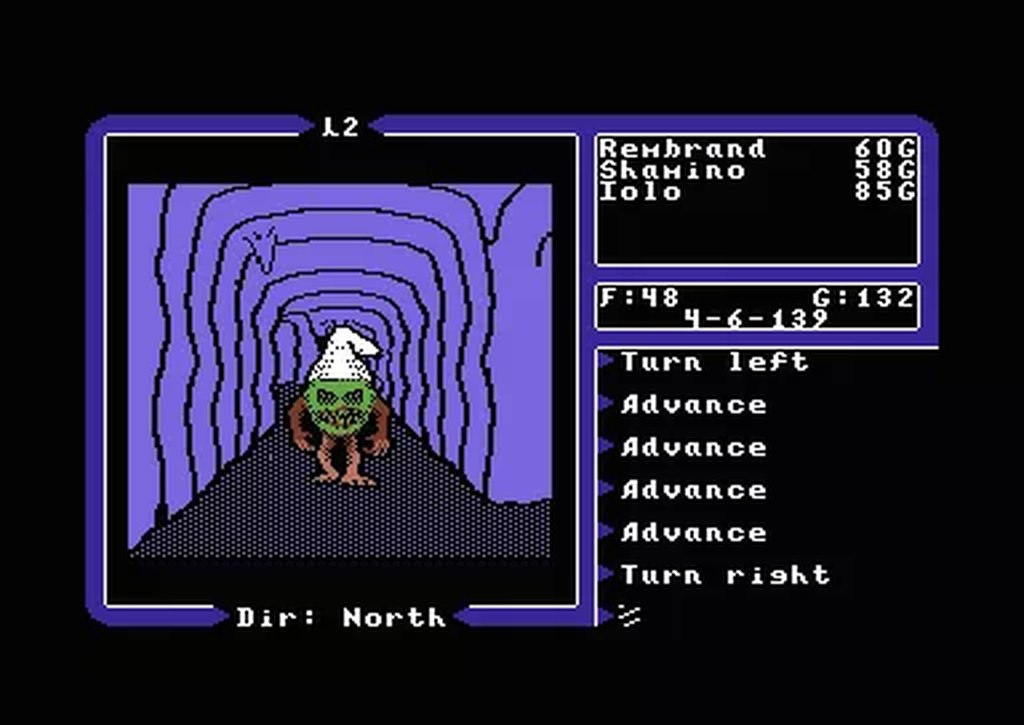
Ultima V rewards the systems-minded player as much as the story-minded. Its eight dungeons are full 3D-mapped descents whose bottom floors open into the Underworld; its magic system demands reagents mixed per spell and memorised by the book; its economy — food, torches, gems for peering at maps, horses, skiffs, a magic carpet behind a famous waterfall — makes Britannia a logistics problem as much as a quest. The Avatar’s party carries over relationships from Ultima IV, and the game quietly tracks your virtue in the new regime’s shadow: steal from a blind reagents-seller and the game notices even when no sheriff does. Death, unusually, is not a reload: Lord British himself retrieves you, at the cost of experience, which keeps the campaign’s tension honest without erasing an evening’s play. None of these systems was new to the Commodore port, but the 128’s memory made living inside them smoother, and smoothness in a hundred-hour game is not a luxury — it is the difference between a world and a chore.
It is also the last of the classical line. Ultima VI would rebuild the engine around a single-scale world and leave the 8-bit machines behind entirely; Warriors of Destiny is therefore the most advanced form the original design ever took on Commodore hardware, and the C128 the most advanced Commodore it ever met. That symmetry is part of the game’s hold on the machine’s owners.
A note on difficulty, honestly given
One caution for returning players: Ultima V is long and it is stern. A full campaign runs to dozens of hours; the eight virtues’ shrines, the Codex, the captured regalia and the Underworld’s lightless sprawl ask for notes, maps and patience, and the game’s economy of torches and food punishes tourism. The 128 version softens the era’s frictions — the music sustains morale through the grinding hours, and the reduced swapping keeps expeditions flowing — but it does not modernise the design’s demands. That is as it should be. The game’s moral architecture only works because Britannia resists you: the sheriffs, the shortages, the long night roads are the argument. Players who meet it on those terms get one of the medium’s foundational experiences, on the machine that ran it best.
The verdict
Ultima V is one of the greatest RPGs of the 8-bit era on any machine, and on the Commodore 128 it is the best version of itself that the 8-bit world produced: the complete soundtrack, the lighter disk burden, the autobooting convenience, all wrapped around Garriott’s darkest and most thoughtful Britannia. Origin gave the 128 “particular attention” when almost nobody else did, and the result is the single strongest argument ever made for the machine as a games platform. If a C128 has one essential game, this is it.
Score: 9.0/10 — The definitive 8-bit Ultima V: same Britannia, same disks — but on the 128 it sings, and it never stops mattering that it sings.