At a glance: Samurai Shodown! 2 · Neo Geo Pocket Color · SNK, 1999 · Fighting · Score: 8.5/10
Samurai Shodown was always the thinking person’s SNK fighter — the series where one clean sword strike could end a round and patience beat button-mashing. Bringing that tension to the Neo Geo Pocket Color at the system’s Western launch in 1999 was a statement, and Samurai Shodown! 2 (the exclamation mark is SNK’s own) delivers it: a super-deformed weapons fighter in which the small screen somehow makes every duel feel closer and more personal.
Despite the numeral, this is not a conversion of the arcade Samurai Shodown II. Its roster and structure draw on the 64-bit entries, Samurai Shodown 64 and Warriors Rage: Haohmaru and Genjuro headline the eternal rivalry, Nakoruru and Rimururu bring the Ainu contingent, and the newer faces include Shiki and Asura from the Hyper Neo Geo 64 games, plus the puppet-master Kuroko lurking as this game’s oddball. Sixteen fighters in total make it one of the larger pocket rosters of its day, each redrawn in the house super-deformed style without losing their silhouette or stance.

The duel, distilled
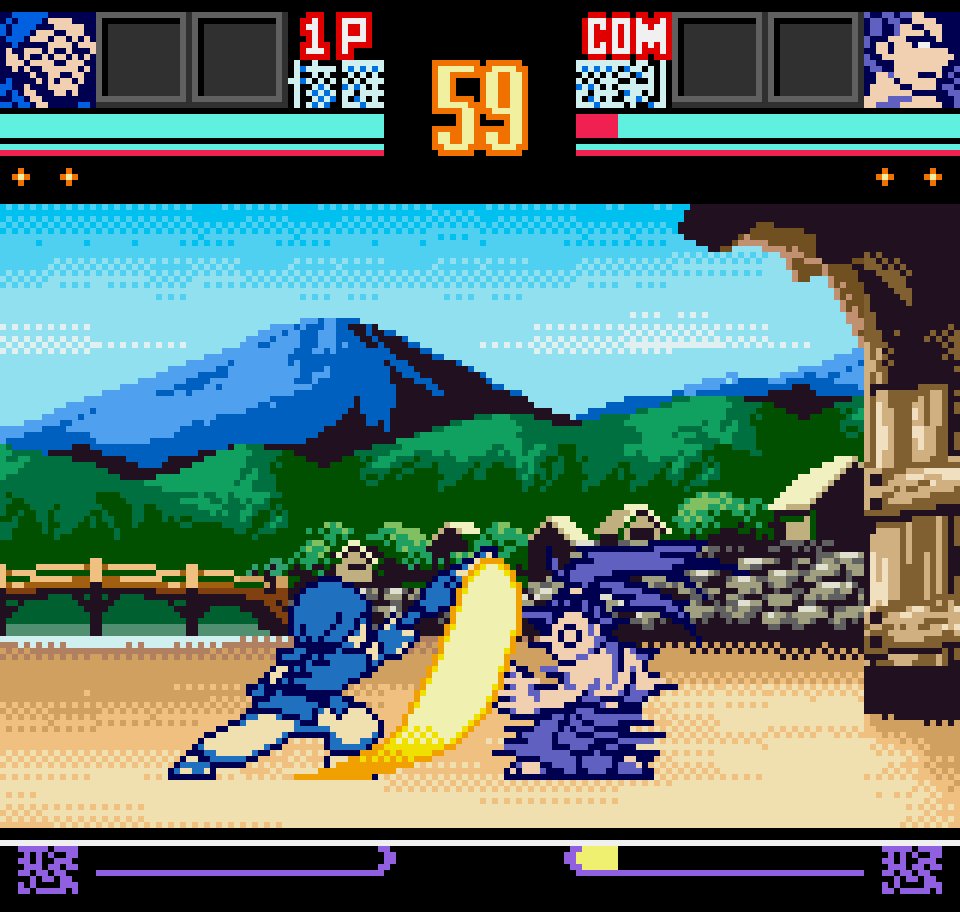
Weapons fighting lives or dies on spacing, and the pocket version understands this. Light and heavy strikes come from taps and holds of a single attack button, a second button handles kicks and utility, and the rage gauge builds toward the series’ signature explosive comebacks. Duels feel deliberate: the smaller movelists put the emphasis back on footsies, whiff punishment and nerve — exactly where Samurai Shodown belongs. Getting disarmed and scrambling for your blade while Genjuro advances is a handheld memory that sticks.
Modes go beyond the expected ladder. Alongside arcade and link-cable versus play, a Collection mode deals out character cards — earned through play and traded via link cable — that flesh out the roster’s art and lore. It is a modest system next to Card Fighters’ Clash, the stablemate built entirely around cards, but as a bonus pursuit inside a fighting game it was generous for 1999, and it gave solo players a reason to keep every character in rotation.
One clean strike can still end a round. The pocket version protects the series’ defining tension — patience over panic — better than anyone expected.
Cloth and steel
Presentation leans into the period setting: stages evoke Edo-period Japan with cherry blossom, torchlight and mountain backdrops rendered in the NGPC’s bold palette, and the soundtrack’s shamisen-flavoured chiptune keeps the mood. The super-deformed art remains the acquired taste of the whole pocket fighting line — these are chibi swordsmen, however sharp their blades — but the animation sells weight where it counts, in the slash effects and the hit-stop on a heavy connect.

As a launch title it also carried a burden: for many Western buyers this was the second game they owned after the pack-in choices, and its difficulty is honest about the series’ learning curve. Newcomers will lose rounds they feel they should have won while they learn that this is a game of single decisions. Persevere and it opens up. Its 2019 re-release as a Switch pre-order bonus and its place in the NGPC Selection compilations have rightly reintroduced it to the curious.

Cards on the table
The Collection mode deserves a second look, because it captures something about the NGPC ecosystem that is easy to miss. SNK’s pocket strategy was interlocking: the fighters fed the card game, the card game fed the fighters, and systems like Shodown’s collectible character cards — traded over the same link cable you dueled with — turned a single-player ladder into a social pursuit. In Japan especially, where the WonderSwan was proving how much players loved collecting systems, this was shrewd design. The cards also function as the game’s gallery and lore archive, fleshing out a roster drawn from the 64-bit games that many Western players had never had the chance to meet.
That cross-64 connection is the game’s other quiet distinction. Shiki, Asura and Gandara came from the Hyper Neo Geo 64 line — arcade hardware that barely existed in the West — so for most English-speaking players, this little cartridge was their only encounter with that whole chapter of the series until modern re-releases. A launch game that is also an archive: Samurai Shodown! 2 has worn both jobs gracefully for twenty-five years.
The game’s difficulty deserves honest framing for newcomers. Samurai Shodown has always been the SNK series that punishes flailing, and the pocket edition inherits the temperament: the CPU reads panic as an invitation, and the road to the final boss runs through duels you will lose by one strike, repeatedly, until the spacing lessons take. This is a feature. The first time you win a round with a single patient counter-slash, the whole design clicks into place — and that moment, on a handheld in 1999, had no equivalent anywhere else in portable gaming.
Longevity, too, is better than the mode list suggests. Sixteen fighters with distinct weapons and ranges, the card collection to complete, link duels to contest and a ladder that stays honest at the top: Shodown 2 is a game you master over months, not a weekend. In a launch line-up, it was the connoisseur’s cartridge — the one the fighting-game faithful chose while everyone else reached for the mascot games — and connoisseurs, twenty-five years later, still speak of it first.
One more practical pleasure: the game is a superb traveller. Duels are short, the ladder saves your dignity between sessions, and the rage of a lost round fades at exactly the speed of the next credit. Handheld design is full of games that demand your whole evening; Shodown 2 demands only your next decision — one strike, well chosen — and that discipline, fittingly, is the game’s whole philosophy in miniature.
It also remains the best argument that the super-deformed style was a feature, not a compromise: these little swordsmen emote. Haohmaru’s grin, Genjuro’s glare, Nakoruru’s serenity — faces you can read at 160 pixels, in a game about reading opponents. The style is the strategy. It always was.
The roster’s chemistry deserves its final word. Sixteen fighters is a number; what matters is that no two of them solve a duel the same way — Haohmaru’s honest power, Genjuro’s cruelty, Rimururu’s ice-borne mischief, Shiki’s speed, the puppet Kuroko’s strangeness. Learning the roster is learning sixteen arguments about how a sword fight should go, and the game grades every argument fairly. That depth, in a launch-window cartridge the size of a matchbox, is why the faithful kept it in the slot.
Honourable, patient and sharp: the pocket’s most philosophical fighter, and a launch title that has never stopped being a connoisseur’s recommendation.
Verdict
Samurai Shodown! 2 is the connoisseur’s pick of the NGPC fighting line: less immediate than Match of the Millennium, less populous than KOF R-2, but truer to a distinctive fighting philosophy than either. It proved at launch that SNK’s pocket was a serious fighting machine with range. Honour, at 160 pixels wide, fully intact.