
It is the most famous ambush in the history of the games industry, and it was self-inflicted. On 11 May 1995, at the first E3 in Los Angeles, Sega of America’s president Tom Kalinske stepped onto a stage and announced that the Sega Saturn — planned for a September launch on a date the company had been promoting as Saturnday — had already shipped. It was in stores. That day. A hundred and fifty dollars cheaper than expected headlines could not save what followed, because almost nothing else about the moment had been prepared: not the retailers who had not been told, not the developers still finishing launch games, not the magazines, not the customers. Sega had four months of surprise on Sony’s PlayStation and spent them apologising. Saturnday is the story of how the Saturn’s American life began — with a bang, a whimper, and a lesson the industry has never forgotten.
The logic, from inside Sega’s panic, was almost sound. Sony’s PlayStation was coming in September at a price nobody yet knew — at that same E3, Sony’s Steve Race would walk on stage, say two words, two hundred and ninety-nine dollars, and walk off, into legend. Sega’s Genesis empire was ageing, the 32X had confused the faithful, and Saturn’s Japanese launch the previous November had been a genuine success against the PlayStation’s debut there. Kalinske’s team feared being second into American homes with the more expensive machine — the Saturn’s US price was set at $399 — and reached for the one weapon surprise offered: be first, be now, be the console you could buy while the rival was still a promise. The plan required secrecy so total that it became the failure’s engine. Only four retail chains were stocked for the surprise launch. Others — most notoriously KB Toys — learned about it from the press, and some never forgave the insult, dropping Sega’s support in ways that cost shelf space for years.

The launch that arrived before its games
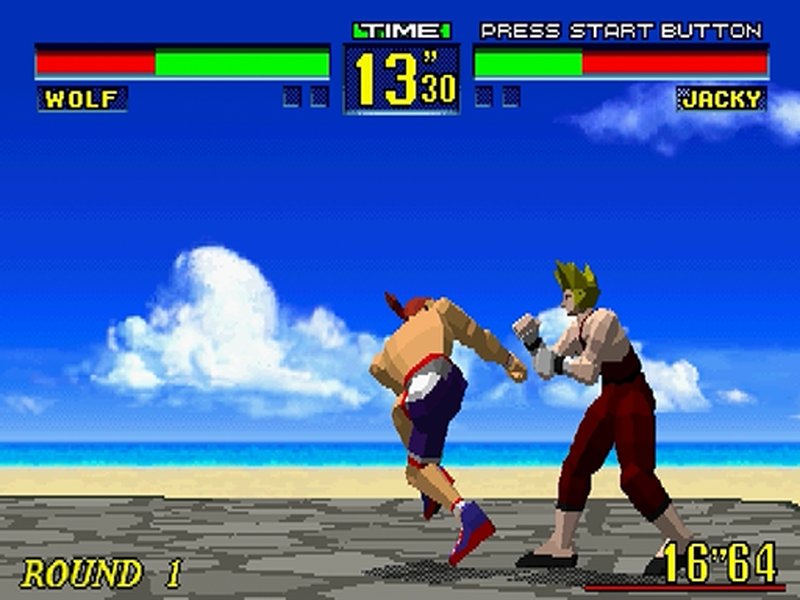
A console launch is a promise kept in software, and Saturnday’s shelf was thin: Virtua Fighter, Daytona USA, Panzer Dragoon, and a handful more, several of them conversions finished in a visible hurry. The games themselves were better than the launch’s reputation — Panzer Dragoon was a jewel, and Virtua Fighter, for all its roughness next to its sequel, was a phenomenon arriving from Japanese arcades. But Daytona USA’s home conversion wore its deadline on its frame rate and draw distance, the pack-in strategy confused, and the months that followed — the long summer until the PlayStation’s September — brought a trickle of releases rather than a drumbeat, because the development schedules of every major publisher had been built around September. Third parties who had been ambushed alongside the retailers did quiet arithmetic about Sega’s reliability as a partner. The surprise had spent the industry’s trust to buy a head start it could not stock.
Then September arrived, and the comparison Sega had tried to pre-empt happened anyway, on the worst possible terms. The PlayStation launched at $299 — a hundred dollars less — with a deep bench of launch titles, a marketing campaign aimed like a weapon at exactly the young-adult audience Sega had pioneered, and retailers who felt courted rather than ambushed. The Saturn’s early adopters, the most loyal customers Sega had, watched the machine they had bought at $399 in May get its price cut within the year, and drew their own conclusions. None of this was the Saturn hardware’s fault. The console’s American identity — difficult, expensive, mismanaged — was set in those four months, and no subsequent excellence, and the Saturn had plenty, ever fully reset it. In Japan, where the launch had been orderly and the machine was marketed to its strengths, the Saturn outsold its predecessor’s pace and hosted a golden library. The American Saturn lived in Saturnday’s shadow.
Sega surprised everyone — the shops, the developers, the magazines, the customers. The only people not surprised were Sony, who simply waited for September and collected the industry Sega had startled into their arms.
What Saturnday teaches
The industry studied the failure like a crash site, and its lessons are now load-bearing rules of every console launch since. Retailers are partners, not props: shelf space is allocated by relationships, and a launch that humiliates your channels will be repaid in kind. Developers are partners too: a launch date is a promise made to hundreds of teams’ schedules, and moving it in secret breaks all of them at once. Surprise is not a strategy when the product needs an ecosystem standing ready — games, stock, advertising, accessories — because an ecosystem cannot be surprised into existence. And the early adopter is sacred: the customer who buys in May at full price is your evangelist, and a launch that makes evangelists feel like marks spends the one currency a new console cannot mint twice. Every subsequent surprise launch in the industry — and there have been successful ones — has been run the way Saturnday was not: secretly prepared, fully stocked, with partners briefed under embargo rather than ambushed on stage.
There is a coda the Saturn faithful are entitled to. The machine that stumbled out of the gate in May 1995 went on to host one of the great libraries: the AM2 conversions, the Panzer games, Treasure’s twin masterpieces, the RAM-cart fighters, the import scene that made American Saturn ownership an education in Japanese game design. Kalinske himself, who had built Sega of America’s Genesis miracle, left in 1996; the Saturn’s American story never recovered its launch, but the console outlived its obituaries in the collections of the players who know it best. Saturnday sank the American Saturn, as our title says — but it could not sink the Saturn itself. The games saw to that. They are why, thirty years on, the ambush is a feature like this one, and the console it ambushed is a library people still build, one import and one RAM cart at a time.

The summer of the trickle
The months between May and September 1995 deserve a closer look, because they are where the ambush’s cost compounded. A healthy console launch is a metronome — a notable release every few weeks, advertising in rhythm, the sense of a platform being fed. The Saturn’s first American summer was the opposite: long silences between releases, launch-window games slipping into autumn, and a press corps with nothing to write about except the launch itself and the PlayStation’s approach. Sega filled the gap with price moves and bundles that read as improvisation because they were. Meanwhile the Saturn’s genuine early strengths — its arcade conversions, its 2D power, the Japanese software pipeline that would define its cult — had no time to become the story before the PlayStation’s launch redefined the comparison entirely. By the time Virtua Fighter 2 and Sega Rally arrived that Christmas and showed what the machine could do, the narrative had set like concrete: Saturn the expensive stumble, PlayStation the future. First impressions in consumer electronics are not everything, but Saturnday arranged for the Saturn’s first impression to be its worst one, at maximum volume, in front of everyone. The recovery that followed — and the library is the recovery — happened in the shadow of a single morning in May.
The date that became a warning
Saturnday survives as the industry’s favourite cautionary tale because it is perfectly shaped: a single decision, made by smart people for defensible reasons, whose every consequence was the opposite of its intent. Sega wanted a head start and got a stumble; wanted to pre-empt Sony’s price and ended up defined by it; wanted the headlines and got thirty years of them, of the wrong kind. The Saturn deserved a better first day in America. It got, instead, the most instructive one any console has ever had — and a generation of launch planners, at every company since, who check their retailer lists twice because of what happened on 11 May 1995.