
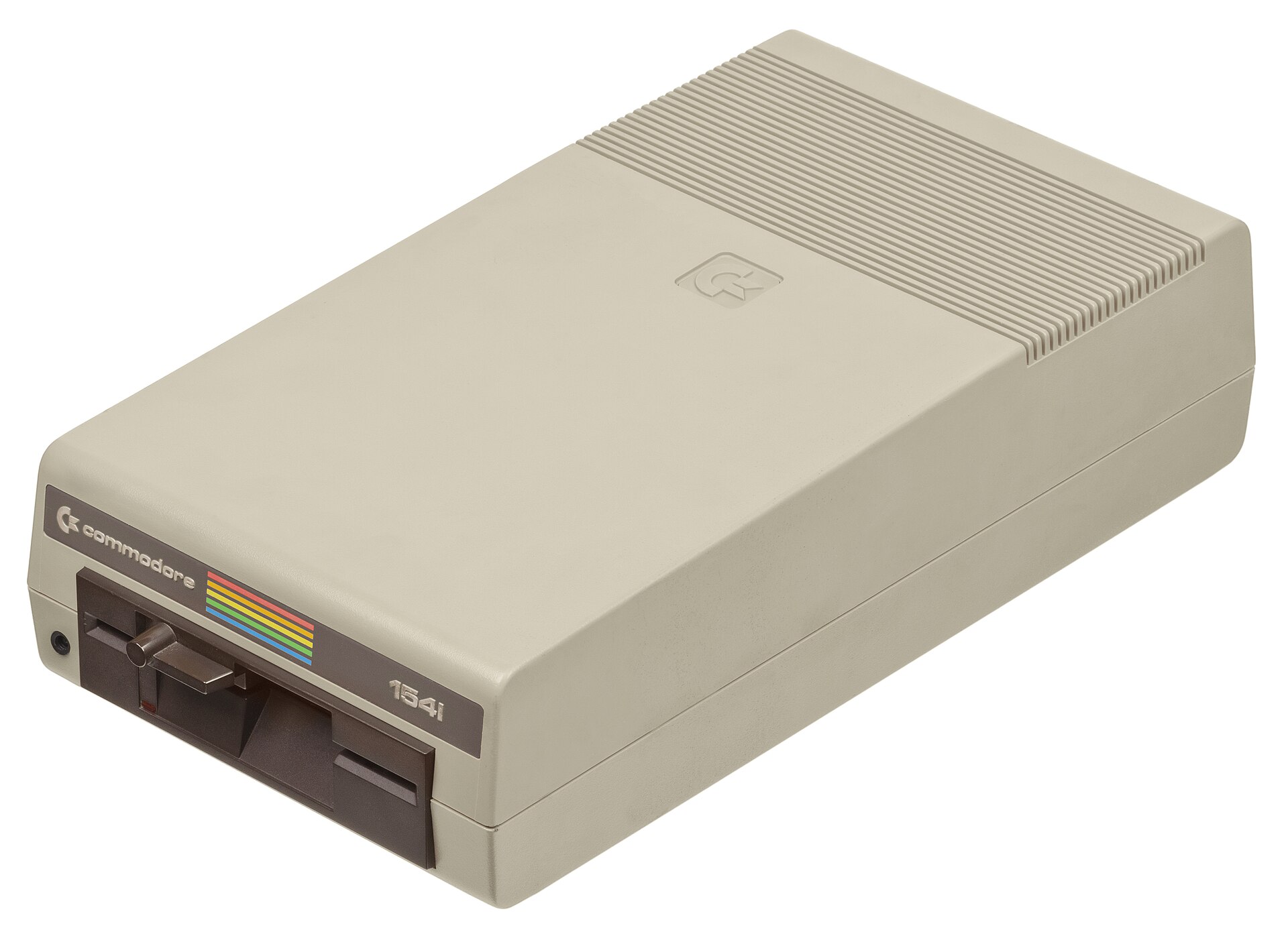
Every Commodore 64 owner eventually learns the secret: the 1541 disk drive is not really a peripheral. It is a second computer. Inside that beige box sits a 6502 processor running at 1 MHz — the same clock speed as the C64 itself — with its own RAM, its own 16K of DOS ROM and a pair of 6522 interface chips, all chattering away over the serial IEC bus. Games did not just read data from the 1541; they uploaded entire programs into it — fast loaders, copy protection schemes, music-playing loader routines — and expected the drive to run them, cycle for cycle, in perfect time with the machine it served. That is why so many cheap SD card readers for the C64 only half work. And it is why, in early 2015, Polish designer Krzysztof Świtajski — Kisiel of the ICON demo group, working under the Projekt64 banner — announced a small black board with an immodest name: the UK1541, short for Ultimate Killer.
The arrangement was born of an accident. The 1541’s serial bus was meant to be quick, but a hardware bug in the C64’s shift register forced Commodore to slow the whole interface to a crawl, and the drive’s own DOS was in no hurry either: loading a typical game from a stock 1541 could take minutes. The industry’s answer, from the earliest Epyx Fast Load cartridges to the demo scene’s hand-tuned IRQ loaders, was to exploit the computer inside the drive — replace its transfer routines with faster ones, uploaded on the fly. By the late eighties the 1541 was less a storage device than a co-processor that happened to spin disks, its 170-kilobyte floppies guarded by protection schemes that read deliberately corrupted tracks and expected exact mechanical behaviour. Any modern replacement that could not honour all of that was, to a large slice of the C64 library, not a replacement at all.
The SD2IEC problem
To see what the UK1541 was rebelling against, consider the device it was designed to outclass. The SD2IEC, the C64’s most popular budget storage gadget, is a protocol translator: it listens for standard Commodore DOS commands on the serial bus and answers them from files on an SD card. For a single-file game or a cracked release, that is plenty. But the moment software tries to talk to the drive as a computer — uploading a custom fast loader into drive RAM, timing the bus to the cycle, checking a deliberately malformed sector — the SD2IEC has nothing to say, because there is no drive in there. Multi-disk games stumble, protected originals refuse to boot, and the great C64 demos, with their streaming IRQ loaders feeding music and graphics off the disk in real time, simply fall apart. Owners learned to keep a real, rattling 1541 beside the SD reader for exactly the software they cared about most.
The established escape route was FPGA hardware — Gideon Zweijtzer’s superb 1541 Ultimate cartridge, or the Turbo Chameleon 64 — which recreated the drive in programmable logic and charged accordingly. The UK1541’s provocation was to do the same job in software, on a microcontroller that costs a few dollars: an NXP LPC1114, an ARM Cortex-M0 running at 48 MHz, executing a cycle-exact emulation of the 1541 — its 6502 core complete with the illegal opcodes real drive code sometimes uses, its VIA chips’ ports and timers, its full memory map — in real time, while a second helper chip runs the user interface. No FPGA. Just a tiny CPU, running very precisely, very fast.
A drive with a remote control
The board itself is a hobbyist jewel: 88 by 70 millimetres of black PCB that hangs off the back of the computer, drawing power from the user port and talking over the IEC bus through a mini-jack lead — leaving the cartridge slot free, which cartridge-based rivals cannot claim. On top sits a 2.2-inch colour TFT screen, 320 by 240, and here the UK1541 becomes gloriously eccentric: you navigate its four-window interface — file list on the left, the mounted D64’s directory on the right, status and current track along the bottom — using either a joystick plugged into its DB9 port or, wonderfully, an infrared remote control, included in the concept if not always in the box. Four LEDs report drive, motor, debug and system status; two buttons reset the interface or the emulated drive; the device number flips between 8 and 9 at a press.
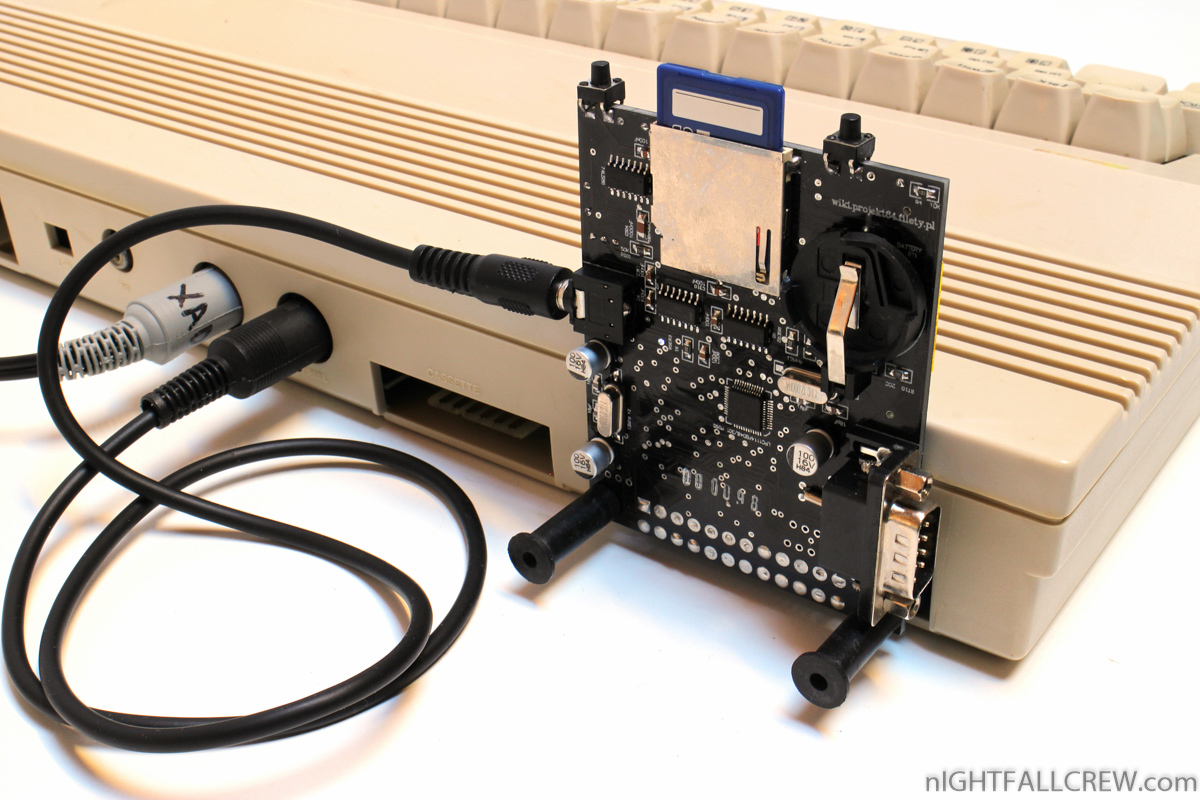
Underneath the theatre is serious capability. The UK1541 mounts D64 images of 35 or 40 tracks and both reads and writes them, so saving to a disk image works exactly as it should; SD cards from 1 to 8 GB formatted FAT32 hold a lifetime of software; firmware updates arrive on the card itself. Because it emulates the machine rather than the protocol, the software that broke lesser devices — protected games, track-loading demos, the Booze Design back catalogue that AmiBay’s drive hunters name-check — simply runs, and scene users who tested it against the FPGA establishment reported demo timings holding up where even pricier hardware occasionally wavered. It also speaks to the whole family: C64, C128, VIC-20 and the 264 series, with the Plus/4 needing only a user-port extender.
In daily use the remote control turns out to be more than a gag. Multi-disk adventures and demo megaprods ask for side two at the worst possible moment, and with the UK1541 the swap is a button press from the sofa: unmount, scroll, mount, and the emulated drive never misses a beat, its motor LED blinking in faithful imitation of the real mechanism. The screen’s track counter ticking upward as a loader does its work is a small pleasure of its own — telemetry from a machine that, strictly speaking, does not exist. Owners came to treat the board the way hi-fi owners treat a good turntable cartridge: a specialist instrument, bought deliberately, for the records that matter most.
Small batches, sharp edges, real legacy
Honesty requires the footnotes. The UK1541 was a small-batch, built-to-order device, sold in limited runs through Projekt64’s pages, and it shows the charming roughness of one man’s project: documentation beyond the project wiki is essentially non-existent, the LCD’s file-selector font is famously tiny, early firmware carried quirks including a crash if you actually inserted the CR2032 battery the board provides a holder for, and write support began life labelled beta. Nobody sane would call it the polished option. The 1541 Ultimate remained the more complete cartridge, with its Ethernet, its menus on the TV screen, its endless extras.
But polish was never the UK1541’s argument. Its argument — made in its very name — was that true, cycle-exact 1541 emulation did not require a big FPGA or a big price, just one scene programmer who understood the drive deeply enough to recreate it on a 48 MHz microcontroller and the stubbornness to finish the job. In the years since, that argument has become the C64 scene’s common sense: the drive is a computer, so emulate the computer. The UK1541’s place in storage history is secure — the little board with the television remote that treated the humble disk drive with the respect its hidden processor always deserved, and let a generation of C64s retire their clattering 1541s without giving up a single demo.