
Open a 32X — the black mushroom that plugged into a million Genesis cartridge slots in November 1994 — and the first thing to understand is that you are not looking at an upgrade chip. You are looking at a computer. Inside the shell sit two Hitachi SH-2 processors running at 23MHz, a pair of custom Sega video chips, its own RAM, its own framebuffer, and a sound chip for good measure: a complete games console that happens to borrow its host for controllers, some sound, storage and a power supply. The 32X was not the Genesis made stronger. It was a second machine wearing the Genesis as a backpack, and every triumph and failure of its short life follows from that design.
Twin SH-2s: the Saturn’s heart, early
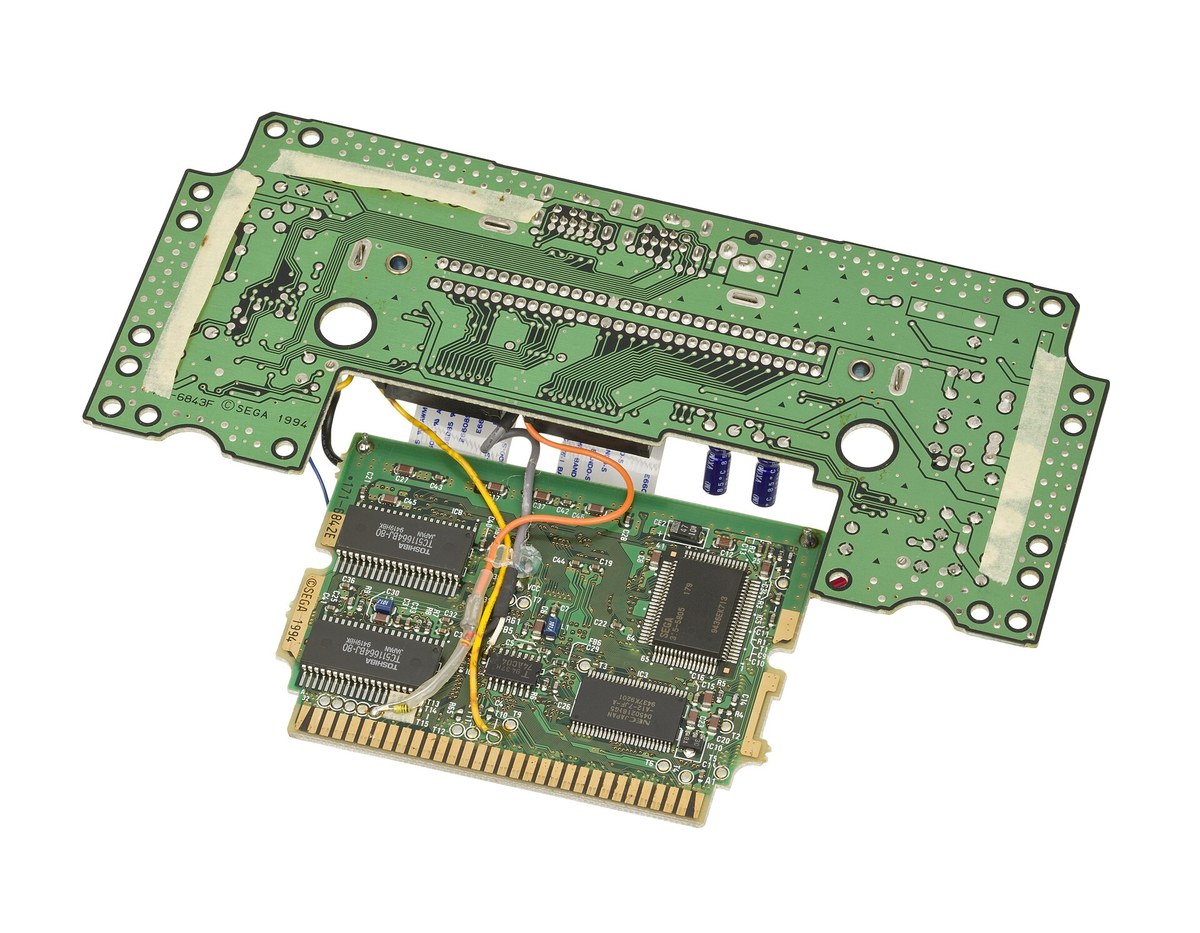
The SH-2 choice is the architecture’s famous irony: the same processor family — in the same twin configuration — powers the Sega Saturn. Hitachi’s RISC chip was cheap, fast and good at the geometry maths 3D games devour, and Sega’s engineers (the design came substantially from Sega of America’s skunkworks, championed as project ‘Mars’) specified two of them working in a master-slave arrangement, dividing rendering and game logic between them. At 23MHz each, with a quarter-megabyte of main RAM apiece in effect shared between them, plus dedicated video RAM, the pair could push flat-shaded polygons at rates the Genesis’s 7.6MHz 68000 could not dream of — the Virtua Racing Deluxe and Metal Head results elsewhere in this library are their work. The catch was the same one Saturn developers would curse: two CPUs are harder to feed than one, and 32X tools and documentation were rushed out in months, not years.
The video design is the mushroom’s cleverest and most fragile idea. The Genesis continues to draw its own layers — backgrounds, sprites, whatever the cartridge asks — while the 32X draws its graphics into its own framebuffer; the add-on’s video encoder then composites the two, passing the Genesis picture through itself and overlaying its own image where the Genesis displays a designated transparent colour. This is why 32X video cables route the Genesis’s output through the mushroom, why the little metal clips shipped for cartridge-slot stability mattered, and why a dirty connection gives you games with their 32X layer missing — Genesis backgrounds playing under absent polygons, the console equivalent of a magic trick explained. When it works, the layering is seamless and genuinely greater than either machine alone: Genesis parallax behind 32X polygons, 32,768 colours on screen against the stock machine’s 64.
The 32X was not the Genesis made stronger. It was a second machine wearing the Genesis as a backpack.

Sound, storage and the bottlenecks
Audio tells the same split story. The Genesis’s Yamaha FM and PSG chips keep working — most 32X soundtracks are recognisably Mega Drive music — while the 32X adds a PWM sample channel pair that games used for drums, voices and effects of a clarity the base machine could not serve. Tempo and Metal Head’s talking heads are the PWM channels earning their silicon. Storage was the architecture’s hard ceiling: cartridges, mostly 16 to 32 megabits. In an era tipping toward CD-ROM, the mushroom’s games had to fit in the same few megabytes as a Genesis title — one reason its polygon games are lean and its ambitions texture-light, and why the 32X CD experiment tried to marry the mushroom to the Sega CD’s storage.
So why did it fail, if the silicon was this capable? The hardware itself answers in two parts. First, the bottlenecks were real: the cartridge-slot bus, the composite-through video path, the small RAM — every cross-boundary conversation between the two machines cost time, and developers had months to learn tricks the Saturn’s teams would need years to master. Second, and more fatally, the architecture had no future tense: Sega’s own Saturn, using the same chips at higher clocks with CD storage, was months away, and every developer doing the maths chose the Saturn. The 32X’s hardware was a bridge design — competent, even elegant — built across a river its own company was already spanning elsewhere.
The mushroom today

Open one now — carefully, the shells have aged — and the board remains a small marvel: two CPUs, the video pair, the pass-through encoder, all of it in a case the size of a sandwich. The architecture’s modern reputation has quietly risen with its games: emulator authors and homebrew developers who finally learned the twin-SH-2 dance (the Doom Resurrection project is the famous proof) have shown the headroom the 1994 schedule never let anyone reach. The 32X was not underpowered. It was under-timed — the most Sega sentence in hardware history, cast in black plastic.
Time has sorted the 32X library into the famous, the infamous and the forgotten, and the 32X hardware rewards being met on its own terms rather than through any of those reputations. Played today — on a serviced stack, through a clean video path, with the six-button pad the era intended — it is a reminder that the mushroom’s forty games were never its problem. The problem was the calendar they were born into, and calendars cannot be replayed. Games can.
There is also the matter of what the 32X hardware says about its machine. The 32X was sold as a bridge to the 32-bit future and remembered as a dead end, but its best cartridges argue a subtler case: that for eighteen months it was simply a good games platform with a small, strange, high-quality library, judged at the speed of a market panic rather than at the pace games deserve. Revisiting it now, without the panic, is the closest thing the platform will ever get to a fair trial — and on the evidence of this cartridge, the defence rests well.
For collectors, the 32X hardware sits in the honest middle of the 32X market: neither the loose-change common nor the four-figure grail, but a cartridge that rewards the hunt and justifies its shelf space every time the stack is powered up. In a library this small, every game is a significant fraction of the whole. This one earns its fraction.
What lingers after the credits is how completely the 32X hardware belongs to its moment — and how well that moment has kept. The early polygon years are often treated as an embarrassing adolescence for the medium, all jagged edges and experimentation. The best 32X games suggest otherwise: the experiments were the point, the edges were the aesthetic, and a generation of designers was learning 3D in public, at full speed, on hardware like this. the 32X hardware is one of their better lessons.
Time has sorted the 32X library into the famous, the infamous and the forgotten, and the 32X hardware rewards being met on its own terms rather than through any of those reputations. Played today — on a serviced stack, through a clean video path, with the six-button pad the era intended — it is a reminder that the mushroom’s forty games were never its problem. The problem was the calendar they were born into, and calendars cannot be replayed. Games can.
There is also the matter of what the 32X hardware says about its machine. The 32X was sold as a bridge to the 32-bit future and remembered as a dead end, but its best cartridges argue a subtler case: that for eighteen months it was simply a good games platform with a small, strange, high-quality library, judged at the speed of a market panic rather than at the pace games deserve. Revisiting it now, without the panic, is the closest thing the platform will ever get to a fair trial — and on the evidence of this cartridge, the defence rests well.
For collectors, the 32X hardware sits in the honest middle of the 32X market: neither the loose-change common nor the four-figure grail, but a cartridge that rewards the hunt and justifies its shelf space every time the stack is powered up. In a library this small, every game is a significant fraction of the whole. This one earns its fraction.