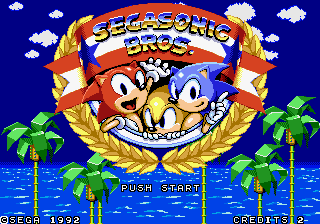
In February 2016, a Japanese arcade board collector who posts as ShouTime revealed something the Sonic the Hedgehog history books had no page for: a complete, working arcade game called SegaSonic Bros., built in 1992, designed by the man behind Bubble Bobble, and quietly buried by Sega after it flopped in location tests. It was not a prototype in the usual sense — not a half-finished demo or a magazine rumour, but a finished game that had been played by the public, judged, and erased. For twenty-four years it survived as one board in one collection, while the cartridges and circuit boards of its era slowly decayed around it. Its reappearance is one of the great game-preservation stories of the last decade, and it begins with Sega trying to turn a hedgehog into an arcade empire.
A Sonic Game Nobody Knew About
Sonic the Hedgehog had conquered the home market in 1991, and Sega commissioned a run of arcade projects to cash in. Among them was a falling-block puzzle game — a sensible genre for the designer Sega had secured. Fukio Mitsuji, who signed his work MTJ, was Taito royalty: the designer of Bubble Bobble and Rainbow Islands, of Halley’s Comet, Syvalion and Volfied, a man whose games hid entire secret languages of symbols and bonuses. By the early Nineties he was freelancing, and SegaSonic Bros., running on the Genesis-derived System C2 board, was his shot at giving Sonic a puzzle game. Kenjoh would later note that it stood to be one of the last games to carry Mitsuji’s design credit under his own name. Nobody outside the test locations saw it.
How It Played
The strangest thing about SegaSonic Bros. is that almost everything known about its rules, for two decades, came from one man’s memory. Kohji Kenjoh — the designer behind Custom Robo — had played the game at its location test, and in December 2013 he wrote up his recollections on Sega’s own it-tells social site, in an instalment of his “A is for Arcade” column. His account describes blocks of four Sonics, curled into their spin attack and coloured red, blue and yellow, dropping in a two-by-two square that the player could rotate as it fell. The trick was enclosure. If Sonics of one colour completely surrounded Sonics of another colour — boxed in on every side, with the floor and the walls of the well allowed to count as part of the ring — the trapped Sonics vanished. A single drop could complete two enclosures at once, and the game’s own tutorial screen, once the board surfaced, confirmed the memory: surround with one colour, erase, and mind all three edges at once.
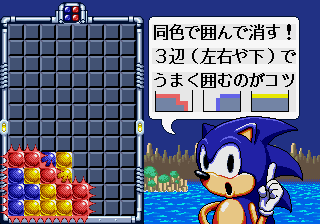
Kenjoh was honest about what that design demanded. One careless placement could wreck an enclosure you had spent a dozen blocks building, recovery was agonising, and because the pieces arrived four Sonics at a time, the board filled with the wrong colours at terrifying speed. Your eyes had to track the inside and outside of every half-built boundary simultaneously. It was, he concluded, a difficult and slightly infuriating game — Mitsuji’s trademark method of seizing one catchy idea and forcing it to work, problems and all, applied to a well of coloured hedgehogs.
It helps to understand what an oddity Bros. was within Sonic’s arcade family. Sega’s other Sonic coin-ops of the period were mostly novelties wearing the mascot: a popcorn vending machine that played a minigame while it cooked, a ride-on patrol car for small children, a shooting gallery called Cosmo Fighter. The one conventional game, 1993’s SegaSonic the Hedgehog, was a trackball platformer famous mostly for introducing Mighty and Ray. Bros. was something else entirely — a full, serious design by one of the medium’s most decorated puzzle minds, built at the height of his freelance powers a year after his Game Gear gem Popils. That it, of all of them, was the one to vanish is the kind of joke arcade history specialises in.
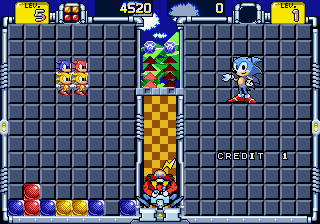
There was also a competitive dimension the EGM whisper had been pointing at: two wells side by side, two players racing to bury each other’s boards — the surviving game offers head-to-head play in which your clears become your opponent’s problem. It is the mode that makes the design’s cruelty legible as sport rather than flaw. Against another human, the demand that you track every enclosure inside and outside the lines at once becomes a duel of attention, and the four-Sonic blocks become ammunition. Even the game’s harshest modern critics tend to soften in versus play; what failed as a solo coin-op experience in 1992 might have thrived as a competitive one, had the test locations given Sega a reason to find out.
Failed the Test
Arcades of the era lived and died by the location test: a near-finished game placed in a real arcade, its earnings and player reactions measured against the machines around it. SegaSonic Bros. went out on test in late 1992 and performed poorly, and Sega made the coldest decision in the industry — a finished game, cancelled outright, never manufactured. It was not even the only Sonic arcade project to meet that fate; Sega staff would later acknowledge developing two Sonic arcade games that were never released because, in the company’s own retrospective phrasing, they lacked the specialness Sonic demanded. The one surviving whisper in the Western press was an Electronic Gaming Monthly snippet promising an arcade game that invited multiple players to take the role of differently coloured Sonics. Then silence, for more than twenty years.
The Paper Trail
The rediscovery happened in layers. Kenjoh’s 2013 memoir was layer one — proof the game existed at all. In mid-2014 he asked Sega producer Yosuke Okunari about it publicly, and Okunari answered with a photograph of the game running: Sega itself still had it, or knew where it lived. Layer three was ShouTime, a collector with a track record of sharing rather than hoarding — he had helped dump the bizarre SegaSonic Popcorn Shop vending-machine game in October 2015 — who announced in February 2016 that an actual SegaSonic Bros. board had surfaced and been secured. Photographs followed, then showings, and the preservation machinery that the Sonic community does better than almost any other fandom swung into motion.
The Music That Escaped
Strangest of all, pieces of the buried game had been hiding in plain hearing for years. Sega recycled its music: the main theme was rearranged for the Sega CD edition of Teddy Boy Blues, and one of the gameplay tunes was lifted wholesale to become the special stage music in Sonic the Hedgehog 3 — the Blue Sphere stages that millions of players know by heart. The game was cancelled, its board forgotten, and its soundtrack went on to soundtrack one of the best-selling Sonic games ever made. Preservation rarely produces a detail that neat.
Playable at Last
The board, meanwhile, was being shown in public and documented in the way that turns a rumour into a record — photographed, exhibited and studied, while the emulation community waited for the dump that would make it safe forever. That wait matters more than it sounds. Arcade boards of the early Nineties are dying on schedule: batteries leak, custom chips fail, and EPROMs slowly forget. A game that exists as one board exists on borrowed time, and SegaSonic Bros. spent twenty-four years among the most borrowed of all — unknown even to the archivists who would have saved it first.
In December 2018 the ROM image leaked, playable through a modified build of MAME, and the world finally got to judge the location test for itself. The verdict, from Hardcore Gaming 101 among others, was that you could see why Sega walked away: the rules are complicated, the difficulty is needlessly punishing, and the visuals have a jumbled, bargain feel beside Mitsuji’s Taito work. The polished descendant of the encirclement idea turned out to be Taito’s own Cleopatra Fortune from 1996, which tidied the same concept into something a first-time player could grasp in one credit. None of that dims the find. Fukio Mitsuji died in December 2008, at forty-eight, never knowing his buried game would resurface; Kenjoh closed his memoir wondering if anyone would ever play it again. Somebody did — everybody can. A finished game by a master designer spent twenty-four years as a rumour because one test audience shrugged, and it survives today only because a collector chose to share it. That is the whole argument for game preservation in a single story: boards rot, companies forget, and the difference between lost and found is usually one person who refuses to keep a discovery to themselves.
Keep reading: First, an Announcement of an Announcement: The Day Sonic Adventure Took the Stage · the Arcade system archive