At a glance: Shanghai · Atari Lynx · Atari Corp, 1990 · Puzzle · Score: 7.5/10
Shanghai is the game that taught the West what to do with a mahjong set and nobody to play against. Brodie Lockard’s solitaire — match a free pair of tiles, remove them, repeat until the stack of 144 tiles is gone or you are — was a sensation on the Amiga and Macintosh when Activision published it in 1986, and it has been ported to practically everything with a screen since. The Lynx version, published by Atari in 1990, is one of the quiet triumphs of the system’s early library: a contemplative game on a machine sold for arcade noise, executed with a care that makes it still, three decades later, a completely respectable way to spend a train journey.
The slowest game on the Lynx
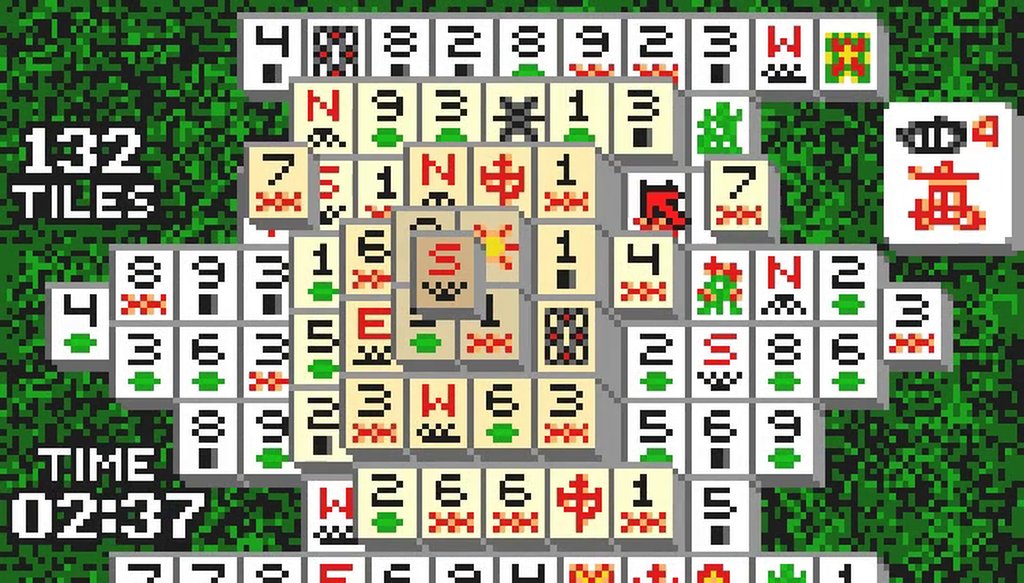
The rules fit in a breath. Tiles are stacked in a layout — the classic “dragon” formation — several layers deep. A tile is playable only if nothing sits on top of it and it can slide out to the left or right. Match two identical free tiles (with the seasons and flowers matching any of their own family) and both leave the board. Win by leaving nothing. The depth is in the stack: every pair you remove changes what is free, every choice between two identical pairs is a fork in the game, and the famous trap — three of a kind free, one buried — punishes greed beautifully. Shanghai is a game about consequences disguised as a game about relaxation.

On paper the Lynx should be the wrong machine for this. The screen is small, the tiles are detailed, and mahjong faces — bamboos, characters, dots, winds, dragons — need to be legible at a glance. The port solves it with clean, high-contrast tile art and a cursor system that makes selection feel deliberate rather than fiddly: you always know which tile you are touching, the game always tells you what it is, and helpful options — take back a move, peek at a buried tile’s identity, ask for a hint of an available match — are a button away for players who want the meditation without the punishment. Purists can ignore every crutch; learners can lean on all of them. That flexibility is the port’s real design achievement.
Every games library needs one title that lowers the heart rate. On the Lynx, a machine that otherwise specialised in raising it, Shanghai is that title — and it earns the role honestly.
Reading the stack: the game’s hidden curriculum
Play Shanghai seriously for a week and it teaches you a discipline most puzzle games never touch: reading in three dimensions. The stack is a building, and the skill is seeing its load-bearing tiles — the pairs whose removal collapses a whole wing of the structure into play, versus the tempting matches on the roof that free nothing but themselves. Veterans play the edges, hoard the flower and season matches for emergencies, and treat the fourth copy of any tile as a loaded question: three visible copies mean the game is daring you to spend two of them wrongly. None of this is in the manual. All of it is in the tiles, waiting. For a solitaire, Shanghai has a remarkable amount to say.
The Lynx version serves that curriculum well because it never rushes you. There is no timer unless you invite one, no lives, no fail state except the board’s slow refusal — a full stack with no legal moves, delivered without drama. In an era when handheld games were learning to shout, a cartridge content to sit quietly and think was its own kind of confidence, and it is why Shanghai cartridges so often show the heaviest wear on a collector’s shelf. This one got played at kitchen tables, not just in the backs of cars.
The tile art deserves a paragraph
Credit, too, to whoever drew the tiles. Mahjong faces live or die on instant recognition — a 3 of bamboos confused with a 5 is a design failure — and the Lynx set is a small masterclass: strong outlines, restrained colour, suits distinguished by shape before hue so the game survives the screen’s modest contrast. The dragons and winds have genuine character. It is the kind of invisible craft you only notice when a lesser port gets it wrong, and several computer versions of the period did. This one didn’t.
Modes, manners and small mercies
The cartridge offers more structure than the premise suggests. Beyond the standard game there are variations in how deals are generated, a tournament flavour for players who want the same deal raced against the clock or against a previous best, and the all-important shuffle-and-restart mercies for a board that has beaten you. Deals are guaranteed solvable in the classic Shanghai manner — the game builds the stack backwards from a solution, so a loss is always your own archaeology rather than the dealer’s cruelty. That guarantee matters more than any feature list: it turns frustration into information, and information into one more game.
Where it creaks
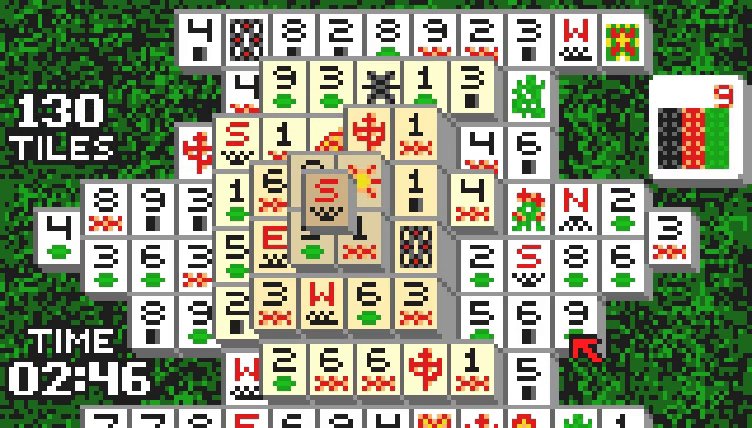
The Lynx screen does impose a tax. In the full-stack view the smallest tiles demand good light and decent eyes — this is a game that benefits enormously from a modern screen mod or an emulator’s larger canvas, and on an original 1990 panel in poor light it can feel like reading a newspaper through a letterbox. The soundtrack is minimal to the point of near-silence, which suits the mood but exposes the odd sound effect as lonely. And solitaire is solitaire: if the core loop doesn’t meditate you, no presentation will. Shanghai knows exactly what it is and offers no apology, which is a virtue and a limit in the same breath.
A word about the library it anchors
It is worth stepping back. The Lynx’s puzzle bench — Chip’s Challenge, Klax, Blockout, Shanghai, later Crystal Mines II and Ishido — is the deepest of any handheld of its generation, and Shanghai is its elder statesman: the game your non-gaming parent would steal the machine for, the cartridge that lived in the console between arcade sessions. Libraries are remembered for their flagships, but they are loved for their furniture. This is very good furniture.
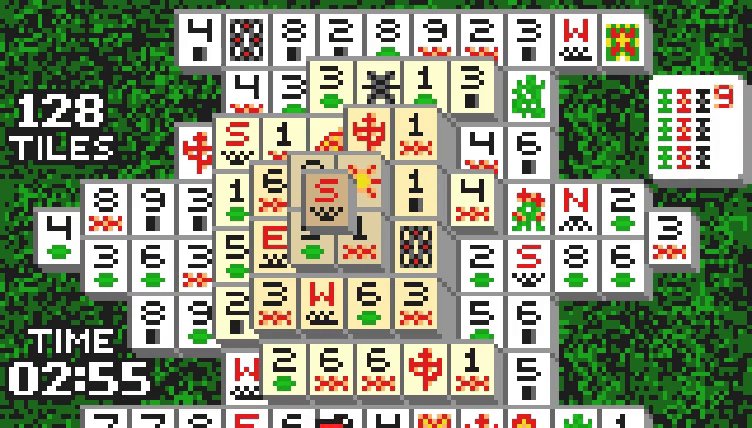
A word, finally, on who this cartridge is for in 2026. It is for the player whose Lynx lives on the bedside table rather than in the display case; for anyone who has discovered that the most replayable retro games are often the ones with no ending to reach. Shanghai will not raise your pulse. It will lower it, deliberately, expertly, one pair at a time — and some nights that is the most valuable thing a game can do.
Battery life, for once, is on the player’s side too: a thinking game makes a merciful change from the Lynx’s arcade thirst, and a single set of AAs carries a great many quiet evenings of tiles.
Verdict
A faithful, thoughtfully-assisted port of the defining mahjong solitaire, on the one 1989 handheld whose colour screen did the tiles justice. 7.5/10 — not the Lynx’s most exciting cartridge, and possibly its most durable.