
At a glance: Rampart · Atari Lynx · Tengen, 1991 · Strategy action · Score: 8.5/10
Rampart is three games welded into one clockwork loop, and the weld has never broken. Atari Games’ 1990 arcade original asked you to build a castle wall out of Tetris-shaped pieces against a timer, place cannons inside the walls you managed to close, blast an approaching fleet into driftwood, then rebuild the smoking ruins before the next wave — and do all of it faster than the sea, the fire and your own bad geometry could undo you. It was one of the most original arcade designs of its decade. Tengen’s 1991 Lynx port is the version nobody talks about, which is a shame, because it may be the best Rampart you can hold in one hand.
Build, aim, repair, repeat
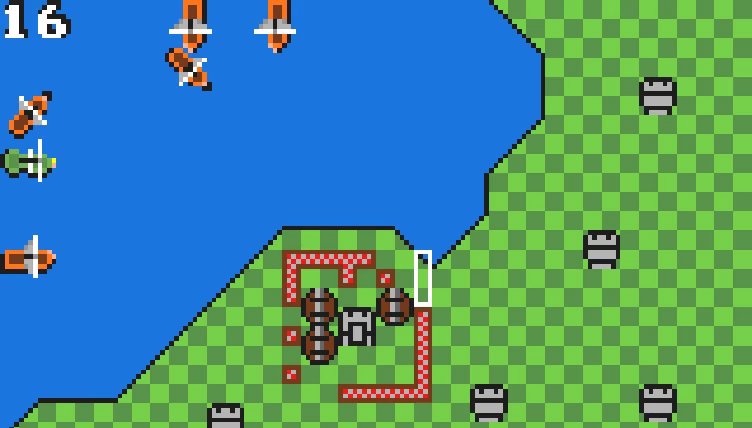
The loop’s genius is that each phase feeds the next. The building phase hands you random wall pieces — straights, corners, L-shapes, the cruel little nubbins — and a few seconds to enclose territory. Only fully enclosed ground counts, and only enclosed ground earns cannons, so every wall is an economic decision. Then the battle: your cannons, aimed with a cursor, duel single- and double-masted ships that shoot back with real malice, setting fires that spread through your castle and kill your guns. Then the repair phase, where the loop shows its teeth — you rebuild with the same random pieces, around craters and burning squares, and if you cannot close a wall around at least one castle, your game ends not with a lost battle but with a failed construction project. Strategy games have been built on less.

The Lynx handles the translation with intelligence. The arcade used a trackball; the port maps building and aiming to the joypad with a cursor speed that respects the timer without turning placement into guesswork, and the small screen actually helps the building phase — the whole tactical picture, walls, water, wreckage, is visible at once, which is the only way Rampart can be played honestly. The graphics are crisp, the ships are characterful, and the gruff sampled voice work that survives the trip (“Ready! Aim! Fire!” in spirit if compressed in fact) keeps the arcade’s drill-sergeant personality alive.
Rampart is the rare strategy game that makes panic a mechanic. The timer is always running, the pieces never fit, the ships are already shooting — and somehow that is a relaxing way to spend an evening.
The head-to-head game
Where the Lynx version earns its shelf space is the two-player game. Linked by ComLynx cable, two castles face each other across the water and the phases turn personal: you are no longer rebuilding against an algorithm but against a friend who is deliberately aiming at your newest wall. Rampart head-to-head is one of the great early handheld multiplayer experiences — short, vicious and endlessly arguable — and it previews the versus-puzzle and tower-defence duels of decades later. The single-player campaign is no slouch either, escalating through harbours and ship types to the fire ships and armoured threats of the late game, where building speed stops being a preference and becomes the whole skill.
An ancestor worth naming
Modern players will keep having small shocks of recognition. The build-defend-repair economy is tower defence before the genre had a name or a grid; the random-piece building is Tetris re-purposed as architecture; the territory-for-cannons exchange rate is real-time strategy in miniature, years before the RTS boom. Rampart did not influence these genres from the Lynx port — it influenced them from the arcade — but the port is a reminder that the Lynx library, in its Tengen corner especially, preserved arcade design at its most experimental. This was not a machine that lived on platformers and shooters alone. It had a castle-building naval artillery strategy game, and it was excellent.
The geometry of a good wall
It is worth lingering on the building phase, because it is the part imitators always get wrong. Rampart’s pieces are not Tetris pieces with delusions; they are a vocabulary for drawing enclosures, and the game grades your fluency. A wall that closes with a cannon-sized courtyard is worth three times the same wall closed tight, because cannons are firepower and firepower is survival — yet the bigger courtyard takes longer to build, and the timer is a debt collector. Veterans develop a style: build small and certain early, expand greedily only when the fleet allows it, always keep one castle’s enclosure trivially repairable. That such strategy exists at all in a game whose rounds last under a minute is the design’s quiet astonishment. The Lynx port, by keeping the whole field on one small screen, arguably teaches the strategy better than the arcade did.
The presentation supports the strategy with unusual clarity. Burning tiles flicker with intent, damaged ships smoke before they sink, and the colour coding of phases — build, battle, repair — becomes instinct within three games. For a 1991 handheld port of a busy arcade screen, the readability is a small triumph of restraint: Tengen cut decoration before it cut information, which is the correct order and not always the chosen one.
Faults in the walls
The complaints are the design’s own shadow. Random piece distribution can kill you with a straight face — three turns of unusable shapes while your castle burns is a Rampart tradition, and it is no fairer here than anywhere else. The later single-player stages spike hard. The joypad, for all the port’s care, is not a trackball, and veteran arcade players will feel the difference in the battle phase’s finest aiming. And the Lynx version, like every version, assumes you will learn by losing: the first hour is a tutorial written in defeats. Players who bounce off that hour never meet the game. Players who stay meet one of the great loops in arcade history.

Practical notes for the modern player: Rampart is a common cartridge and an inexpensive one, it emulates without drama, and its versus mode needs only a second Lynx, a second copy and a cable to become the best ten pounds’ worth of argument in retro gaming. Play the campaign until the fire ships arrive. Then find a friend. The game has been waiting thirty years to ruin your evening properly.
It also ages unusually well because its graphics serve its systems: you are never admiring Rampart, you are reading it, and a readable game does not date the way a pretty one does. The castles burn as clearly in 2026 as they did in 1991.
One more consideration seals it: Rampart asks for your brain at arcade speed, a combination almost no other Lynx cartridge attempts. The library is richer for having one game that treats the player as a general, an engineer and a gunner in the same sixty seconds.
Build the wall. Man the cannons. Mend what burns. Few games have ever said so much with so simple a creed.
Enclose, bombard, rebuild — the oldest strategy in the world, and still one of the freshest cartridges on the system after all these years of salt air and cannon smoke.
Verdict
Rampart on Lynx is a faithful, sharp, quietly definitive handheld edition of an arcade masterpiece — solo, a strategy workout; linked, a friendship hazard. 8.5/10, and the strongest argument in Tengen’s whole Lynx catalogue.