
Fame in the arcade was never fairly distributed. In 1997, Metal Slug’s star was still rising, and any run-and-gun that dared to appear on the Neo Geo was going to be measured against it and found — commercially, at least — wanting. Shock Troopers, developed by Saurus and released that year, was found wanting by the market and treasured ever since by everyone who actually played it. This overhead run-and-gun is not a Metal Slug clone that fell short. It is a different, arguably more modern answer to the same question, and its central mechanic — a humble roll button — quietly anticipated where action games were heading.
The setup is pure late-nineties arcade pulp. A terrorist organisation calling itself the Bloody Scorpions has kidnapped a scientist and his granddaughter, and an eight-strong international strike team is sent in to do something about it. You will shoot your way through jungles, valleys, railways and enemy strongholds, and if that sounds generic, it is — deliberately. Shock Troopers spends none of its budget on surprise plotting and all of it on how the shooting feels.

Choose Your War: Lonely Wolf or Team
The game’s first great idea arrives before the first stage. In Lonely Wolf mode, you pick one soldier and play a traditional single-life-character run-and-gun. In Team mode, you pick three, and you can swap between them at any moment with a button press — effectively carrying three health bars, three sets of special weapons and, most importantly, three different movement speeds and attributes into every fight. A wounded character can be benched to safety while a fresh one takes point; a specialist can be tagged in for the terrain that suits them. Modern action games treat character-swapping as a headline feature. Shock Troopers was doing it, gracefully, in 1997.
The roster earns the system. The eight troopers — including Jackal, Milky, Loki and the magnificently named Big Mama — differ in speed, in how their special weapons behave, and in small bonuses on particular routes. And routes are the second great idea: the campaign branches between mountain, jungle and valley paths, each with its own stages and mid-bosses, so the walk to the final assault on the Scorpions’ stronghold can be replayed with genuinely different scenery. Between the two modes, the three routes and the eight soldiers, Shock Troopers contains far more game than its modest reputation suggests.
The Roll Button Changes Everything
Now, the roll. Shock Troopers lets your soldier dodge-roll in any direction at the tap of a button, passing clean through enemy fire during the move. It sounds like a small thing. It is not. Overhead run-and-guns before it — Commando, Mercs, the whole lineage — were games of positioning and strafing, where being surrounded was a death sentence and the correct strategy was caution. The roll turns Shock Troopers into a game of aggression. Enemy encirclement becomes an opportunity: roll through the bullet pattern, emerge on the other side, and cut the squad down from behind. Bosses that would be exercises in chipping away become duels of nerve, as you dive through their spreads and punish the recovery.
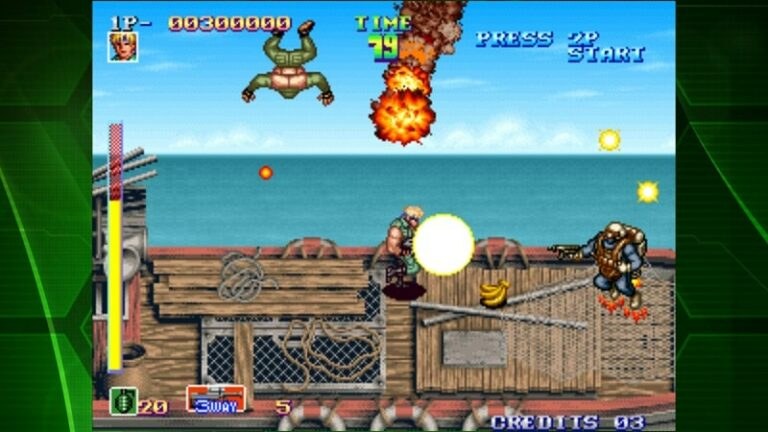
Around the roll, the combat is superbly judged. You can lock your aim while strafing — essential in a genre where enemies come from all eight directions — melee attacks trigger automatically at point-blank range with a satisfying knife-or-boot dispatch, and weapon pickups from grenades to heavy machine guns arrive at a generous clip. A close-range kill bonus system rewards players who fight in the enemy’s face rather than sniping from the screen’s edge, which is exactly the behaviour the roll exists to enable. Every system in the game is pulling in the same direction: forward.
The Saurus Touch
Saurus was never SNK’s most famous studio, but Shock Troopers looks like a team determined to be noticed. The overhead perspective is rendered with chunky, characterful sprites, proper shadows, and stages that scroll through burning villages, train yards and cliff paths without ever becoming visually muddy — no small feat in a genre where readability is survival. Vehicles and mounted guns appear as set-piece toys, the bosses include armoured trains and attack helicopters with real stage presence, and the whole production runs at a clip the sometimes-sluggish Metal Slug games could envy. The soundtrack keeps its head down and drives, all military percussion and arcade urgency.
It is also, by Neo Geo standards, an unusually fair game. Continues are there if you need them, but a one-credit clear feels like an achievable ambition rather than a superhuman feat, and the Team mode’s built-in safety net makes it one of the most welcoming run-and-guns on the system for newcomers — right up until the late stages remind you which platform you are on.

The Fame It Deserved
A sequel, Shock Troopers: 2nd Squad, arrived in 1998 with a different structure and pre-rendered look; it has its defenders, but the original remains the connoisseur’s choice, and modern ACA Neo Geo re-releases have finally put it within everyone’s reach. If you have exhausted Metal Slug and want to see what else the Neo Geo’s action library was capable of, this is the first door to open. Shock Troopers deserved Metal Slug’s fame. Play it, and you will spend the rest of the week telling people so — which is, in the end, how its reputation has survived this long.
How to Get the Most From Your First Runs
Start in Team mode, even if you consider yourself a purist. The character-swap system is Shock Troopers’ identity, and learning to bench a wounded soldier instead of losing them changes how you read every fight — health becomes a resource you manage across a squad rather than a bar you watch drain. Take the valley route first; it is the most forgiving of the three paths and teaches the game’s grammar of mounted guns, ambushes and open-ground firefights. Roll more than feels natural. The instinct of every run-and-gun veteran is to sidestep danger, but Shock Troopers rewards diving through it, and the moment that clicks — usually somewhere around the first helicopter — the whole game rearranges itself around your new aggression.
Finally, play it in co-op if you can. Two teams of troopers, crossfire from four directions and twice the incentive to fight in close makes an already generous game riotous. The Neo Geo had more famous co-op experiences, certainly. It had few that were this welcoming to a second player of any skill level.
There is one more audience who should hear the case: fans of modern twin-stick and action games, who will find in Shock Troopers an uncanny number of their favourite ideas present at the creation — the dodge-roll as a core verb, character-tagging, route-based campaigns, score bonuses for aggressive close play. Games history usually credits those ideas to later, louder titles. The record should show a modest Saurus arcade game from 1997, on an ageing board, doing them beautifully while almost nobody was watching. Now you know. Go and watch.
Verdict in a sentence, then, for the reader in a hurry: this is the second-best action game on the Neo Geo, standing in the shadow of the best one through no fault of its own — and on the right evening, with the roll singing and a partner beside you, you will wonder if the order should be reversed.
Score: 8.5/10