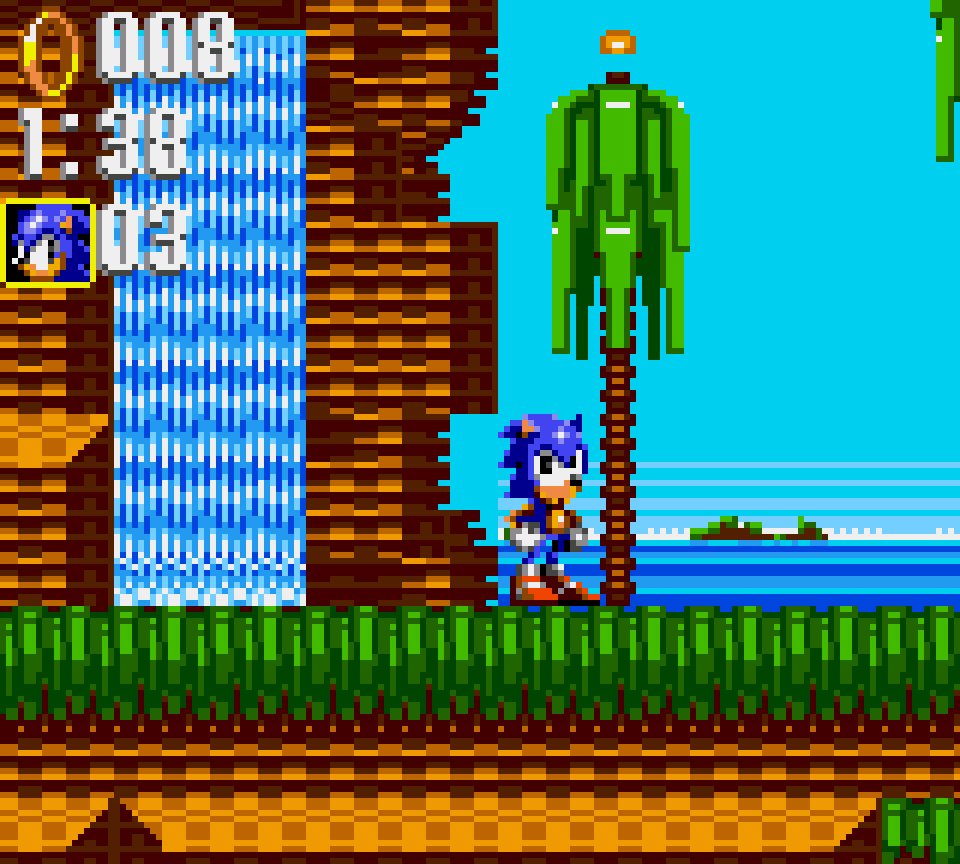
At a glance: Sonic the Hedgehog Triple Trouble · Game Gear · Aspect / Sega, 1994 · Platformer · Score: 8.5/10
By 1994 the Game Gear’s Sonic series had settled into a comfortable rhythm, and Triple Trouble is the moment it broke that rhythm in the best way. Aspect’s fourth handheld Sonic is the most ambitious of the 8-bit games: bigger levels, a second playable character with a genuinely different moveset, a brand-new rival who would outlive the hardware, and special stages that leap between 2D mazes and pseudo-3D flights. It never left the Game Gear in its era — no Master System version exists, because by 1994 Sega’s 8-bit console business outside Brazil had wound down — and that exclusivity makes it the purest expression of what the handheld could do when a talented team designed for it alone.
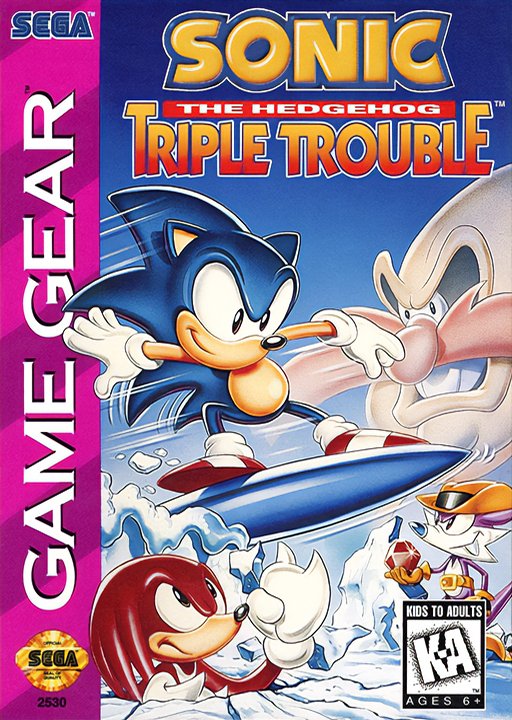
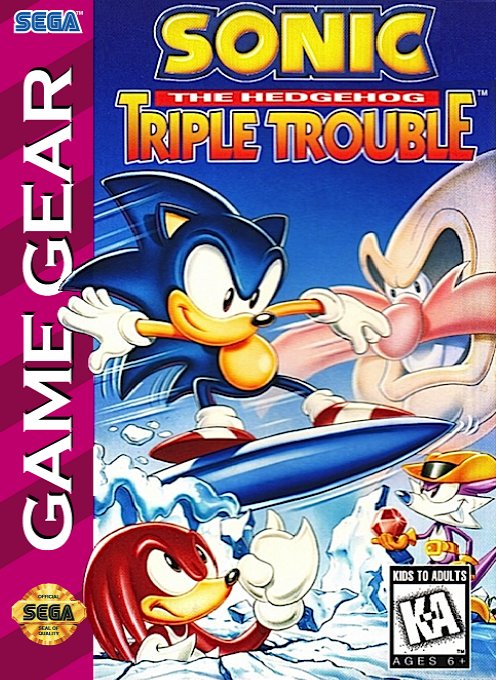
The story is cheerful nonsense in the classic mould. Dr Robotnik has recovered the Chaos Emeralds, lost five of them in an accident of his own making, and now Sonic, Tails and the treasure hunter Nack the Weasel — Fang the Sniper, in Japan — are all racing to collect them first, with Knuckles, misled as ever, turning up to make life difficult. Nack is the game’s masterstroke: a weasel with a popgun and a flying marvel, the first Sonic rival built on greed rather than ideology, and his boss-stage ambushes give the emerald hunt a personality the earlier games lacked.
Two heroes, two games
Tails is playable throughout for the first time in the 8-bit line, and he is no palette swap. His flight opens vertical routes Sonic cannot reach, his Sea Fox submarine stars in an underwater section, and whole pockets of Great Turquoise and Atomic Destroyer are designed around the choice of character. Sonic, in compensation, gains the Strike Dash, a burst of speed with brief invincibility that rewards aggressive play. Playing both campaigns is not a chore but the point: the levels are dense with character-specific shortcuts, monitor caches and entirely different approaches to the same hazards.
The zones are the series’ best on 8-bit hardware. Sunset Park’s second act puts Sonic on a runaway train in one of the era’s great set pieces, all collapsing track and Robotnik’s engine ahead. Meta Junglira’s jungle is lush and vertical, Tivoli-like Robot Winter brings snow and ice physics handled with unusual fairness, and Atomic Destroyer, the finale, is a properly labyrinthine fortress that expects you to have learned the game’s language. The special stages split between top-down mazes against the clock and 3D flights in the Tornado biplane chasing Nack — technically showy, occasionally fiddly, and a clear flex of what Aspect could squeeze from the machine.
Built for this screen
Because Triple Trouble was designed for the Game Gear first and only, it escapes the cropped-view problem that dogs the earlier conversions. Sprites are sized for the 160-by-144 display, sight lines are honest, and hazards announce themselves before they hurt you. It also looks superb: the palette work is the richest in the 8-bit Sonic series, with layered skies, animated water and weather effects that push the hardware’s colour advantage over its rivals. Slowdown still visits when the screen crowds, and the password-free structure means a full run is one sitting — but that sitting is a substantial one by handheld standards, with the emerald collection and dual campaigns stretching it further.
Triple Trouble is the 8-bit Sonic that stopped apologising: designed for the Game Gear alone, and better for it in every zone.
The soundtrack, by Yayoi Fujimori, deserves its verse. Sunset Park’s theme is a series highlight, funky and confident, and the boss music has a menace the earlier games only gestured at. Sound effects are crisp, the new dash has a satisfying whoosh, and the whole audio package feels a generation ahead of the 1991 original — a reminder of how fast handheld production values moved in those years.
Where it stumbles
Honesty requires a few notes. The 3D special stages, for all their spectacle, control loosely, and losing an emerald to a wobbly flight is frustrating in a way the 2D mazes never are. Knuckles’ appearances, while charming, are more cutscene than challenge. The difficulty curve is gentle until Atomic Destroyer, which spikes hard. And Nack’s boss fights repeat their patterns a touch too faithfully. None of this is structural; all of it is the ordinary wear of a hugely ambitious handheld game built on a tight schedule.
The emerald economy
The Chaos Emerald structure deserves a closer look, because it is the game’s cleverest piece of engineering. Emeralds are won from the special stages, which are gated behind giant rings found by carrying fifty rings to a stage’s end — the classic Sonic toll — but the encounters themselves keep changing the terms: maze stages against the clock, flights against Nack, and face-offs where the weasel’s greed does the storytelling. Losing an emerald never blocks progress through the zones, which keeps the campaign welcoming; collecting all of them unlocks the true ending, which keeps it aspirational. It is the same two-tier contract the best Sonic games offer — finish it your way, master it ours — tuned with unusual generosity for a handheld title.
It is also worth saying plainly how well the game has aged next to its 16-bit contemporaries. Sonic’s Mega Drive outings of 1994 are monuments, and nobody is dethroning them here. But as a self-contained handheld platformer, Triple Trouble’s combination of dual characters, honest sight lines and rich colour has no equal in its class or year — the Game Boy’s platformers of the period are not playing the same sport. That it stayed a Game Gear exclusive in its era, unported and largely unexported in spirit, makes it the system’s defining deep cut: the game owners cite when the library is underestimated.
One last distinction belongs in the record: this is the only classic Sonic platformer of its era to debut a character who stuck. Nack — Fang — survived the 8-bit line into the wider canon, turning up wherever Sega gathers its rogues, because his design was complete on arrival: silhouette, motivation, comic timing. Games are remembered for their inventions, and a handheld exclusive that invents a permanent cast member has done more than fill a slot in a series. It has added to the series, from the smallest screen it ever played on.
Sunset Park’s train deserves its final mention here rather than in any list of levels, because it distils the game’s character: a set piece the 16-bit games would have been proud of, staged on hardware a fraction as powerful, with the confidence to make it look easy. Aspect at their peak made everything look easy. It never was.
Verdict
Triple Trouble is the best Sonic game on the Game Gear and one of the best reasons to own the system. It keeps the exploration and emerald hunting that distinguished the 8-bit line, adds a second hero who genuinely changes the game, debuts a fan-favourite rival, and wraps it all in the richest presentation the hardware ever hosted. If the earlier 8-bit Sonics were good ports with original ideas, this is an original with no apologies attached — the handheld Sonic at its peak, and a high-water mark for the whole platform.